Introduction
Robot control answers the question: how do we make the robot move? The control problem for a robot manipulator is to find the joint inputs that make the robot follow a commanded motion.
The joint inputs can be joint forces and torques, or inputs to the actuators, for example voltages to the motors.
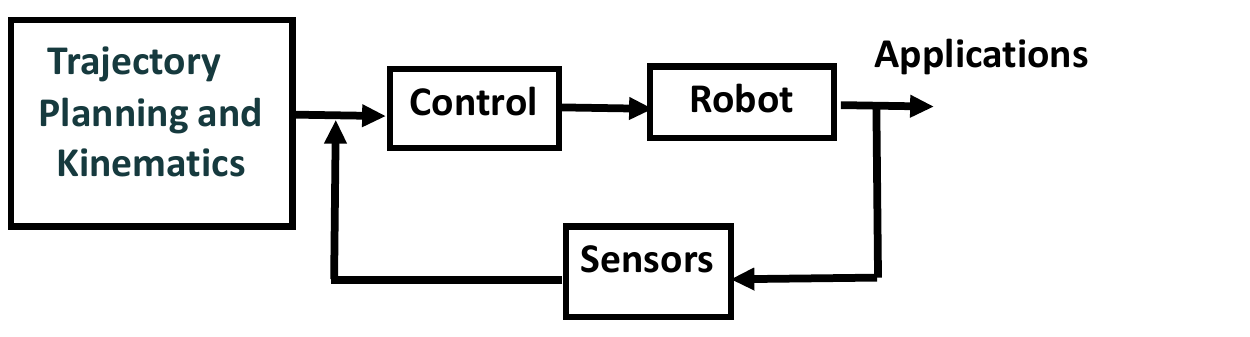
Robot control sits between trajectory planning and the robot. Sensors close the loop.
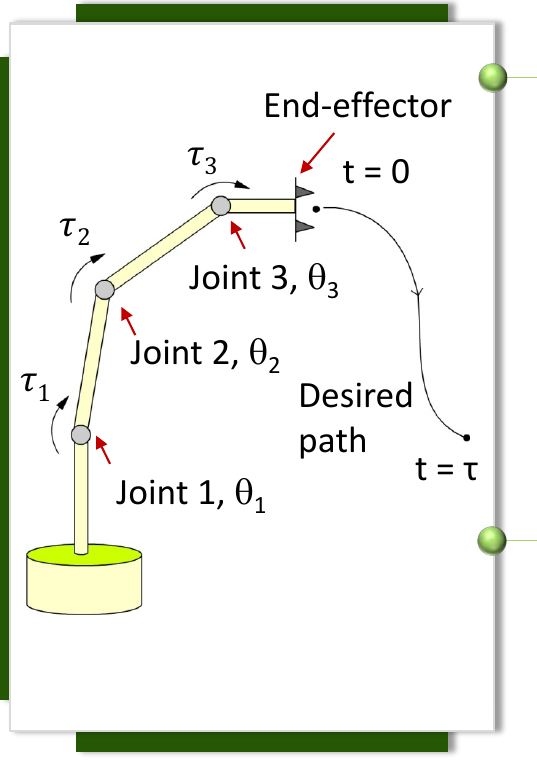
Types of control problem
- Point to point control: move the robot from an initial position to a desired final position
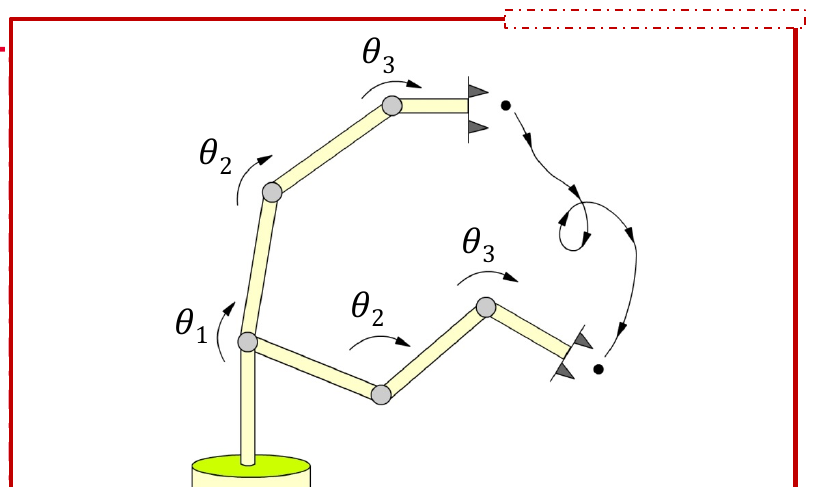
- Path control: the robot must follow a desired path or trajectory, and not only reach the final position
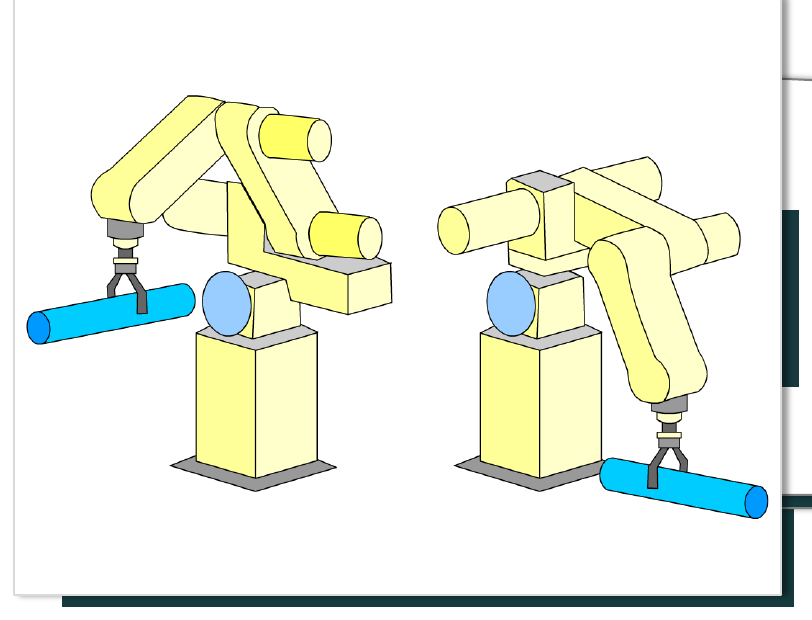
The motion should usually be smooth. Rough, jerky motion causes more wear on the mechanism.
Topics
The related topics are:
- Feedback Control System
- Motion Control Schemes
- Transfer Function Model of a Single Joint
- Proportional, PD and PID Control
- Performance and Stability
- Architecture of an Industrial Robot Controller
- Non-linear Control Methods
- Control Law Partitioning
- Disturbance Rejection
- Third Order System
- Robot Dynamic Model
- Computed Torque Control
- Practical Considerations of Computed Torque
- Approximate Computed Torque
- Adaptive Control
- Cartesian Based Control
Important
Linear control treats each joint as a simple linear system, so its performance is limited. Non-linear control (such as computed torque) uses a model of the robot to cancel the non-linear terms, so the closed loop system becomes linear.