Introduction
In all the control schemes before, the desired trajectory is given in joint space (, , ). But you often want the end effector to follow a straight line or another path in Cartesian coordinates. Control schemes that form the errors in Cartesian space are called Cartesian based control schemes. They extend Computed Torque Control.
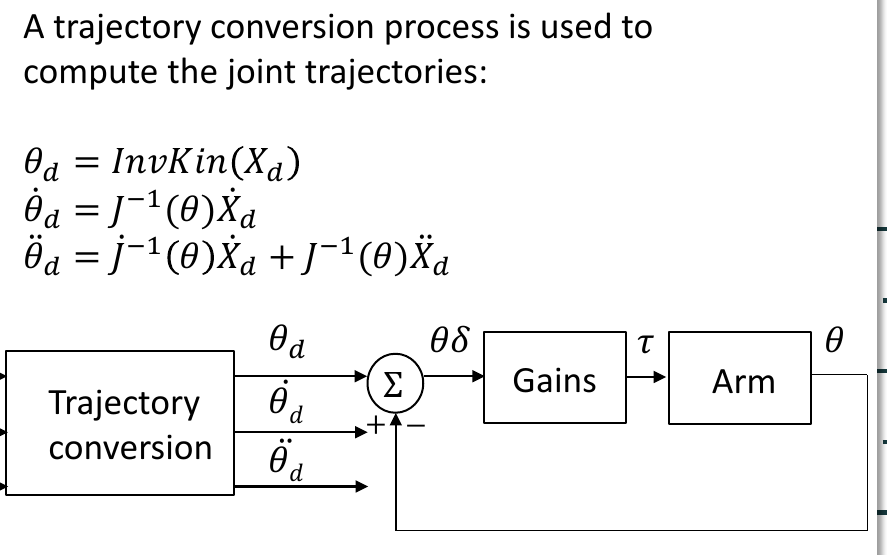
Approach 1: trajectory conversion
Change the Cartesian path into a joint path, then use a joint space controller:
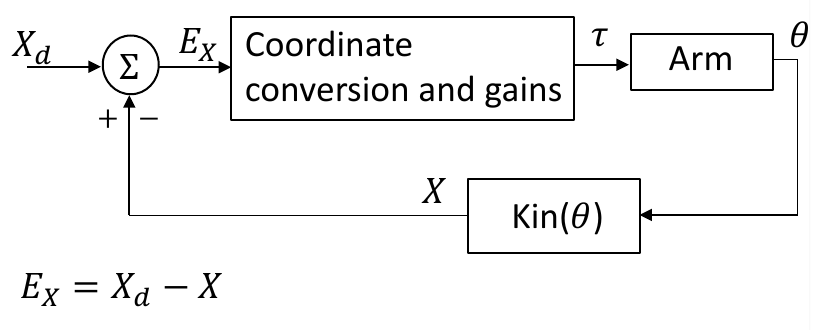
Approach 2: Cartesian error
Measure the error directly in Cartesian space, with forward kinematics :
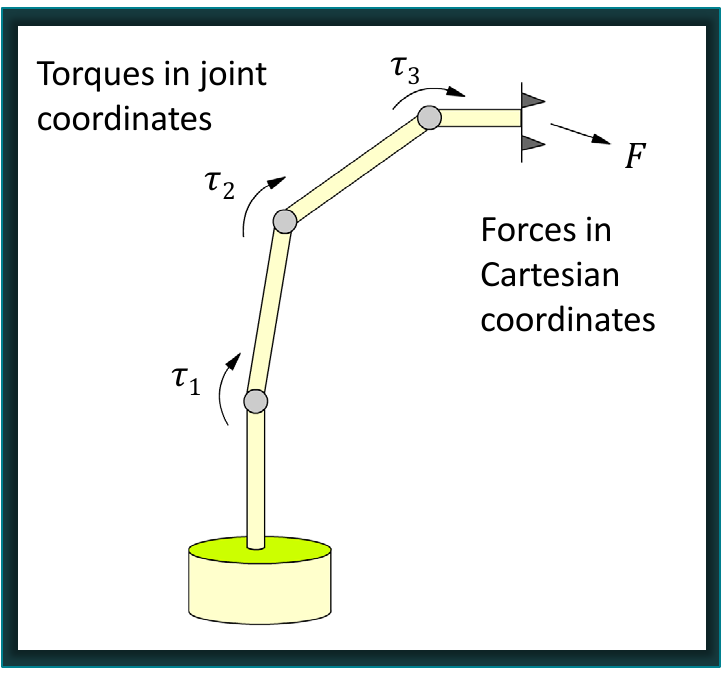
Force and torque relationship
The work done must be the same in any set of coordinates. Let be a small Cartesian displacement of the end effector and a small joint displacement:
Since :
Cartesian computed torque control
Start from the joint space dynamics, , and the kinematics:
Pre multiply the dynamics by and use :
This gives the equation of motion in Cartesian coordinates:
Controller
Use the same partitioning in Cartesian space:
This gives . The servo law is:
The joint torques are:
Note
The slide writes the servo law with twice. The second gain is .