Introduction
Model based control needs the parameters of the manipulator, but these are often not known exactly. When the model does not match the real system, there are servo errors, as in Approximate Computed Torque:
| Symbol | Meaning |
|---|---|
| vector of servo errors, | |
| , | diagonal matrices of position gains and velocity gains |
| error term that comes from the mismatch between the model and the real robot | |
| , , | actual mass matrix, velocity term and gravity term of the robot |
| , , | estimates of , and that the controller uses |
How it works
Adaptive control uses these servo errors to update the model.
- an adaptation law looks at the state of the manipulator and the servo errors
- it changes the parameters in the non-linear model
- it keeps doing this until the errors disappear
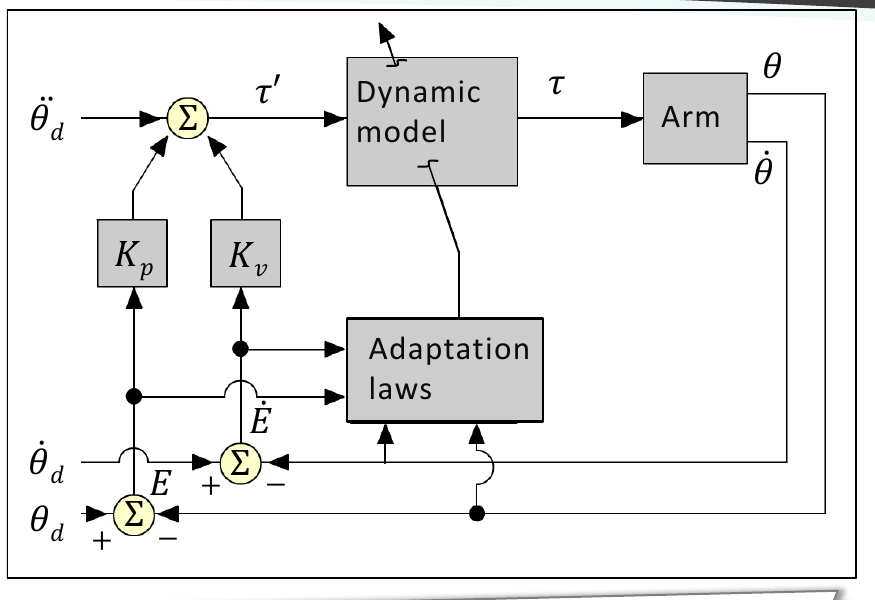
flowchart LR
    S["Servo errors E, E-dot<br/>and robot state"] --> A["Adaptation law"]
    A -->|"new parameters"| DM["Dynamic model"]
    DM -->|"τ"| R["Arm"]
    R --> S