Introduction
After you choose a controller in Proportional, PD and PID Control, you must choose its gains. The performance of the system depends on factors such as maximum overshoot, rise time, steady state error and settling time.
Standard second order form
The characteristic equation of a second order system has the standard form:
- is the damping ratio
- is the undamped natural frequency
For a general , compare terms: and . Then:
| Condition | Damping ratio | Response |
|---|---|---|
| Overdamped, slow with no overshoot | ||
| Critically damped, fastest with no overshoot | ||
| Underdamped, oscillates and overshoots |
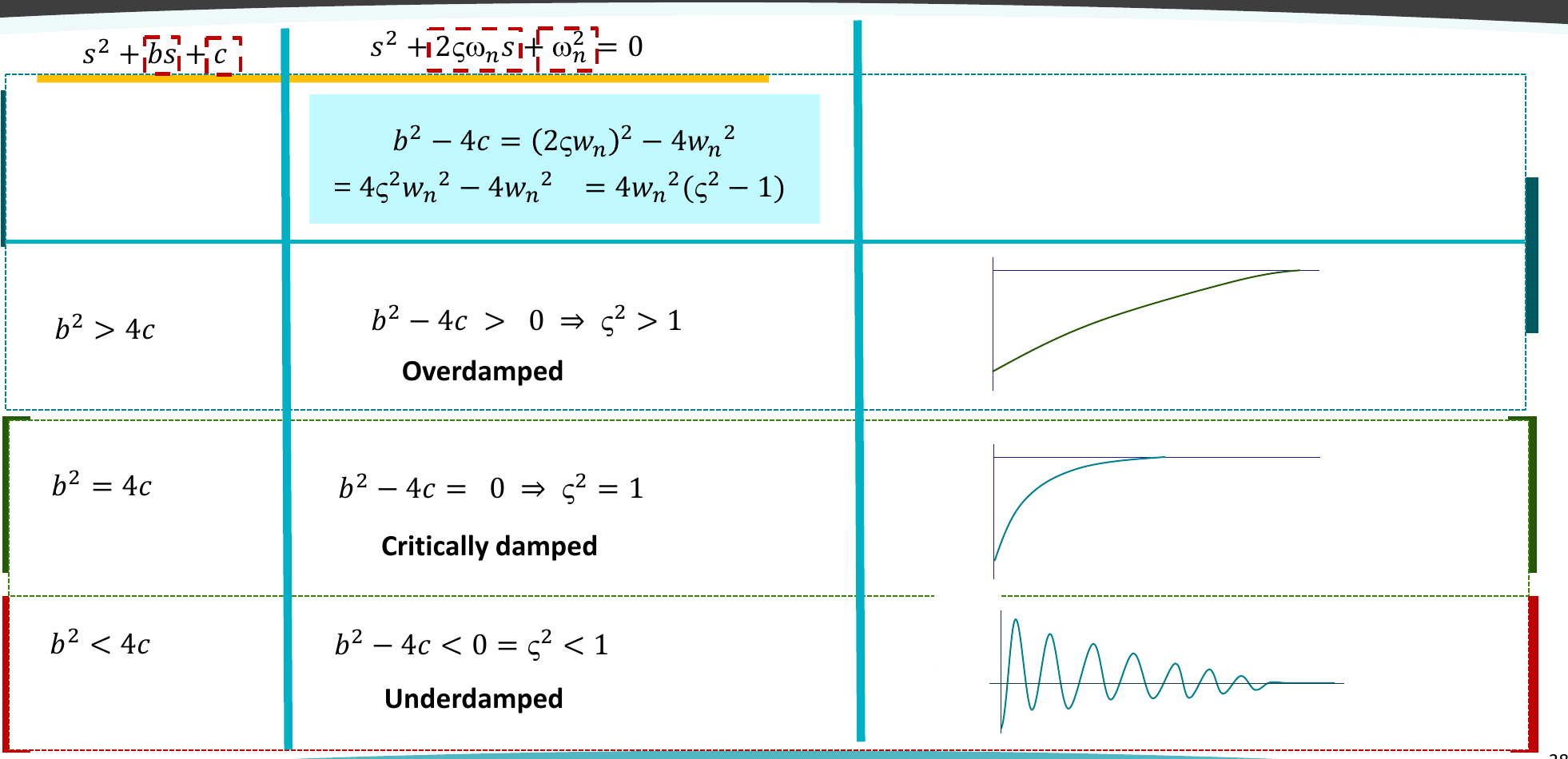
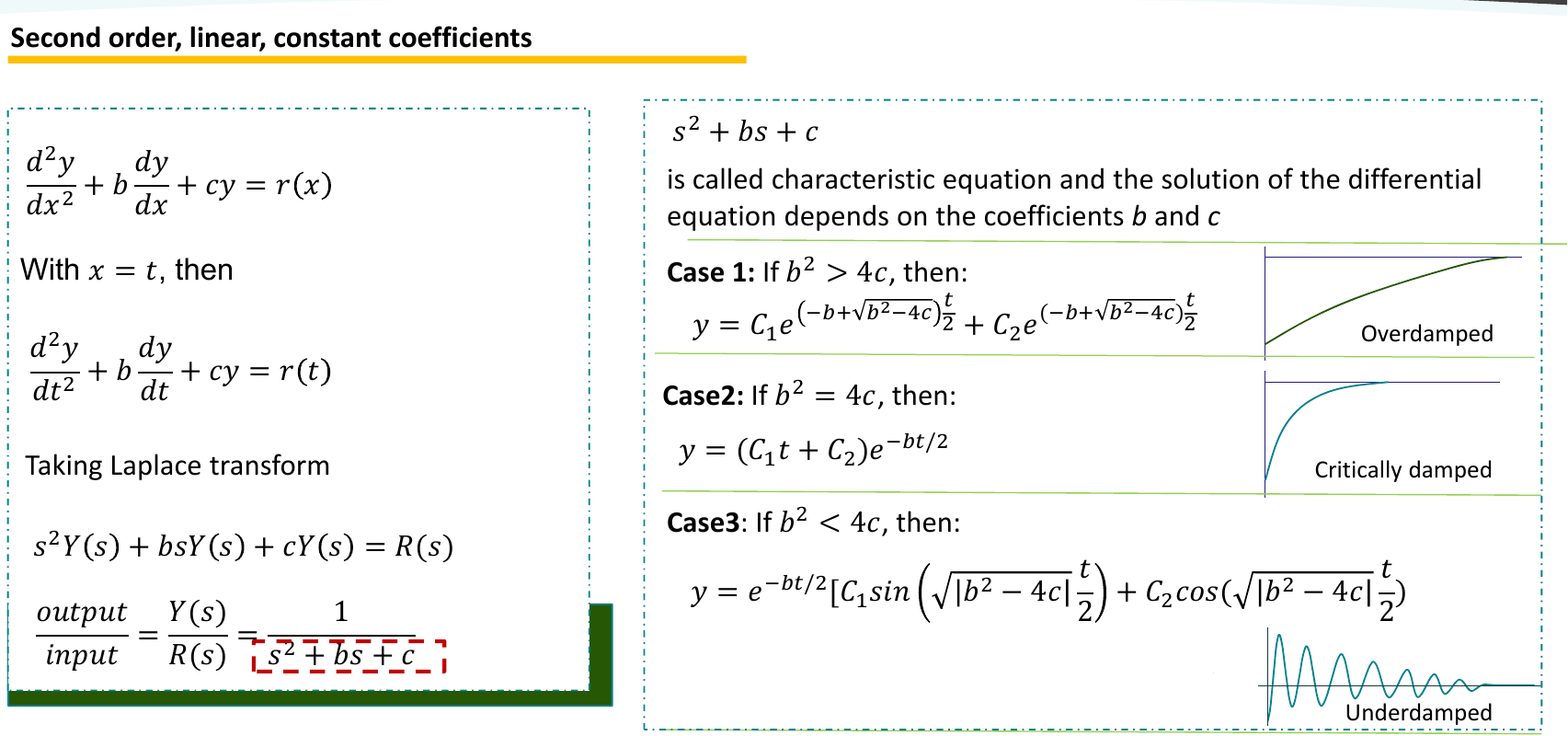
These cases come from the solution of the second order differential equation , whose characteristic equation is :
Design rules
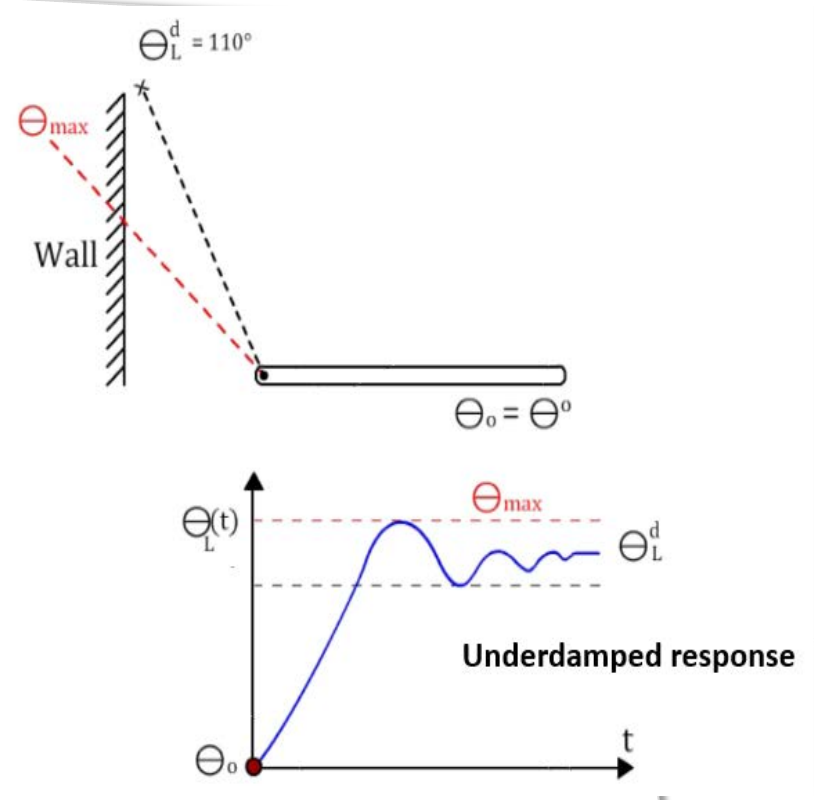
1. No overshoot. For safety, the manipulator must not have an underdamped response. An overshoot can make the arm hit something, for example a wall near the target. So:
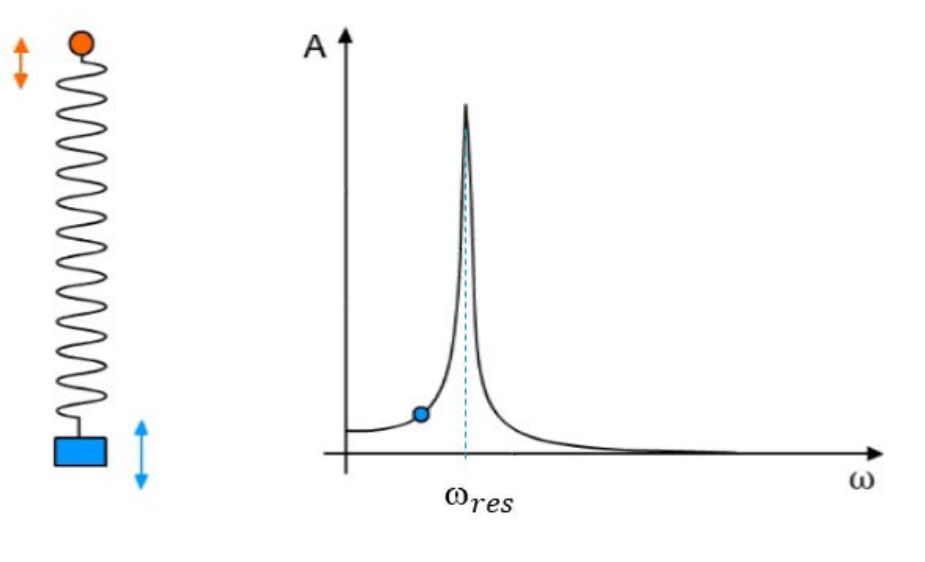
2. No resonance. Do not excite the structural oscillation and resonance of the joint. A rule of thumb is:
where is the lowest structural resonant frequency.
How it works
- Write the closed loop transfer function
- Get the characteristic equation from
- Compare it with
- Use and to find the gains
Example
A motor drives a single link robot with these parameters:
- H, ,
- kg m²
- Nm/(rad/s)
- Nm/A
- V/(rad/s)
Given rad/s, design a PD controller so that the system is critically damped and does not excite resonance.
Step 1: plant model
Step 2: closed loop with PD
Step 3: target values
- critically damped, so
- rad/s, so take rad/s
Step 4: compare terms
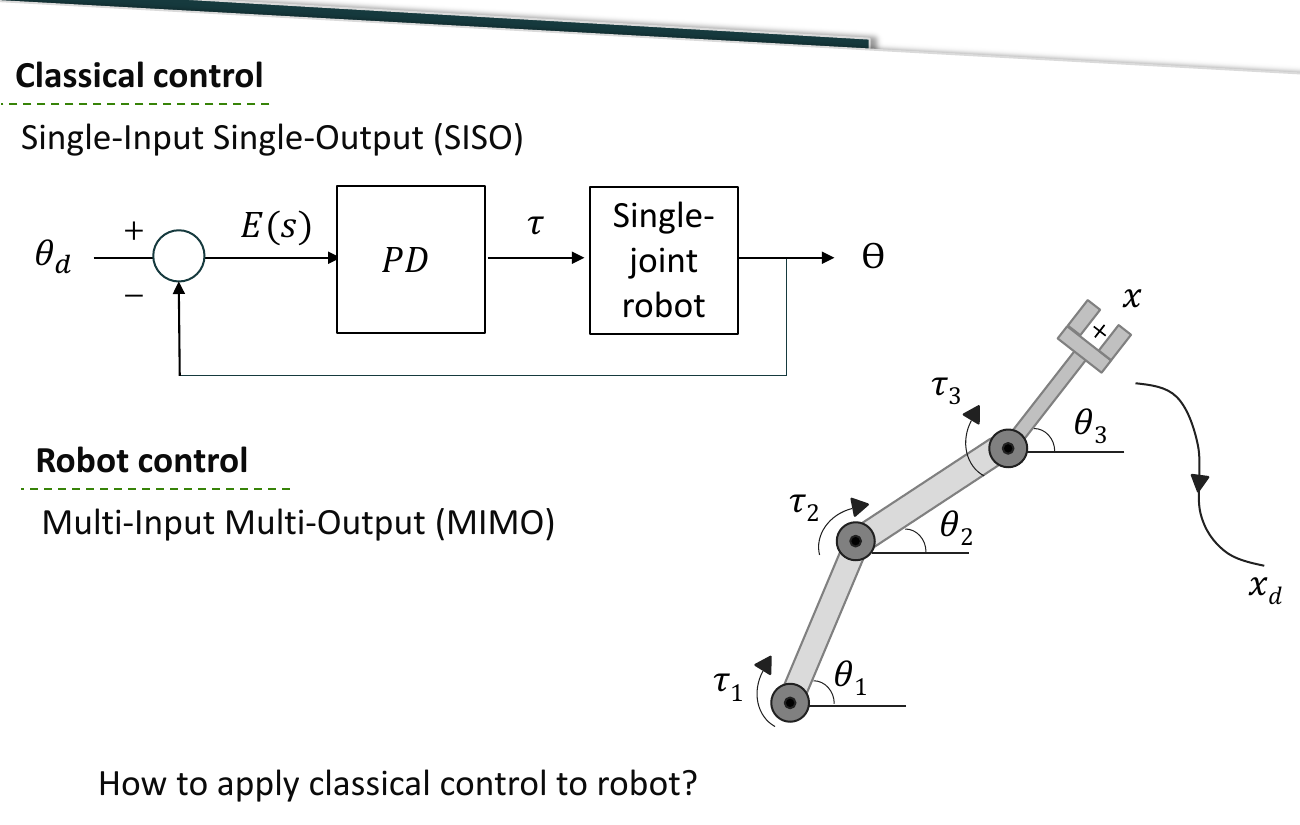
From one joint to a robot
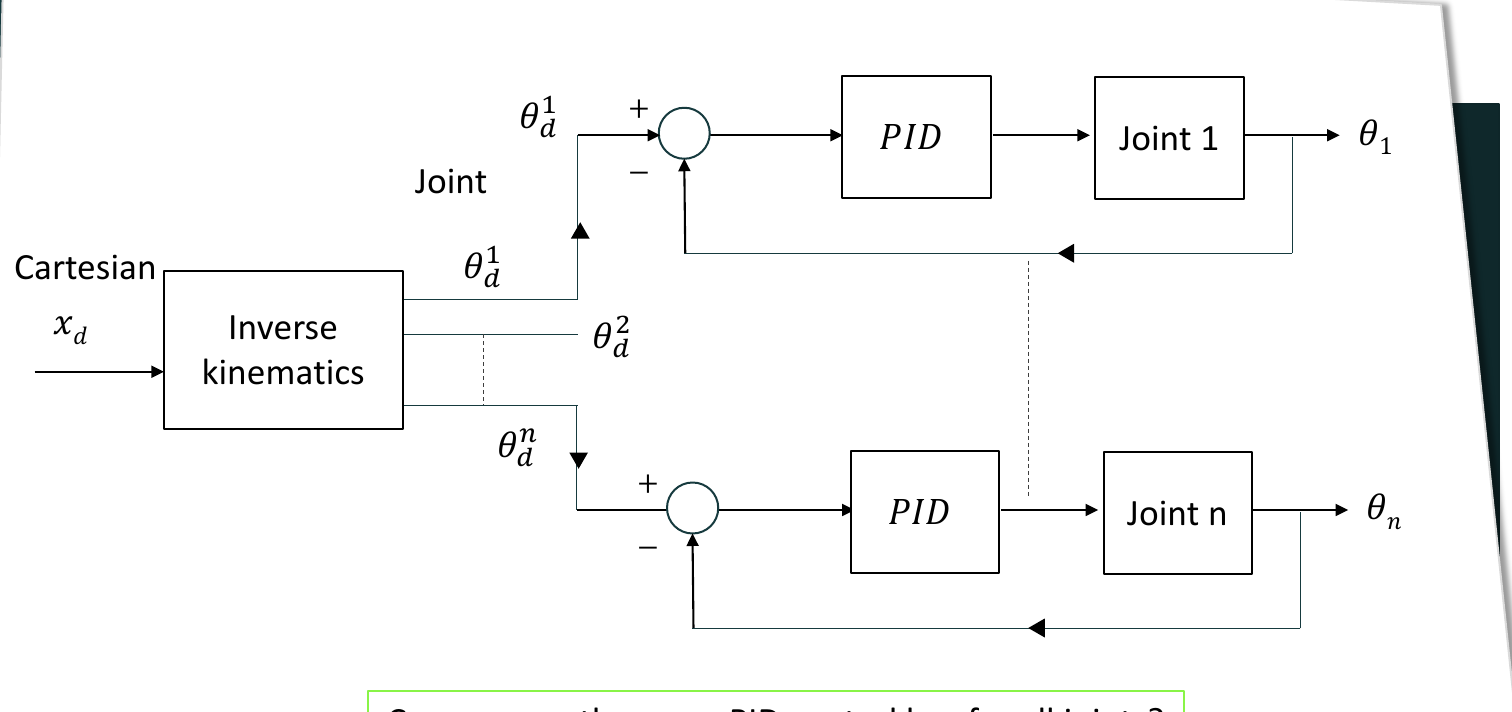
A single joint is a single input, single output (SISO) system. A robot is a multi input, multi output (MIMO) system. With classical control, you use inverse kinematics to get the desired angle of each joint, and each joint has its own PID loop.
Question
The slide asks: can you use the same PID control law for all joints? The slide does not give the answer. Each joint has a different load and inertia, so each joint has a different model , and each joint needs its own gains.