Introduction
Control law partitioning is a non-linear control method.
[! important] The controller is now split into two parts:
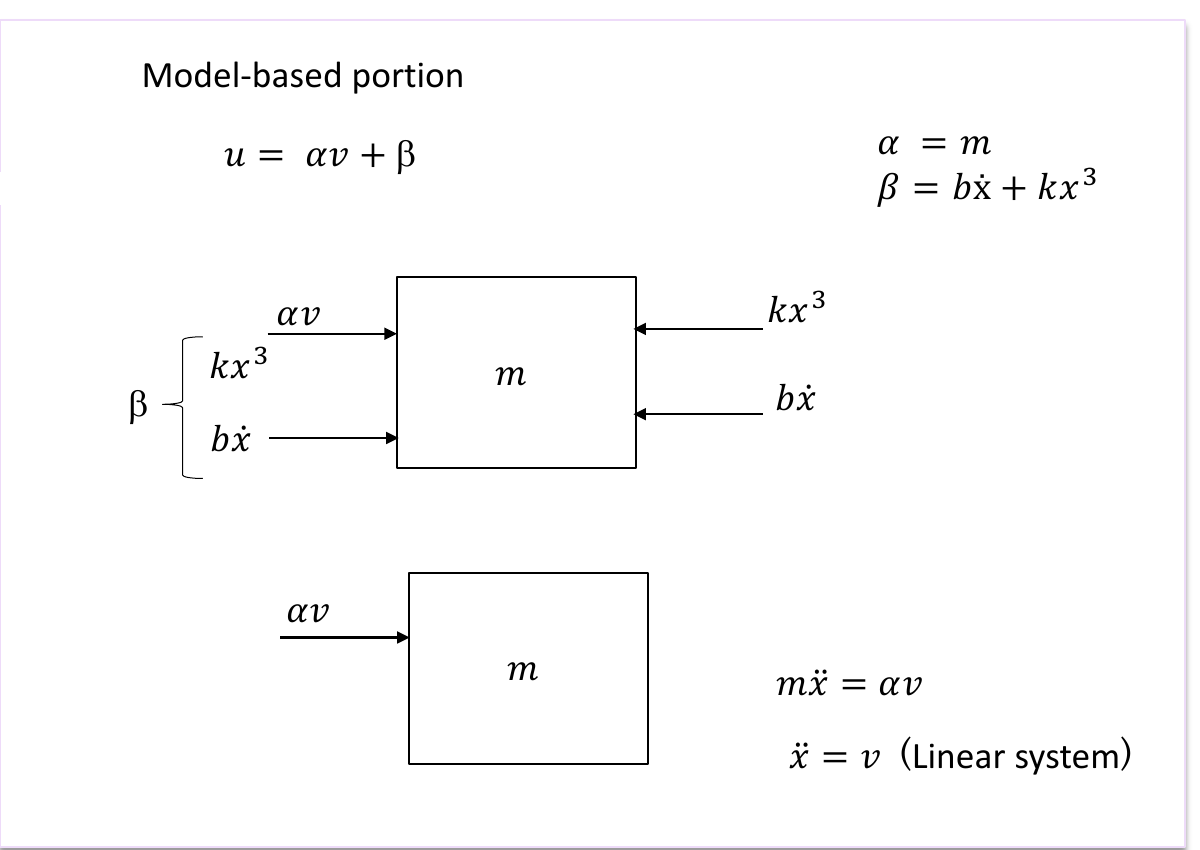
- a (1) model based portion, which cancels the non-linear terms of the system
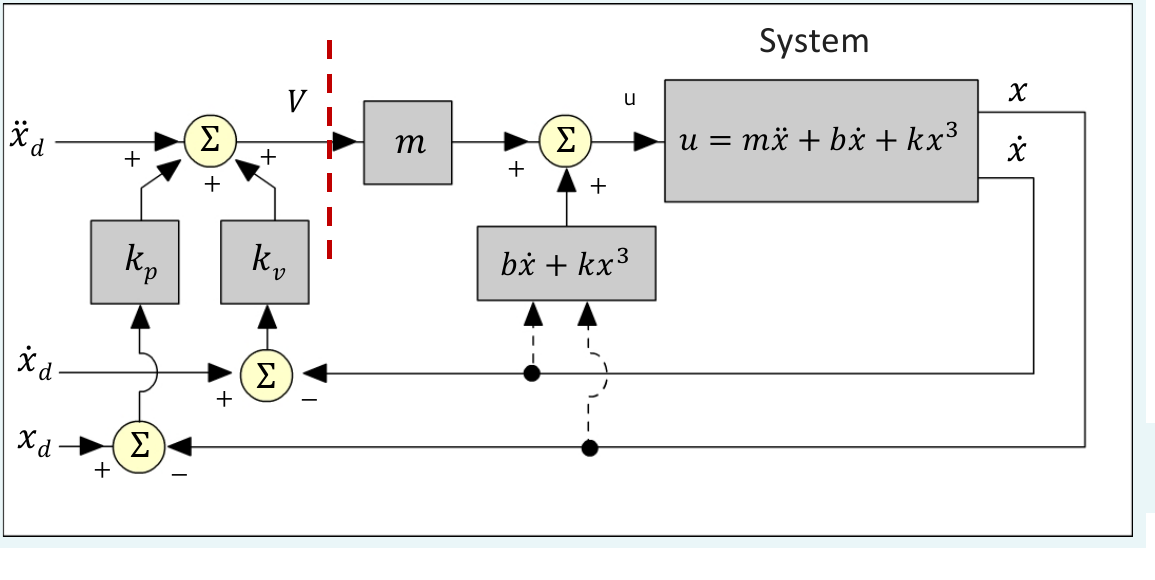
- a (2) servo portion, which controls the resulting linear system
After the cancellation, the closed loop system is linear.
(1) Model based portion
For the mass spring system , use the control law:
| Symbol | Meaning |
|---|---|
| , , | mass, friction coefficient and spring constant of the mass spring system |
| position of the mass | |
| force applied to the mass | |
| gain term of the model based portion | |
| term of the model based portion that cancels the non-linear terms | |
| new input into the linear system, which comes from the servo portion |
and are functions that you choose so that, with as the new input, the system looks like a unit mass. Choose:
Then:
(2) Servo portion
Now control the unit mass with:
where and is the desired position. Combine with :
| Symbol | Meaning |
|---|---|
| position (proportional) gain | |
| velocity (derivative) gain |
Choosing the gains
The characteristic equation is:
- stability needs and
- compare with , so and
- choose and
The gains do not depend on the system parameters , and . The same gains give the same response for any system.
Example
Take , so .
| Response | ||
|---|---|---|
| 2 | 0.5 | Underdamped, overshoot |
| 8 | 2 | Overdamped, slow |
| 4 | 1 | Critically damped, fastest with no overshoot |