Source
Adapted from my own handwritten and hand-typed notes from Year 1 to Year 3 of my EEE degree
The open-circuit time constant (OCTC) and short-circuit time constant (SCTC) methods, developed at MIT in the 1960s, estimate the upper and lower cut-off frequencies without deriving the full transfer function. Each capacitor is handled alone, with the others set to their ideal open or short state.
Classify Each Capacitor
Ask what kills the signal:
- if opening the capacitor kills the signal (at low frequency), it is a short-circuit capacitor: a high-pass element, such as a coupling or bypass capacitor, and it sets
- if shorting the capacitor kills the signal (at high frequency), it is an open-circuit capacitor: a low-pass element, such as , or , and it sets
- every capacitor is a helper at one end of the spectrum and a troublemaker at the other
Procedure
Steps:
- disable all independent sources (voltage sources short, current sources open), keep dependent sources
- for , treat the coupling and bypass capacitors as shorts (irrelevant at high frequency)
- for , treat the internal and load capacitors as opens (irrelevant at low frequency)
- for each contributing capacitor , set the other contributing capacitors open (OCTC) or shorted (SCTC) and find the resistance seen by , usually with a test source
- form
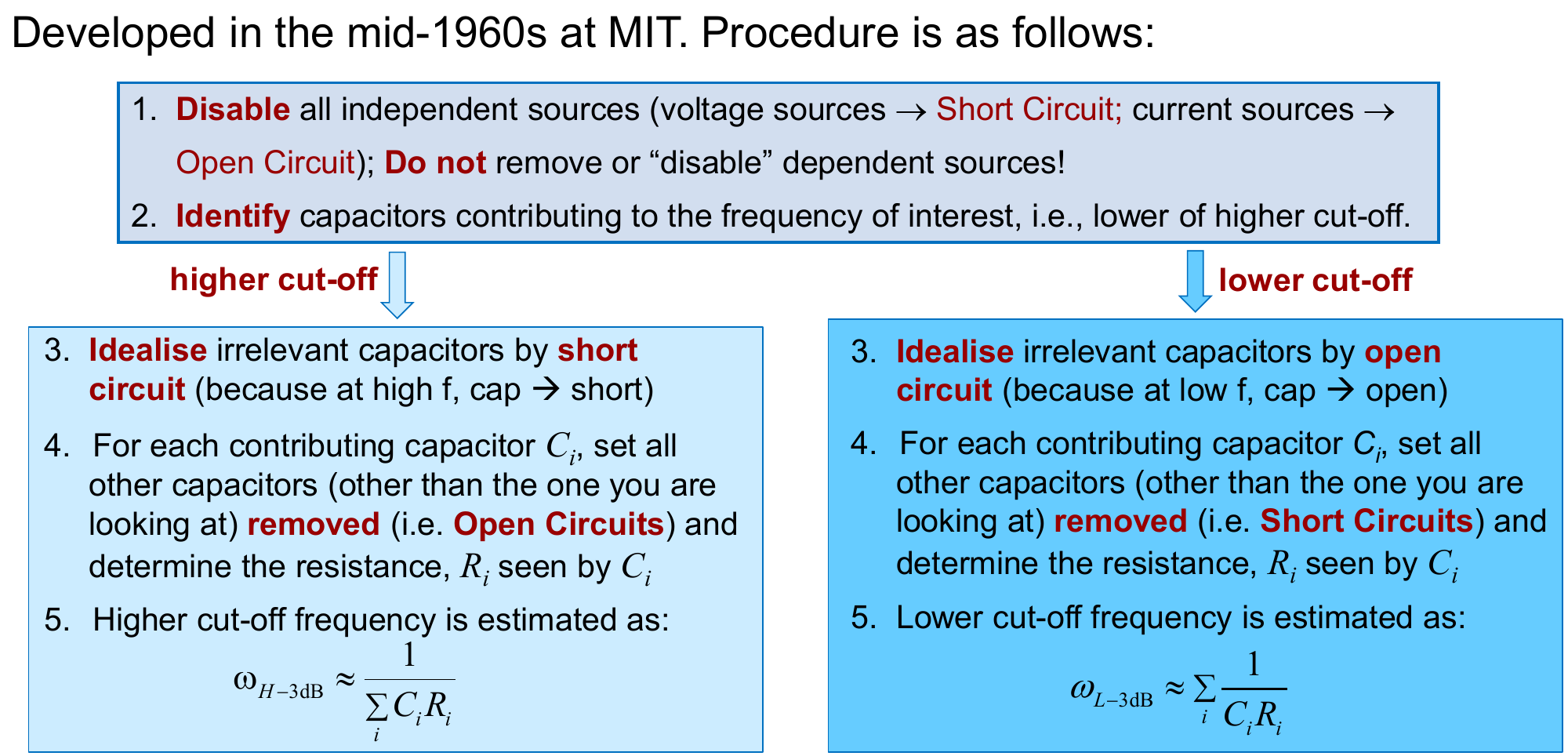
Estimates
Interpretation:
- OCTC: the time constants add, so the largest one dominates
- SCTC: the corner frequencies add, so the highest one dominates
Example: Two Coupling Capacitors
For the two-port amplifier with input capacitor and output capacitor :
With kΩ, µF, and kΩ, µF: rad/s, about 17.5 Hz. The input capacitor dominates.
Finding which capacitors exist in the first place is covered in Parasitic Capacitances.