Source
Adapted from my own handwritten and hand-typed notes from Year 1 to Year 3 of my EEE degree
Inverting Gain Amplifier
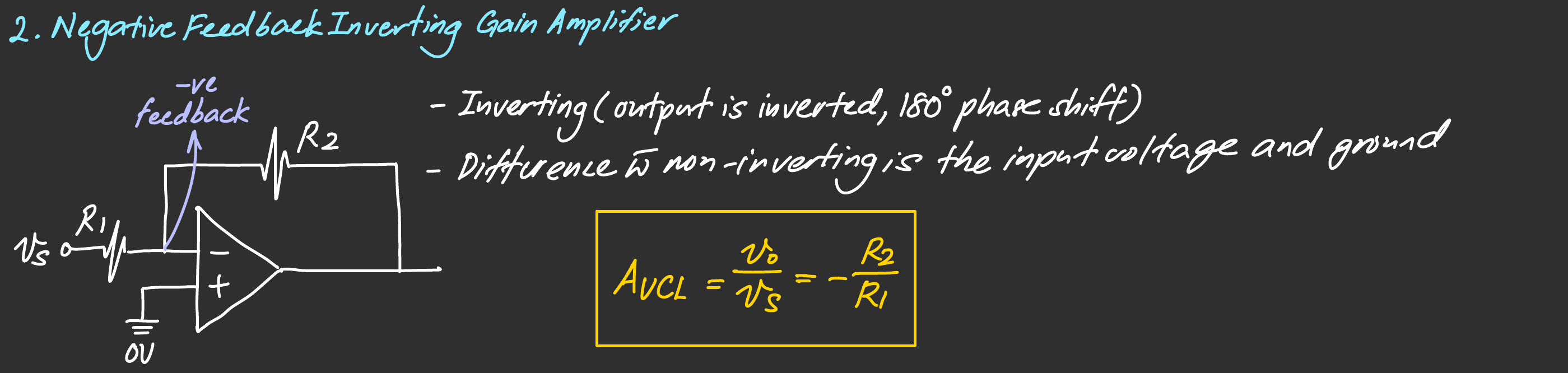
The feedback is negative, so V (virtual ground).
Inverting Amplifier Circuit
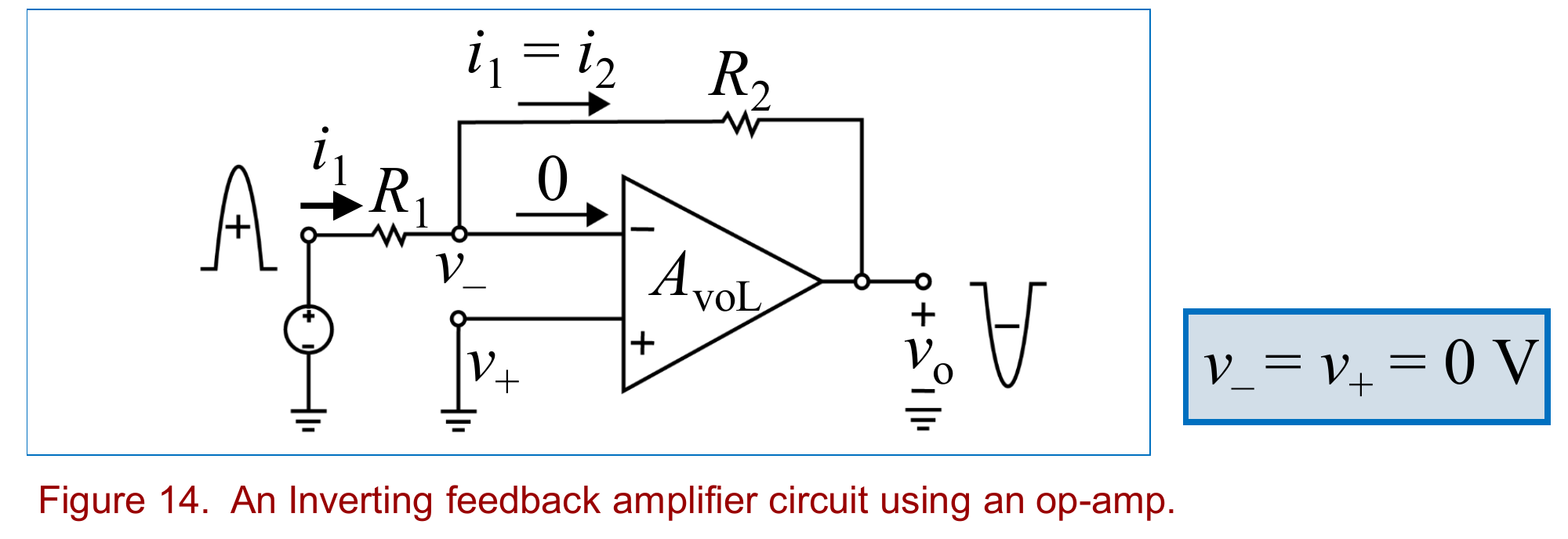
Gain Derivation
No current enters the op-amp, so all of flows through and , giving .
Superposition View
Treat as set by two sources through the divider , :
Setting gives the same .
Rule
Any voltage applied to the far end of a resistor connected to the inverting input appears at the output multiplied by the inverting gain .
Input and Output Resistance
Results:
- input resistance , because is held at 0 V
- output resistance for an ideal op-amp ()
A source with resistance only delivers , so should be much larger than (rule of thumb ). The output power comes from the op-amp supplies, not from the source.
Worked Example: Currents
V, kΩ, kΩ, kΩ, supplies V:
- mA through and
- V
- mA flowing up through into the output
- the op-amp output sinks mA, drawn from the V supply
Compare with the non-inverting amplifier, which keeps the phase and has a much higher input resistance.