Source
Adapted from my own handwritten and hand-typed notes from Year 1 to Year 3 of my EEE degree
A real op-amp needs small DC currents and flowing into its inputs to bias its internal transistors. They are modelled as DC current sources at the inputs of an otherwise ideal op-amp, and they add to any signal current.
Definitions
Typical values:
- ranges from about 0.1 pA to 10 µA and can be either sign
- the input offset current is usually 5 to 10 % of
The external circuit must give both inputs a DC path to supply these currents. For example, if the non-inverting input is fed only through a coupling capacitor with no resistor to ground, there is no path for and the op-amp cannot bias properly.
Effect on an Inverting Amplifier
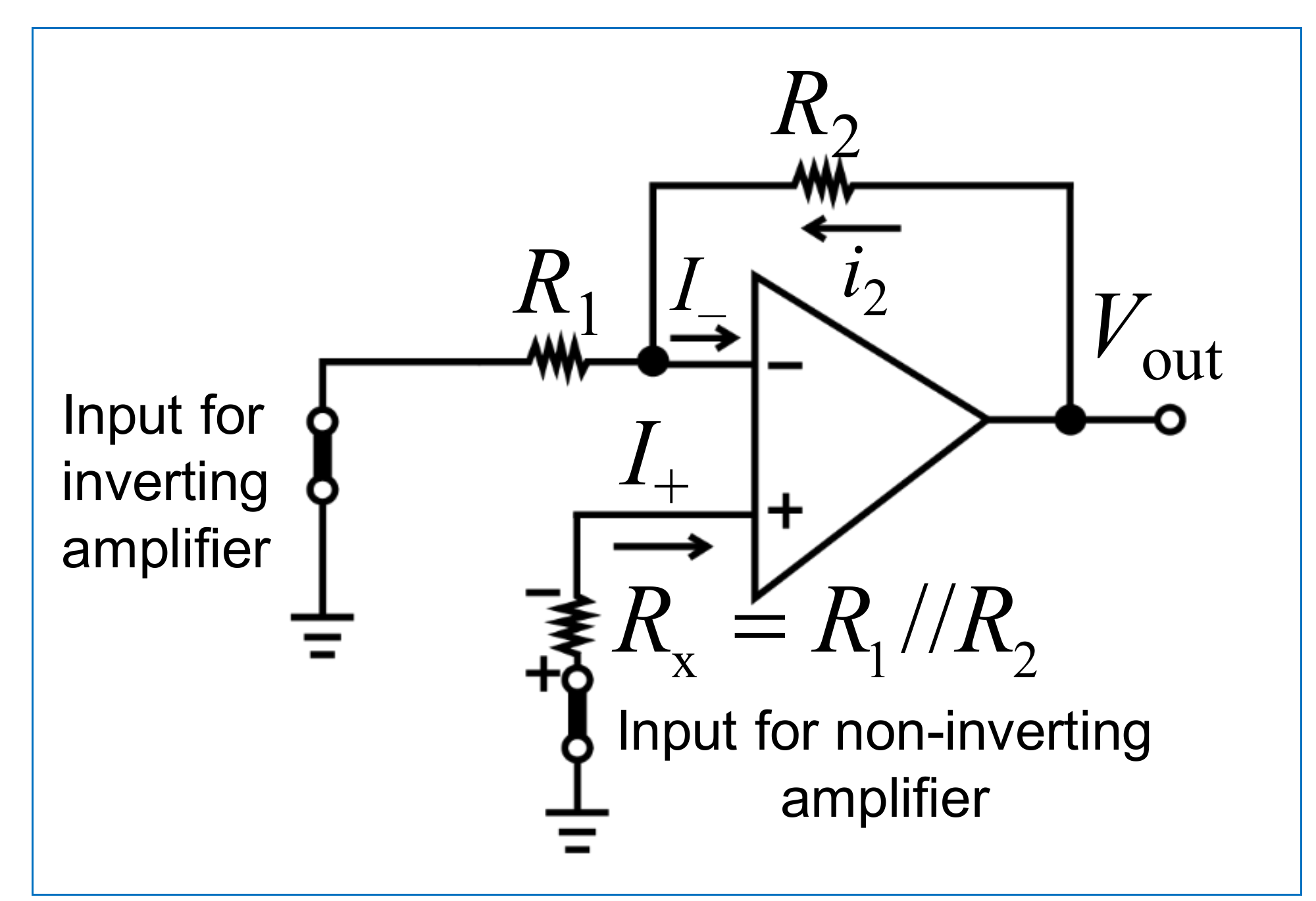
Take the inverting amplifier with grounded and . Then , no current flows in , and must come through :
With a signal as well:
Compensation Resistor
Add from to ground. Then creates , which is amplified by the non-inverting gain. By superposition with :
Choosing makes , so
which is zero when the two bias currents are equal. Only the much smaller offset current remains.