Source
Adapted from my own handwritten and hand-typed notes from Year 1 to Year 3 of my EEE degree
Feedback means taking part of the output and bringing it back to the input through a network, where it mixes with the input signal. For an op-amp, the terminal the feedback goes to decides how the circuit must be analysed.
Two Types
Classification:
- Negative feedback: output is returned to the inverting input
- Positive feedback: output is returned to the non-inverting input
- Open loop: no feedback at all, behaves like positive feedback for analysis
Negative Feedback Gives a Linear Circuit
With negative feedback and an ideal op-amp,
So for any output in the linear range , the two inputs sit at the same potential (, the virtual short). The op-amp works as an amplifier and normal linear circuit analysis (KCL, KVL, superposition) applies.
Positive Feedback Gives a Saturated Output
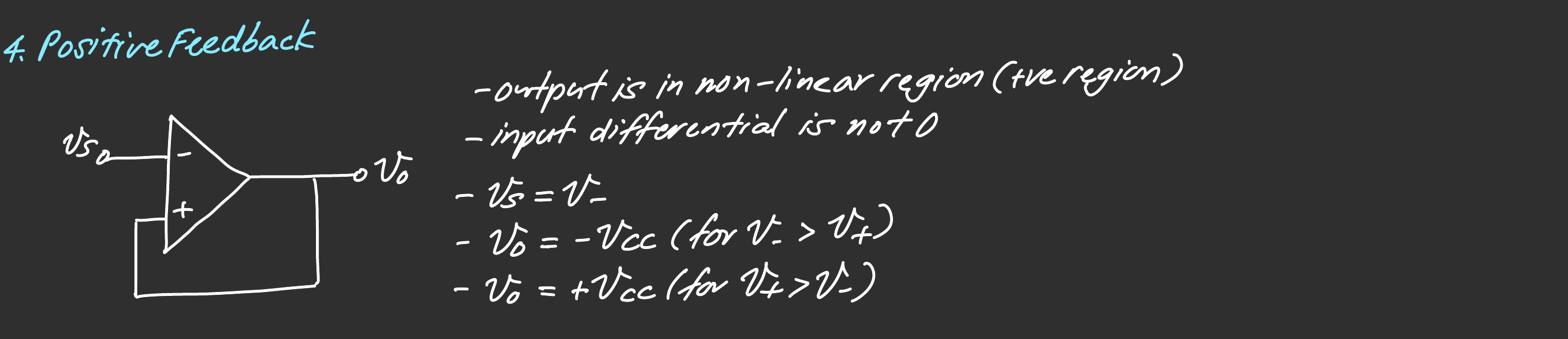
Extra points:
- the virtual short must not be used
- in practice the output saturates 1 to 2 V below the supply, so V gives to V
- the circuit acts as a comparator, not an amplifier
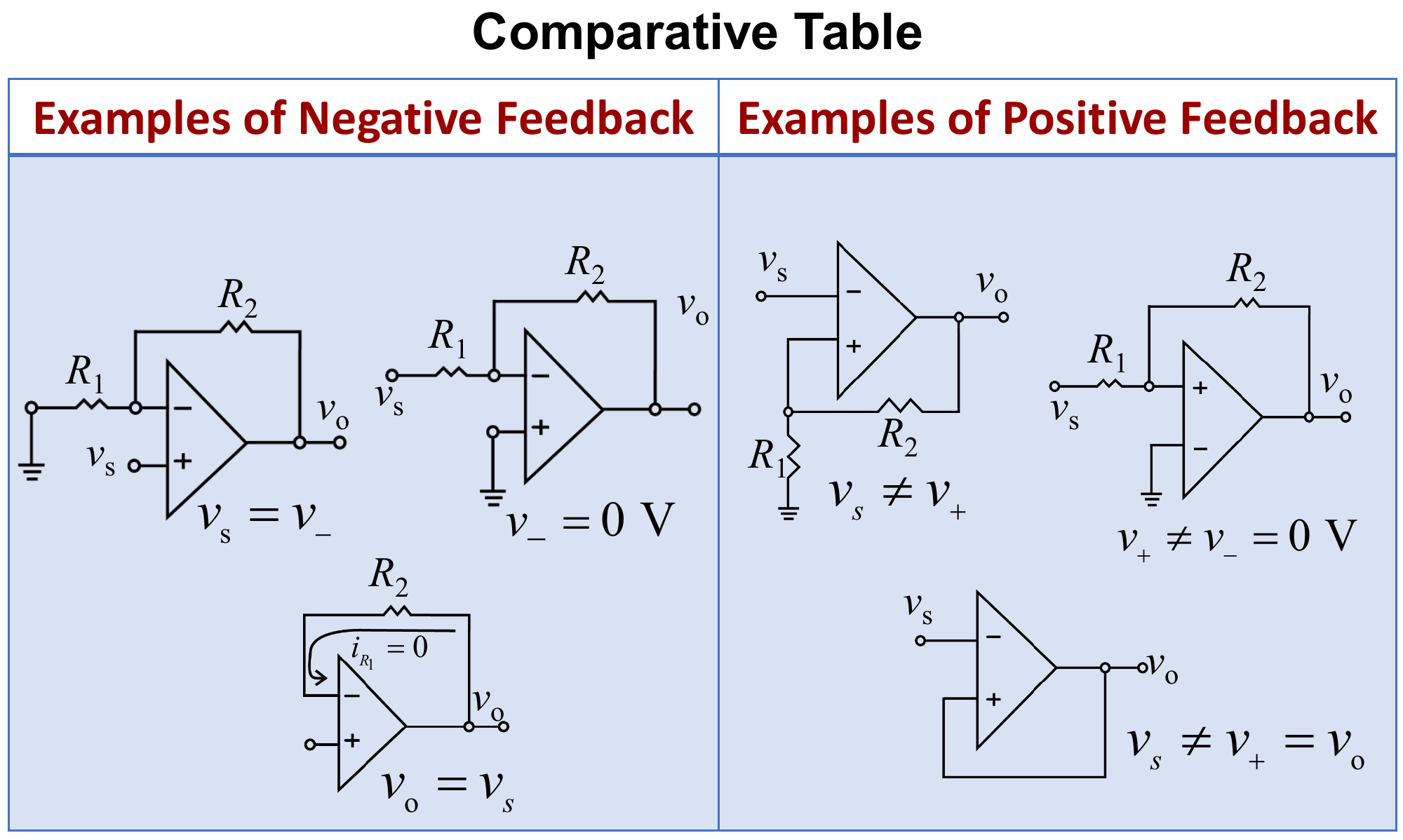
Example with positive feedback: input on , output fed back to through , and from to ground. The threshold seen at is a divided copy of the output:
The output flips only when crosses the threshold that belongs to the current output state, so the switching point depends on which rail the output is on (hysteresis).
Feedback Comparative Table
Analysis Procedure
Decide the feedback type before writing any equation. Using on a positive feedback circuit gives a wrong answer.
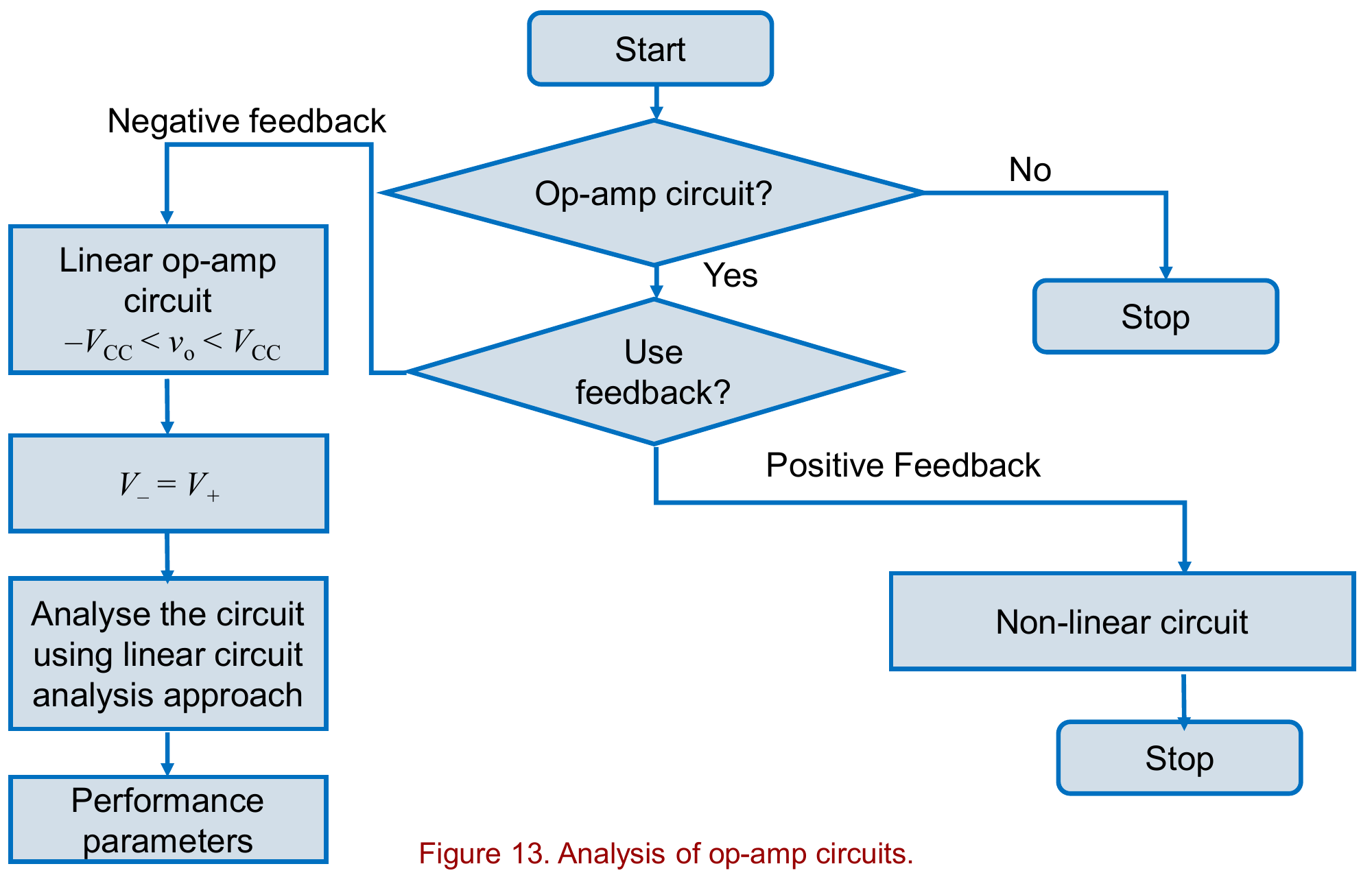
The simplest linear circuit analysed this way is the inverting amplifier.