Rotation Vector, A
A is a coordinate transformation (rotation) matrix.
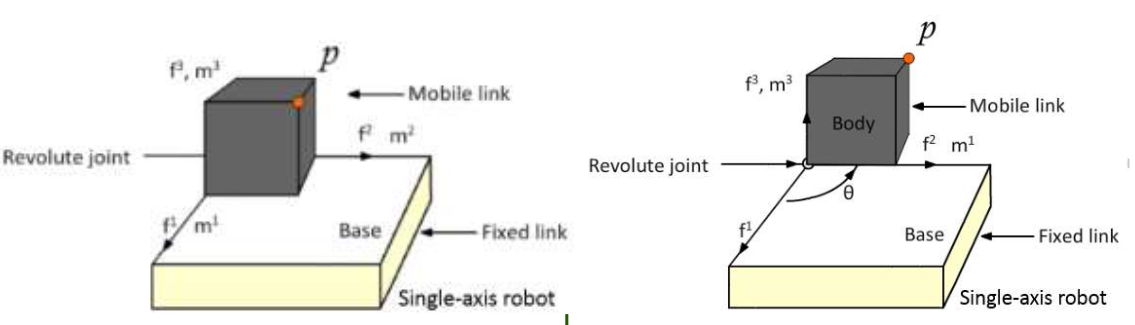
Looking at the above example, we rotate the mobile link 90 degrees from the original position.
There are 2 coordinate frames.
- Base Frame (F)
- Mobile Frame (M)
where:
- are unit vectors unique to the Mobile Frame ()
- are unit vectors unique to the Base Frame ()
- subscript is similar to how we use convention in a 3-Dimensional Space
Next, we know that point moved because we moved the mobile link. Given the coordinates of with respect to Mobile Frame (M), we wanna find out the coordinate of point with respect to Base Frame (F).
We can express a point, , in a coordinate system that is governed by the Mobile Frame () as such:
Note that and are the same thing. is the physical vector, and , , are the unit axes of the frame. We are dotting the physical vector with each unit axis vector to get the coordinates. We also learn previously that dotting is similar to , therefore it has a semantic meaning of finding the signed mangitude of that component of the point .
The formula that links point wrt F and wrt M is:
here represents a coordinate transformation (rotation) matrix that maps transformation from M to F. can also be expressed in terms of it's own unit vectors, i.e. .
This formula can be seen as . It tells us "how can vector be represented wrt base frame ?". This matrix allows us to transform a point with coordinates that are wrt , to a point with new coordinates that are wrt .
This formula is a result of combination of the earlier 2 formulas. What it means is that this rotation vector can be represented as a vector of in 3 components, , in this 3-Dimensional space.
Similar to how we connect the idea of point in frame , , we can do the same for . Let's work on first. What this means is we wanna find how can be expressed in terms of frame . Since may contain components from , , and , we can therefore express it as:
If we continue this on for , we get:
Substitute this back into the equation we get:s
Note that is the coordinate transformation matrix that maps coordinates into coordinates, where .
Formula for Rotation Matrices
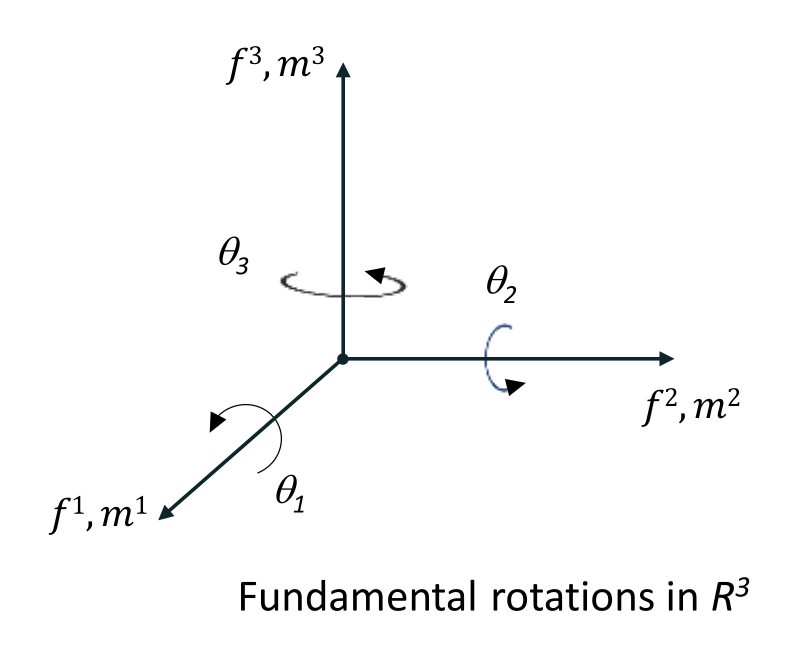
Fundamental Rotation Matrix is defined when a mobile coordinate frame that is obtained from fixed frame , rotates about one of 's unit vectors., as shown in the figure.
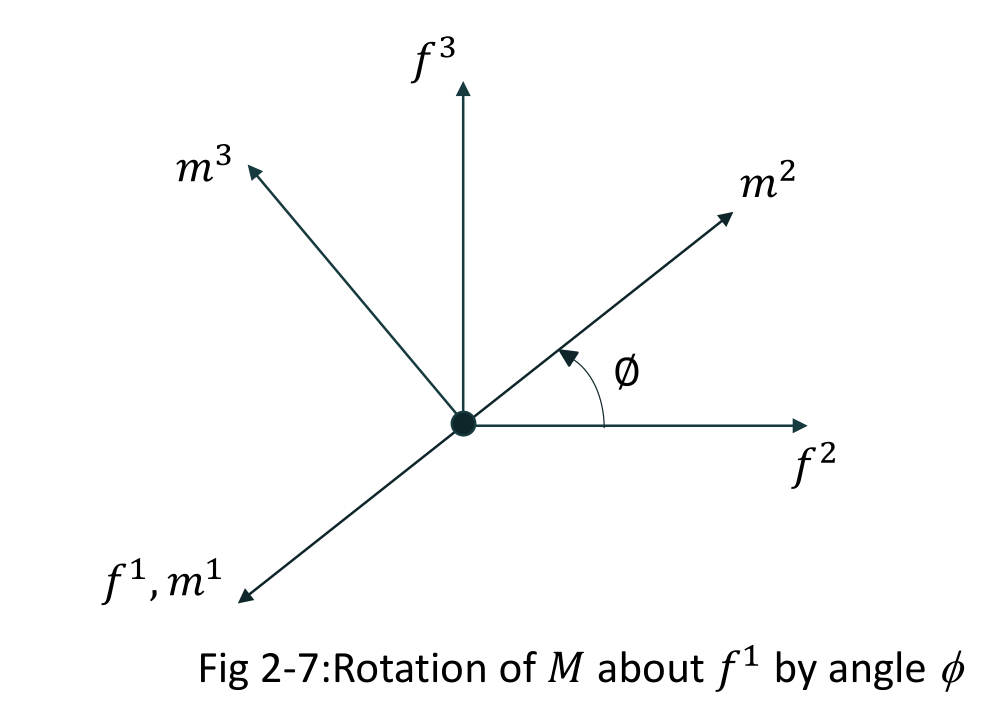
where:
- is the resulting coordinate transformation matrix which maps mobile 𝑀 coordinates into fixed 𝐹 coordinates.
- =
- is the angle that rotates about as illustrated above
Likewise we get: