Introduction
Special automation equipment is made for one product. When the product life ends, the equipment is often of no more use. A robot is different, because you can program it again and use it for the next product. The robot can live longer than the current project, and this adds value.
For example, a project may last only 2 or 3 years, but the robot may last 8 or 10 years. So the robot can serve three or four projects before it wears out or becomes obsolete.
How it works
You give the robot a salvage value at the end of the current project. The salvage value is a positive cash flow at the end of the project life.
A simple way to find the salvage value is the straight line method of depreciation. The value of the robot falls by the same amount each year until it reaches zero at the end of the robot life.
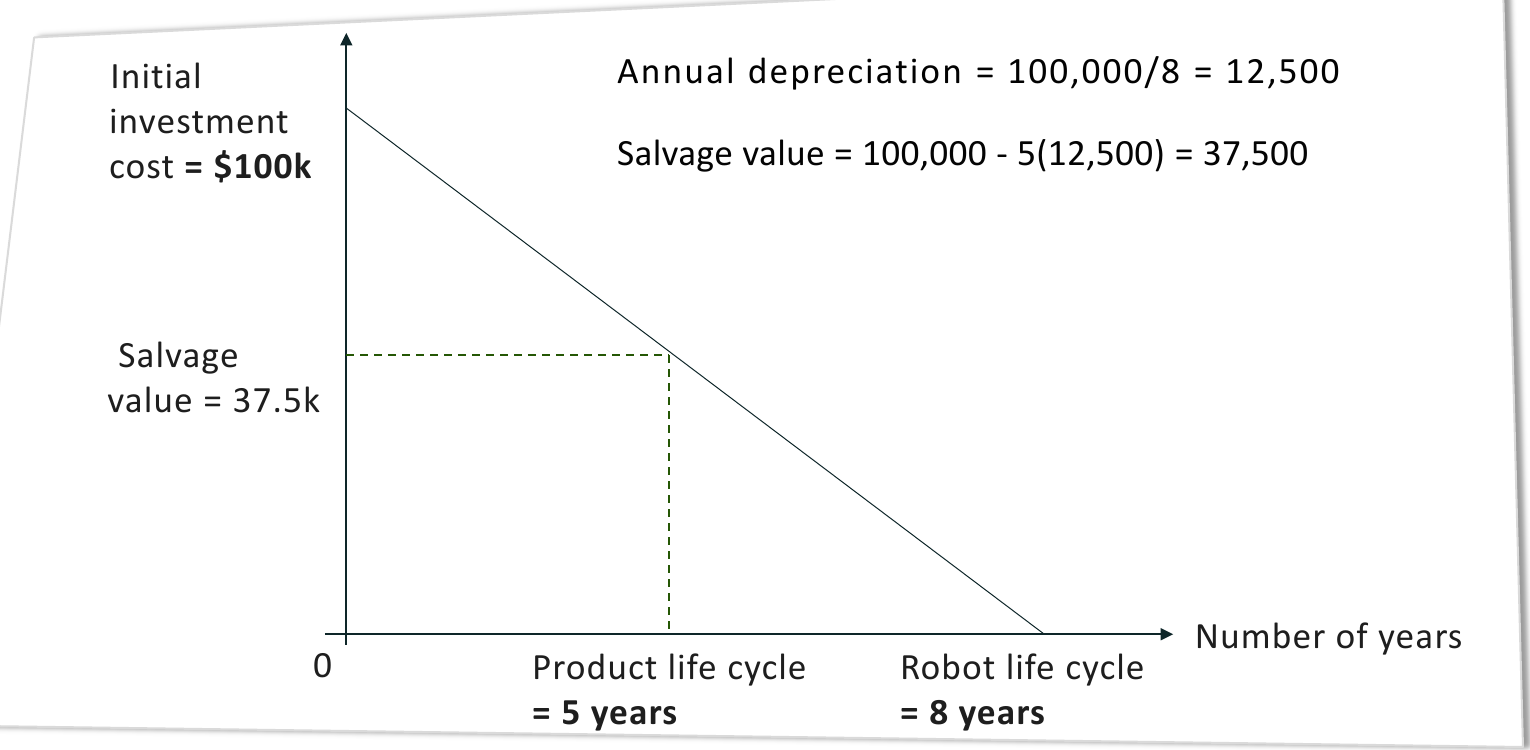
For a robot that costs \100{,}000$ with a life of 8 years, used on a 5 year project:
The company can raise or lower this value. For example, it can lower the value if there is a risk that no new project will use the robot, or if the robot may become obsolete early.
Example 4
Use the data from the ROI example (IC=\100{,}000C=$20{,}000R=$65{,}000n=5$37{,}500$ at year 5.
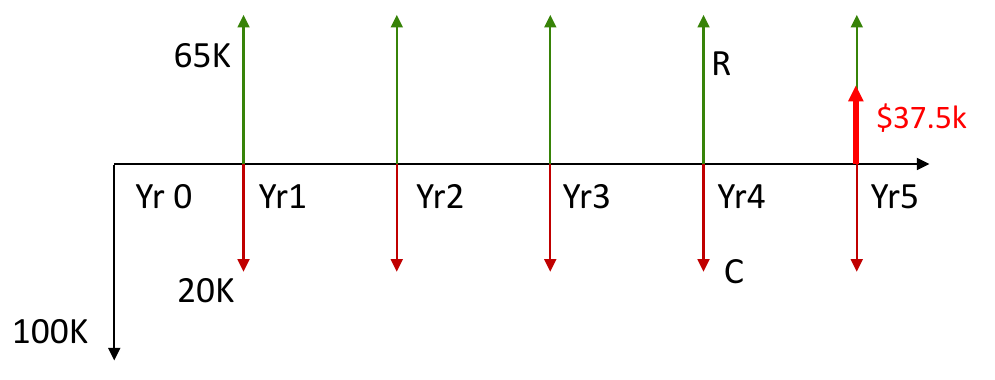
There is more than one unknown factor, so use trial and error.
Try :
Try :
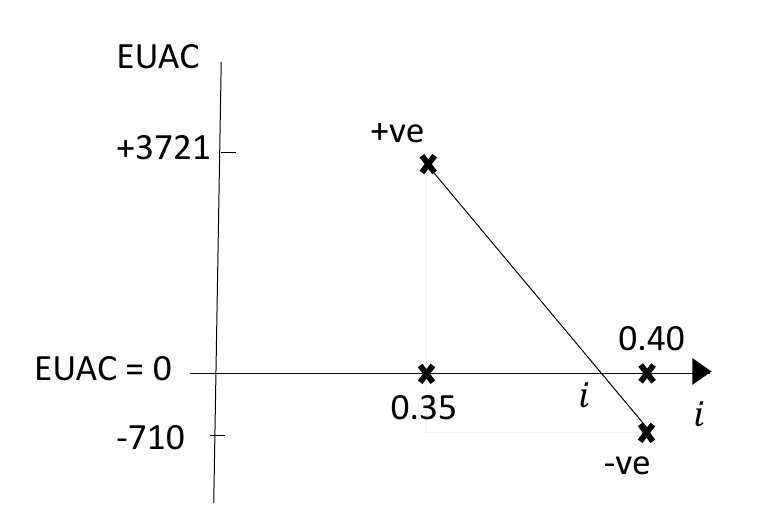
Interpolate with :
The salvage value increases the rate of return from to .