Introduction
Sometimes a robot is already in use, and its current project is at its end. The company wants to move the robot to a new project. The robot now has a lower value than its purchase price, because it is partly used. You find this value with straight line depreciation, the same as in Subsequent Use of the Robot.
How it works
- Find the present worth of the robot today, with straight line depreciation
- Add the new costs, such as the engineering cost to install the robot again
- Find the salvage value of the robot at the end of the new project
- Write the EUAC equation and use it to find what you need, for example the value added per part
Example 7
Three years ago, a robot cost \90{,}000$ and had a service life of 10 years. Its first project is now at its end. The robot will go to a new project that lasts 4 years.
- engineering cost to install the robot is \45{,}000$
- the robot works 15 hours per day for 250 days per year
- annual maintenance and operating cost is \12{,}000$
- production rate is 30 pieces per hour
Find the value added per piece so that the project earns a rate of return of .
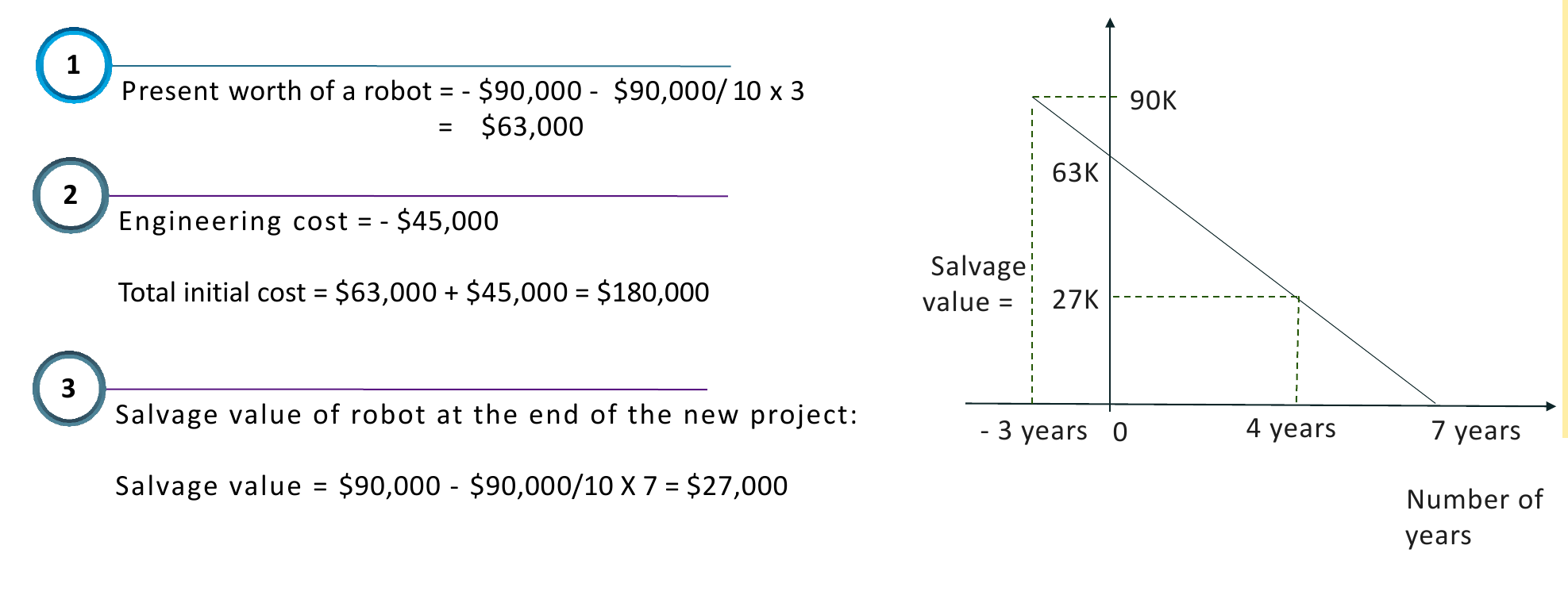
Step 1: present worth of the robot
Step 2: total initial cost
Warning
The slide shows the total as \180{,}000$108{,}000$.
Step 3: salvage value at the end of the new project (the robot is then 7 years old)
Step 4: EUAC without revenue
Units made each year:
Value added per piece: