Introduction
The Return on Investment (ROI) method finds the actual rate of return of the project. Then you compare this rate with the company's MARR.
How it works
Set up the same equation as the Equivalent Uniform Annual Cost Method, but make the EUAC equal to zero. Then find the interest rate that makes the equation true.
Steps:
- Write the EUAC equation and set it to zero
- Solve for the interest factor, or use trial and error with the interest tables
- Use linear interpolation between two table values to find
- Compare with the MARR
Decision rule:
- means the project is good
- means the project is not good
Linear interpolation
When the value you need is between two table values, assume a straight line between them:
Use the two known points to find and , then solve for .
Example 3
Use the same data as before: IC=\100{,}000C=$20{,}000R=$65{,}000MARR=30%n=5$ years.
From the interest tables:
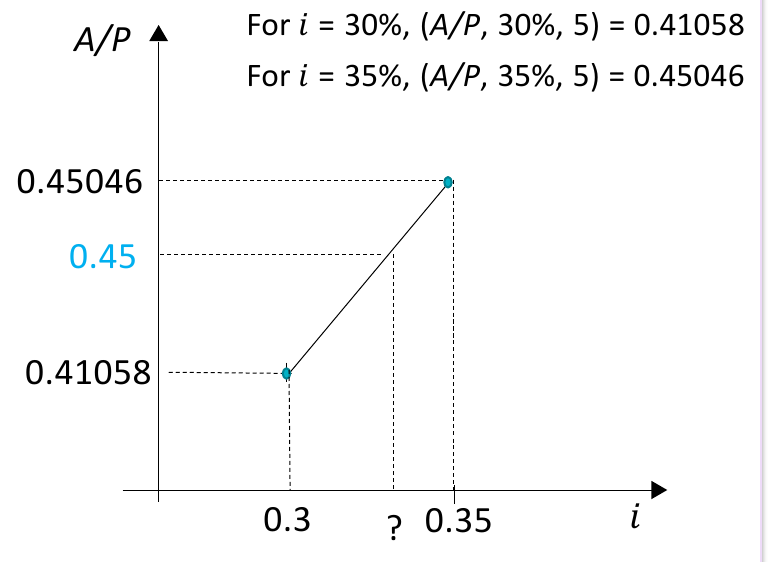
Let :
This gives and . Set :
The rate of return is , which is more than the MARR of . The project is good.