Introduction
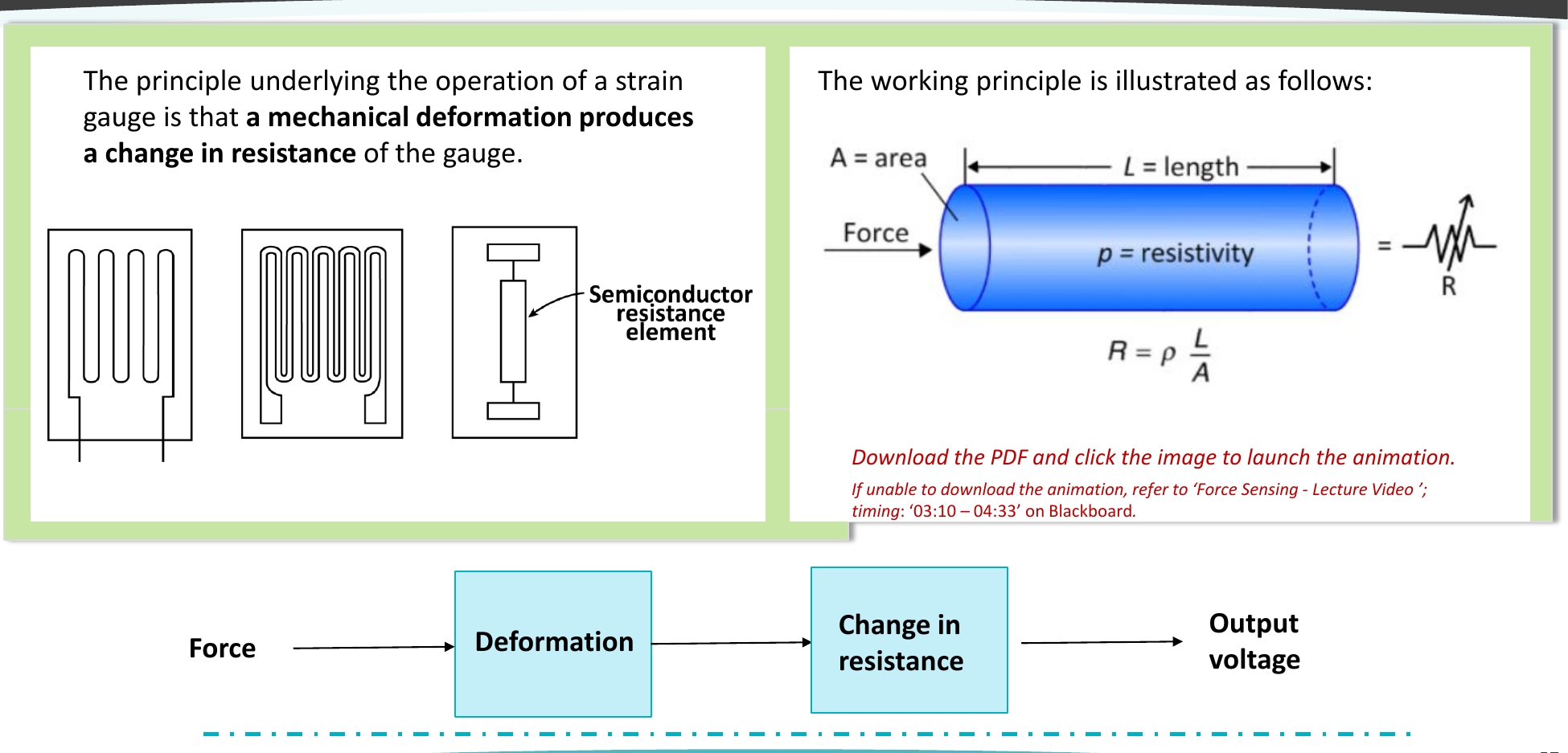
A strain gauge works because a mechanical deformation changes its resistance. Strain gauges are the basic part of most force sensors.
flowchart LR
    F["Force"] --> D["Deformation"]
    D --> R["Change in<br/>resistance"]
    R --> V["Output voltage"]
How it works
The resistance of a conductor is:
where is the resistivity, is the length and is the area. When a force stretches the gauge, increases and decreases, so changes.
Wheatstone bridge
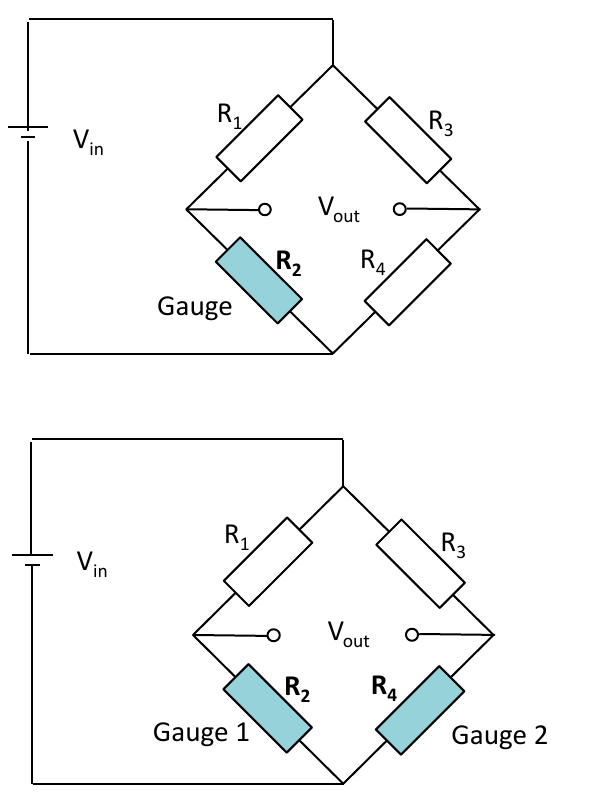
A Wheatstone bridge changes the small change in resistance into a voltage that is proportional to the strain.
If the bridge is balanced at the start, so that , then . Any change in the gauge resistance from a deformation unbalances the bridge and gives a non zero output.
Problem and solution
Changes in the ambient temperature change the gauge resistance, even when no force is applied. You can fix this by:
- balancing the bridge from time to time
- using two gauges and taking the difference of their outputs