The noise amplification problem of the Inverse Filtering or pseudo-inverse filtering can be better addressed by Wiener filtering.
Wiener filtering incorporates both the degradation and statistical characteristics of noise to find an estimate of the un-degraded image such that the mean square error (MSE) between them is minimized:
Assumptions
Assume that the noise and the image are uncorrelated, one of them has zero mean, and that the gray levels in the estimate are a linear function of the gray levels in the degraded image. The MSE estimate of the un-degraded image is then:
- is known as the Wiener filter, also known as the minimum mean square error filter or least square error filter
The filter
where:
- is the degradation function
- is the complex conjugate of
- is the power spectrum of the undegraded image
- is the power spectrum of the noise
- is the scale factor
Wiener is an Inverse filter with a scale factor
- The scale factor, decreases with increasing noise power and increases with decreasing noise power
- The scale factor approaches 0 when the degradation function approaches 0
- When there is no noise, the scale factor becomes 1 and the Wiener filter reduces to the inverse filter
- If for some frequency there is no signal, the scale factor becomes 0, the Wiener filter reduces to 0 there, and the noise is suppressed
- If there is no degradation, , and the Wiener filter reduces to a smoothing filter
Approximation when the spectra are unknown
When both and are not known or cannot be well estimated, we can approximate the Wiener filter as:
where is a specified constant.
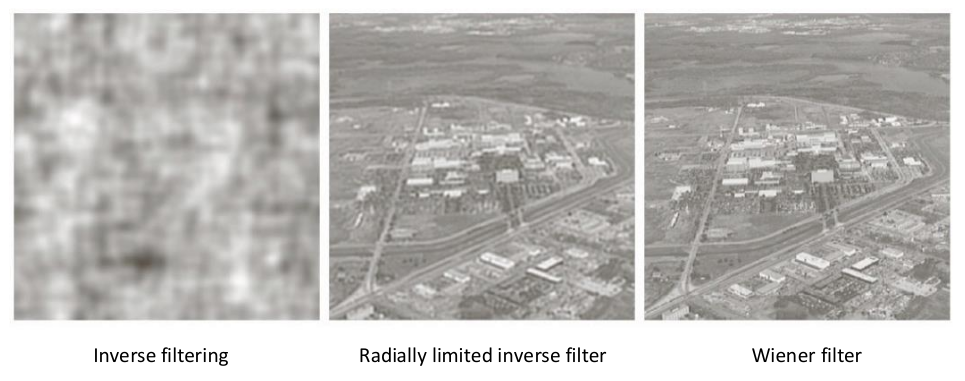
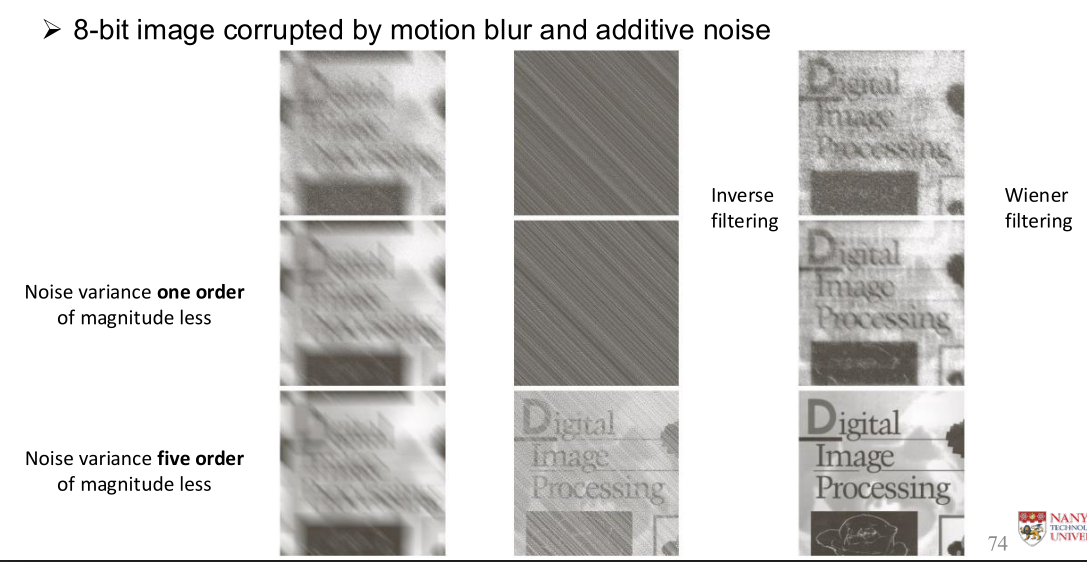
Weiner Restoration
This formula is the final restored image using the new weiner degradation function, .