If the degradation function is known or can be estimated, inverse filtering is one simple and direct approach to restore a degraded image:
The above equation is inverse filtering. However, even if we know the degradation function, we cannot recover the un-degraded image exactly. The quantity that decides whether the estimate is usable is the ratio as we can see below.
- is usually not known
- If has zero or very small values at some frequencies, the ratio could dominate the estimate and make the result not reliable
- If is 0.01 the estimate is fine, but if is 100 the estimate is bad
Motion blur case
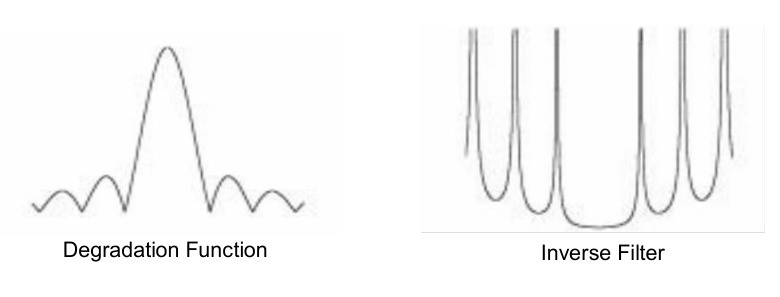
- For motion blur, is a sinc function along some direction
- The inverse filter becomes infinite at some frequencies
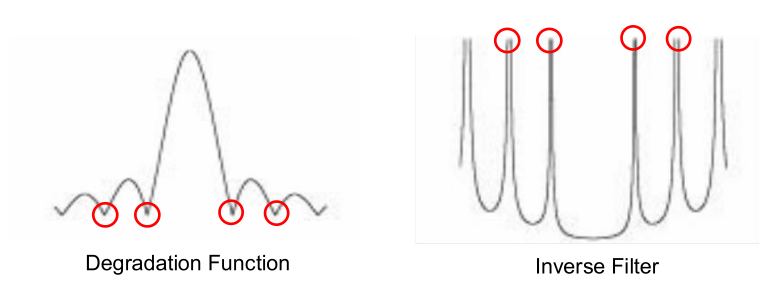
- Motion blur creates frequencies where is zero or very small, and dividing by those values turns weak noise into dominant artifacts
- An exact inverse can therefore be numerically and statistically unstable
- therefore we would want to target those zero points
Pseudo-inverse filter
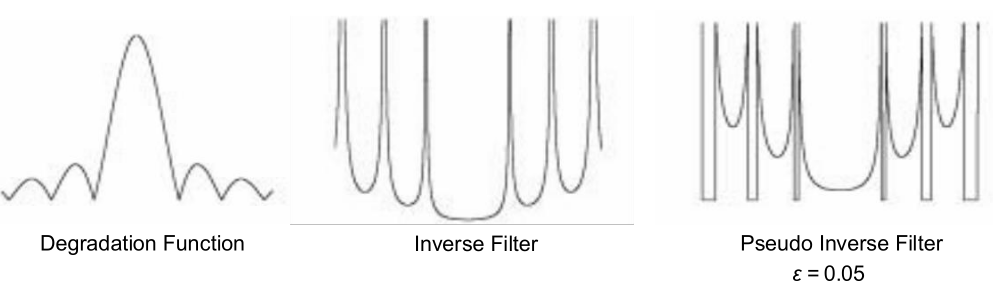
In practice we tackle this by defining a generalized (or pseudo-) inverse filter:
- The slide example uses
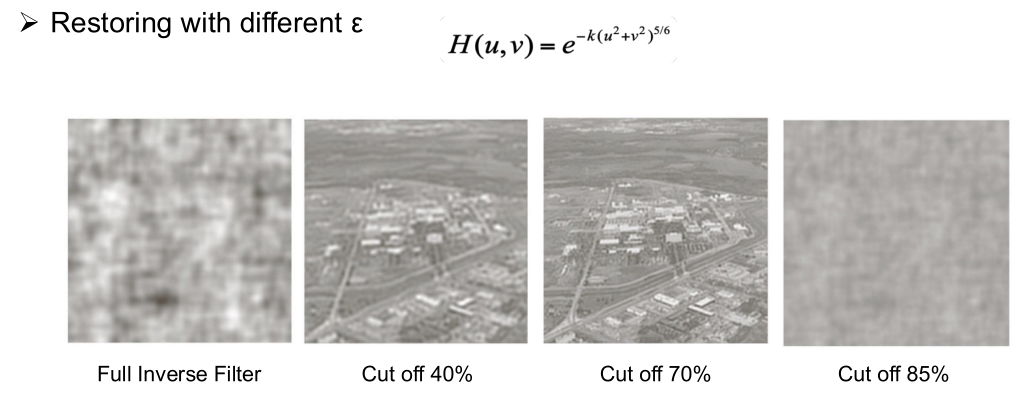
- Restoring with different gives full inverse filter, cut off 40%, cut off 70%, cut off 85%
Reading the artifacts
- Ringing indicates sharp frequency truncation or boundary mismatch
- Grain amplification indicates division by small
- A sharper image is not necessarily a more accurate restoration
- The noise amplification problem is better addressed by Wiener Filtering