The maximum a posteriori (MAP) decision rule picks the class with the largest posterior probability. It is the optimal decision rule because it gives the smallest probability of a wrong decision. It is one step of the Bayes Decision and Classifiers topic.
Main idea
Decide $\omega_k=\arg\max_{\omega_i}\,p(\omega_i|x)$. This is the same as $\arg\min_{\omega_i}\,p(e_i|x)$.
Intuition: Decision with Prior Knowledge Only
You see a student in a classroom, but you cannot see the student clearly. You must decide if the student is male () or female ().
| School | Best decision | Error rate | ||
|---|---|---|---|---|
| EEE | 0.7 | 0.3 | (male) | |
| Accounting | 0.3 | 0.7 | (female) |
This is the maximum probability decision:
- decide if , and vice versa
- the decision can still be wrong, but no other decision is better
- the opposite decision (decide female in EEE) has an error rate of
Adding Data: Prior and Posterior Probability
Now you know that the student has a height of m. The best decision is still to pick the class with the larger probability. The difference is that the probabilities now include the knowledge of .
Two kinds of probability:
- prior probability is the probability of class before you know the data value
- posterior probability is the probability of class after you know the data value in a particular scenario
The rule changes name from maximum probability decision to maximum a posteriori probability decision, or MAP decision.
MAP decision rule:
or, more generally:
Why MAP is Optimal
When you decide from the observed value , the probability that the decision is correct is . The probability of a wrong decision (error rate) is:
Because MAP picks the largest , the error is the smallest. So MAP minimises the probability of decision error:
Calculating the Posterior with Bayes Formula
It is difficult to get directly. It is easier to get the prior and the class-conditional probability .
From the basic rule of probability :
So:
where the mixture PDF or PMF is:
This uses .
Why can be removed:
- is the probability (density) of a height over all classes
- it has the same value for all classes, so it does not change which class is the largest
The Challenge: Class-Conditional PDFs for All
To recognise gender automatically for every value of , we need for all possible values of . This is the big challenge.
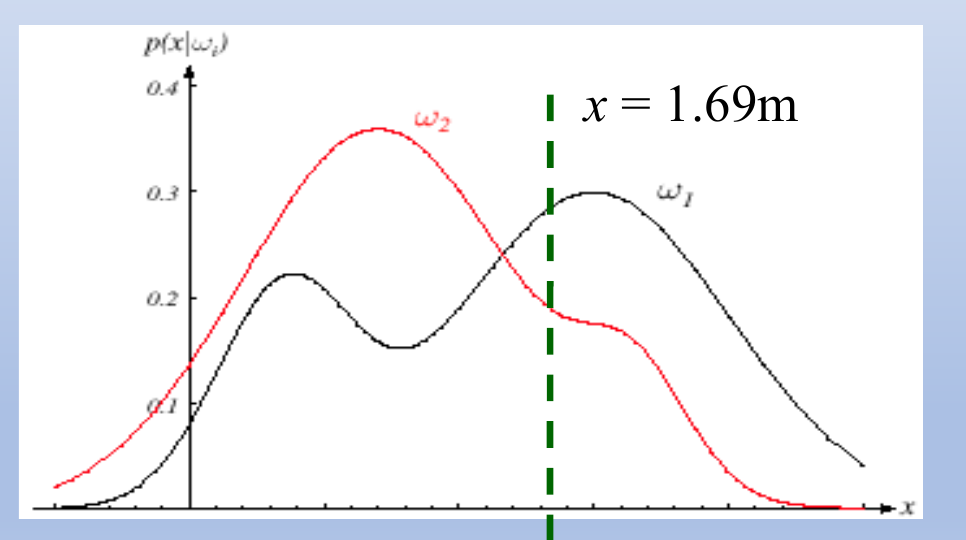
Each class-conditional distribution must sum or integrate to 1 over all heights (0 m to 3 m here):
The lecture then asks how to simplify the computation. The answer is to convert the decision into a classification with discriminant functions.