The probability of error measures the performance of a pattern recognition system. It is the average of the error at each value of , weighted by how often that value of occurs. It follows from the error of one decision in the MAP Decision Rule.
Main idea
$p(e)=\int_{-\infty}^{\infty}p(e_k|x)\,p(x)\,dx$. The MAP boundary (equal posteriors) removes the reducible error and gives the minimum error, the Bayes error.
Error at One Value of
For the decision at one value of :
The performance of the whole system is the average of over all possible values of .
How to Average Correctly
A plain average is not correct:
Why it is wrong:
- is a random variable
- different values of have different probabilities of occurrence
- so each must be weighted by
The correct average:
Derivation for Continuous
Substitute and Bayes formula :
The decision changes with the region of . Classification partitions the whole space of into decision regions . In region the system decides . Therefore:
Two-Class Case
The second line uses and .
Meaning of the two terms:
- the first term is the error when the true class is but falls in
- the second term is the error when the true class is but falls in
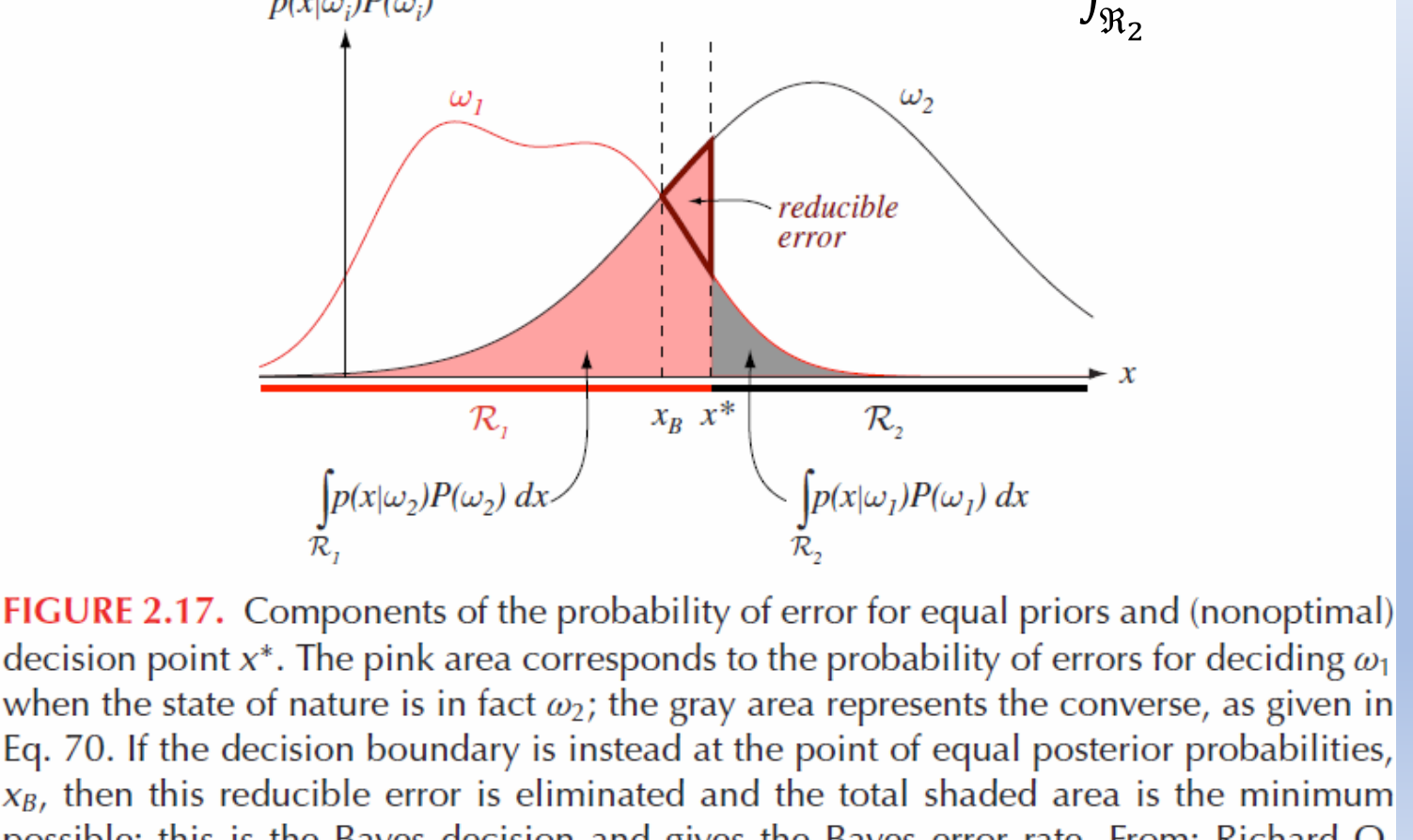
Reading the figure:
- the pink area is the error for deciding when the true class is
- the grey area is the error for deciding when the true class is
- is a non-optimal decision point, and it adds the reducible error (the triangle)
- is the point of equal posterior probabilities, which is the MAP (Bayes) decision point
- at the reducible error is gone and the total shaded area is the minimum, the Bayes error rate
More Features Give Lower Error
If we know the height and also the hair length , we can make a better decision with a lower error. The principle is the same. Replace the scalar with a vector:
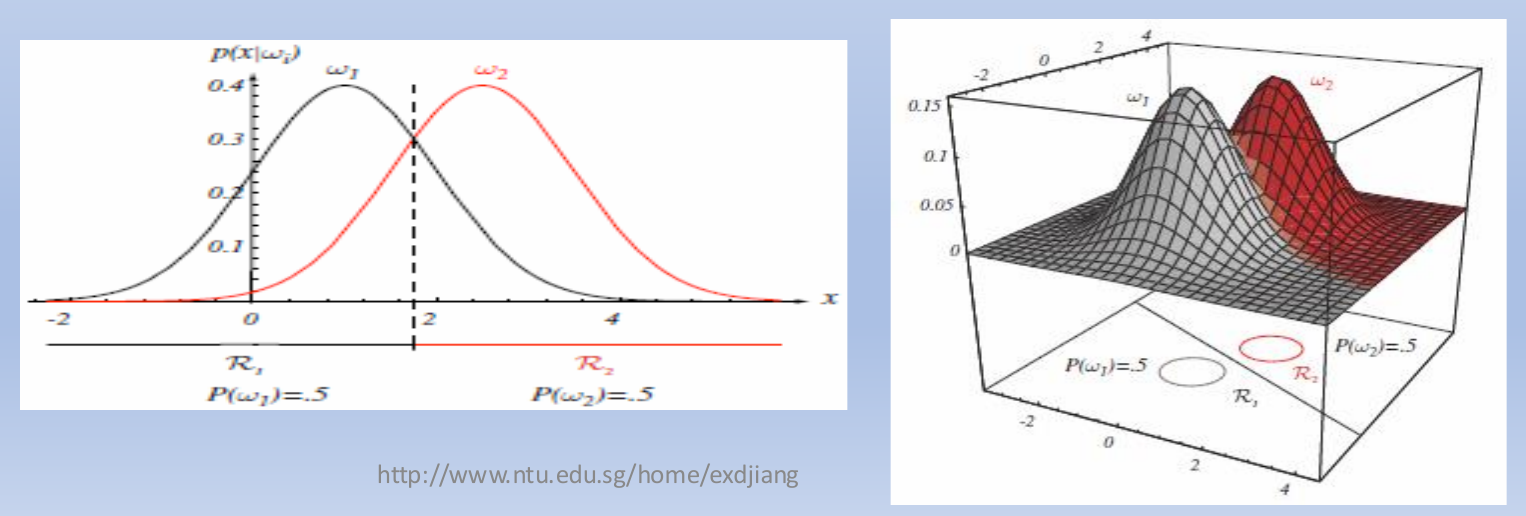
What changes:
- the probability distribution becomes two dimensional
- the scalar threshold in 1D becomes a curve in the plane of
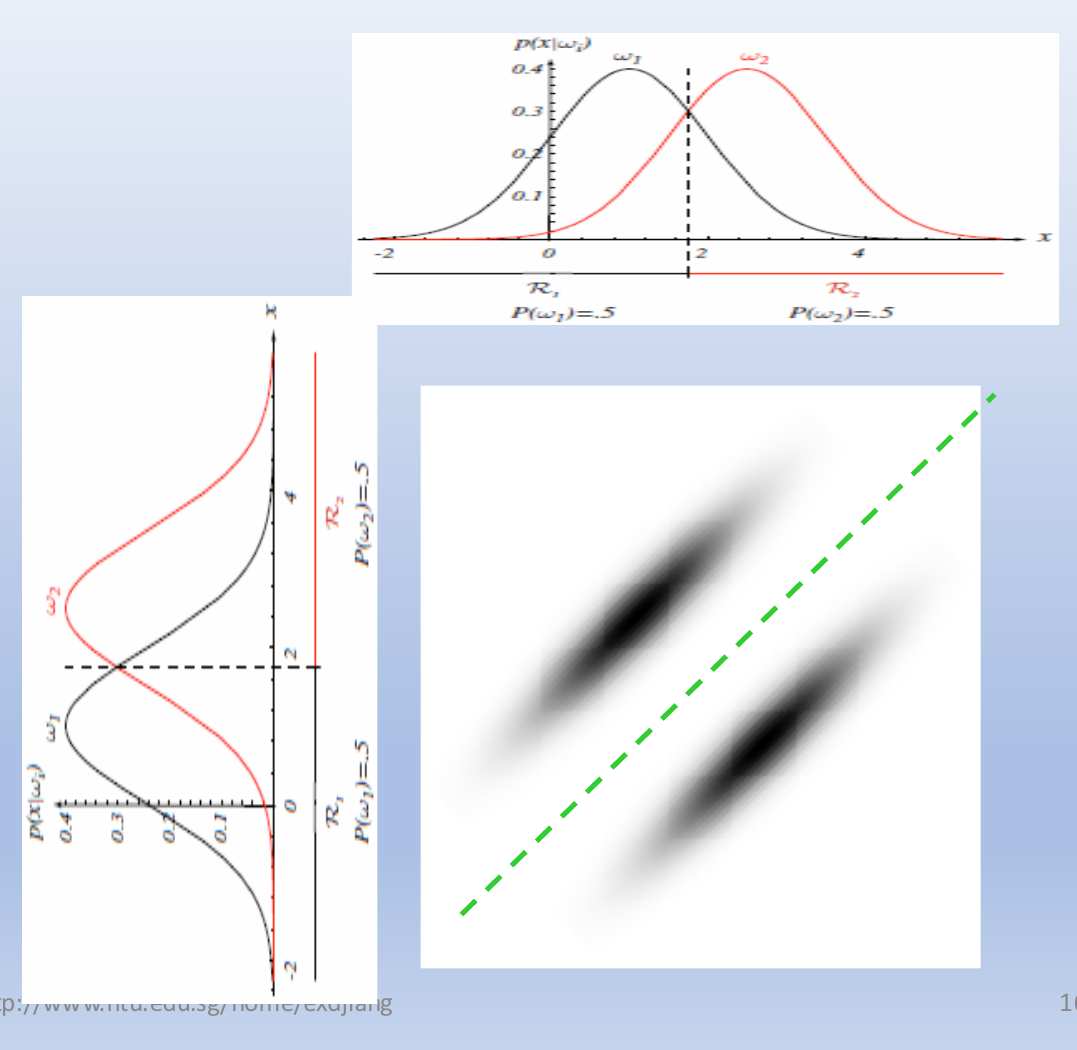
In this figure, the two classes overlap a lot in each single feature. In 2D, a line separates them well. In general, more information or a higher feature dimension increases the probability of a correct decision and reduces the probability of error.