Source
Adapted from my own handwritten and hand-typed notes from Year 1 to Year 3 of my EEE degree
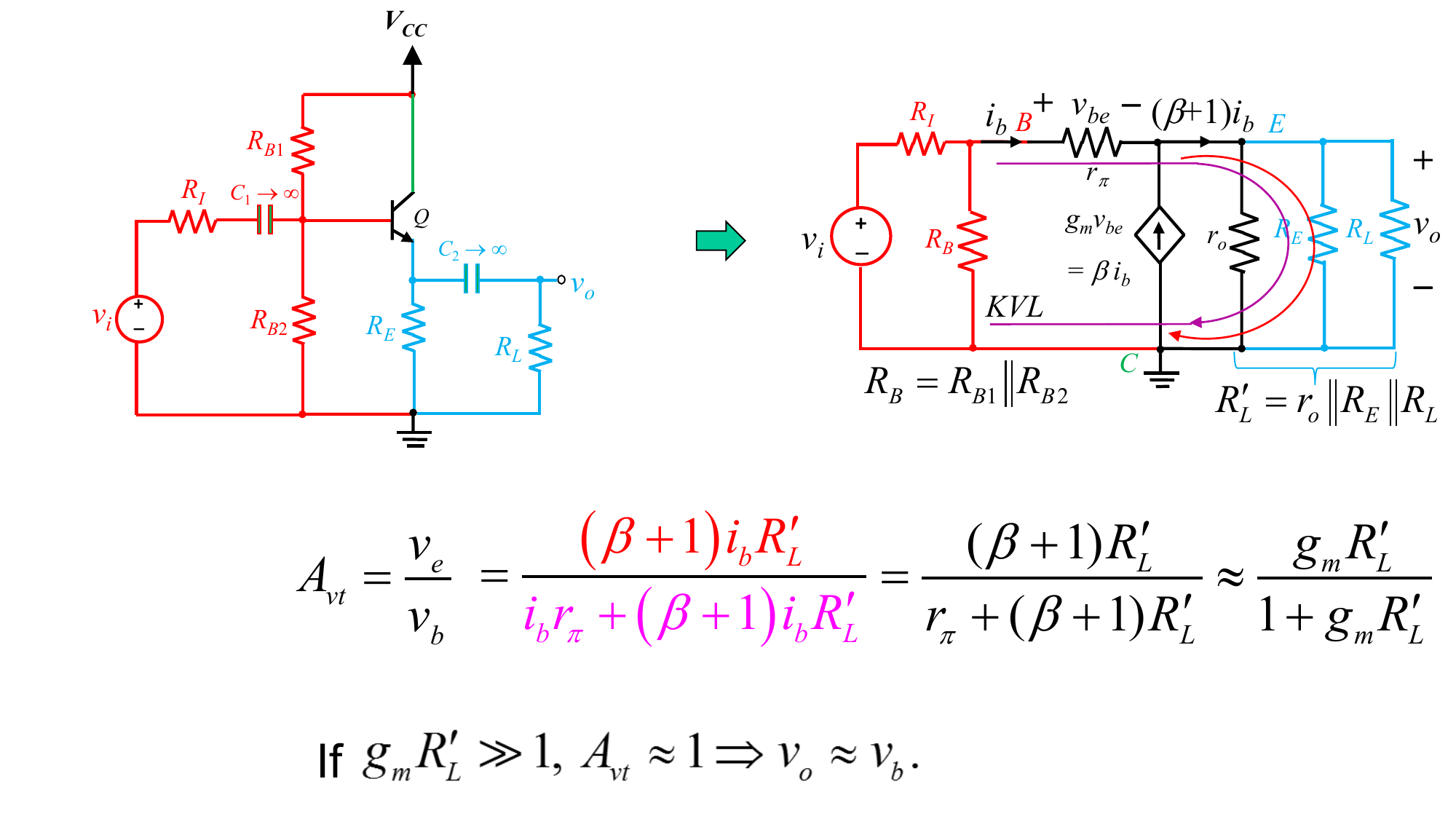
The common-collector (C-C) and common-drain (C-D) amplifiers take the output from the emitter or source. The output follows the input with a gain just under 1, so they are called voltage followers and are used as buffers: high input resistance, low output resistance.
C-C (Emitter Follower)
Let and . KVL from base to emitter with :
If then and .
The source resistance is divided by when seen from the emitter, which is why is small.
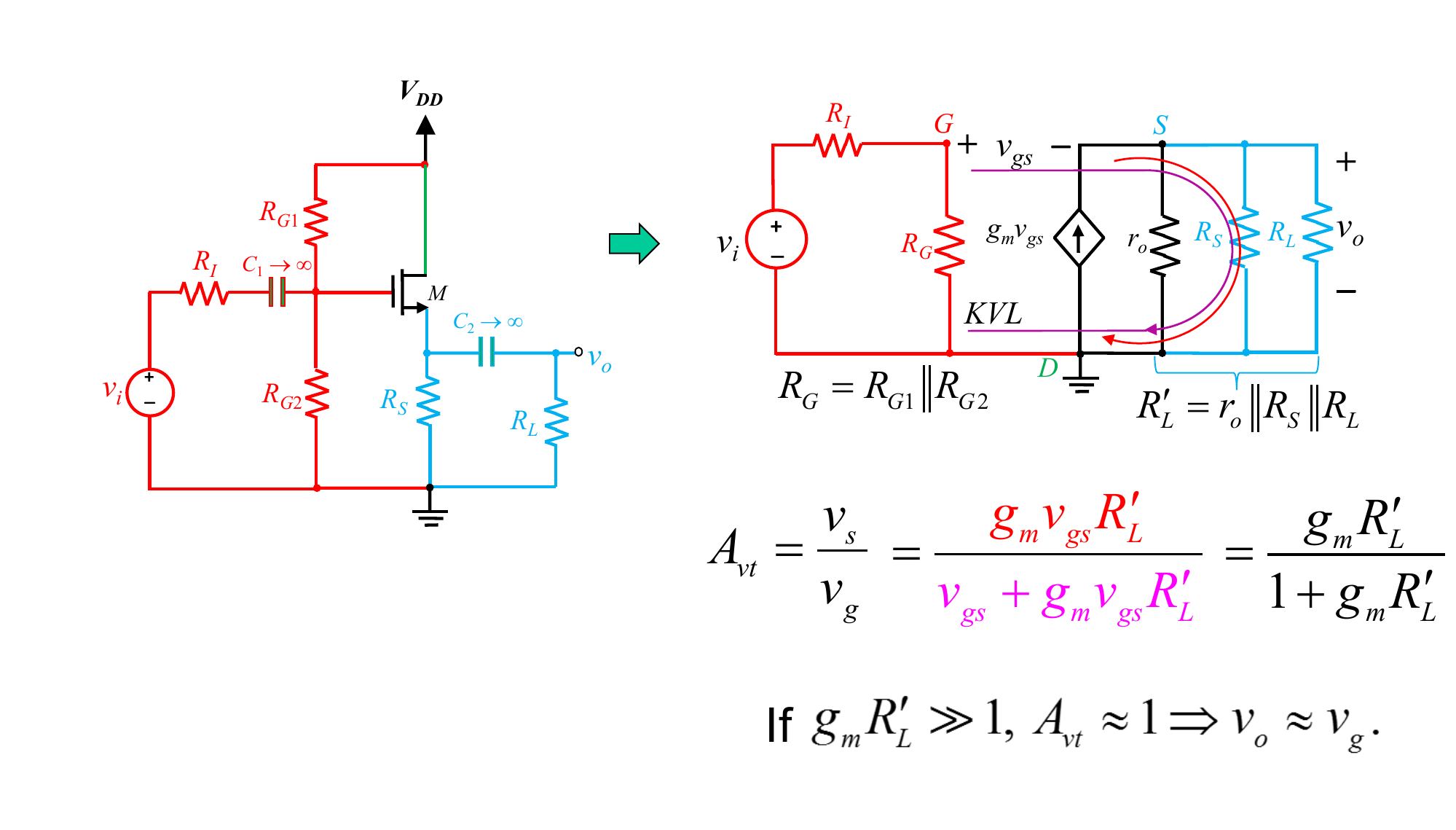
C-D (Source Follower)
Let and :
Comparison
Points:
- both have overall gain , close to 1 when
- the C-D has infinite input resistance at the gate, but its gain is further below 1 because is smaller
- the C-C output resistance depends on the source resistance, the C-D output resistance does not
- the allowed input swing grows by , so followers handle large signals
The remaining family, with the input at the emitter or source, is in Common-Base and Common-Gate Amplifiers.