Source
Adapted from my own handwritten and hand-typed notes from Year 1 to Year 3 of my EEE degree
The four-resistor network (, , , ) is the standard way to bias a BJT amplifier. The base divider fixes the base voltage and gives negative feedback that makes the Q-point stable against changes in .
Method
Replace the base divider by its Thevenin equivalent:
Assume forward-active and write KVL around the base-emitter loop and the collector-emitter loop:
Then check that the BCJ is reverse biased ().
If , then , which no longer depends on . This is why the circuit is stable.
Worked Example
V, kΩ, kΩ, kΩ, kΩ, .
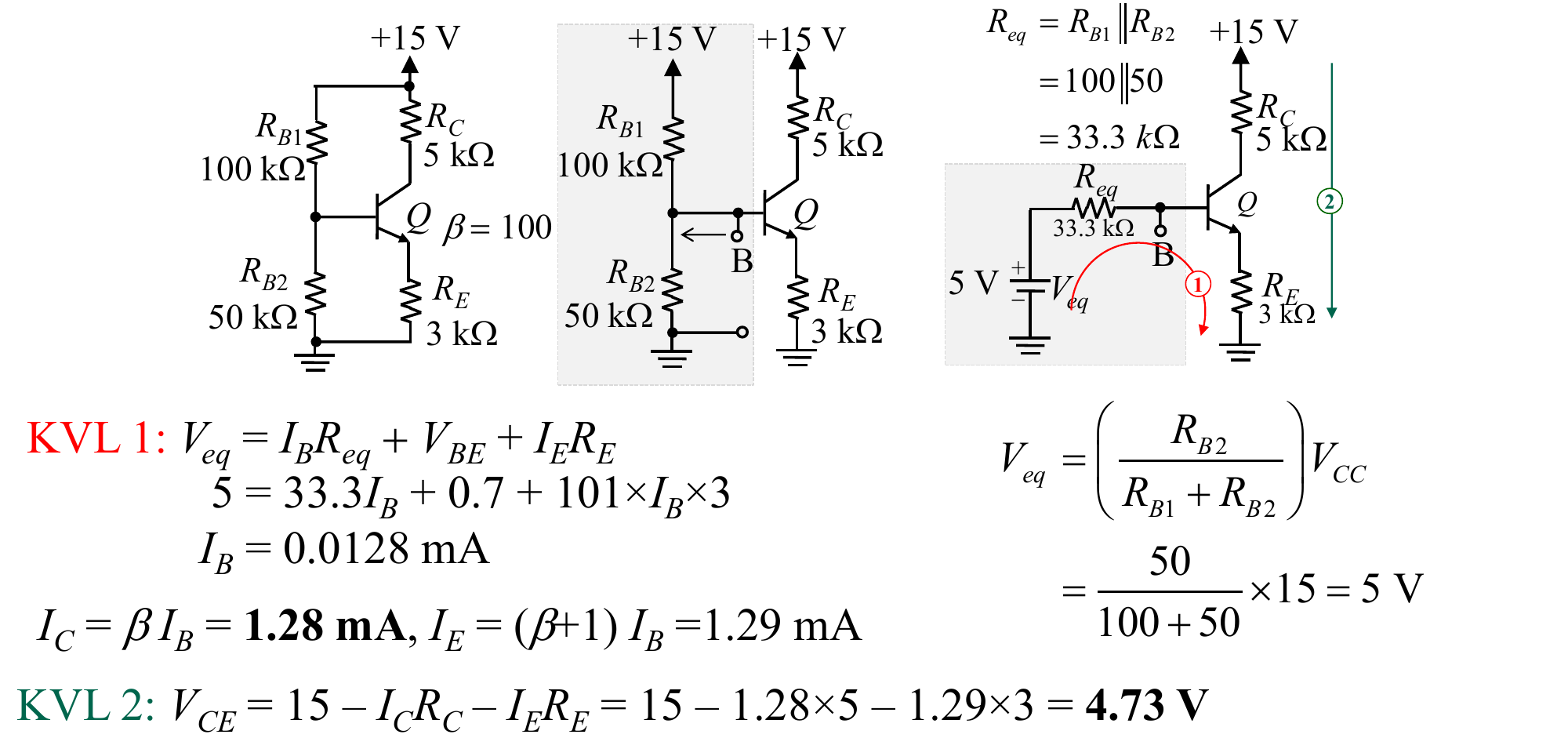
Steps:
- V, kΩ
- , so mA
- mA, mA
- V
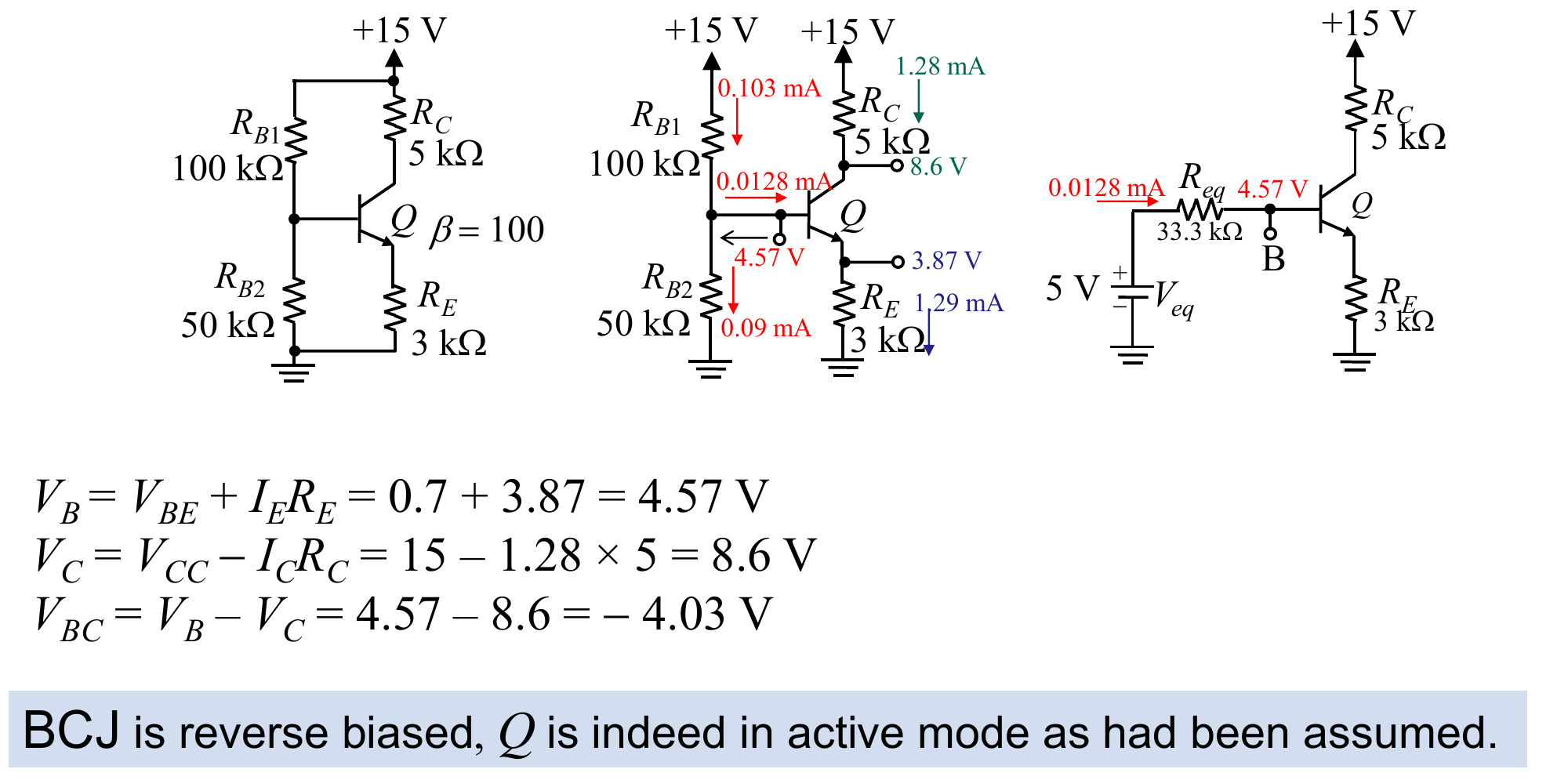
Check the region:
- V
- V
- V, so the BCJ is reverse biased and the transistor is forward-active as assumed
The Q-point values and are then used to compute the parameters of the BJT Hybrid-Pi Model.