Source
Adapted from my own handwritten and hand-typed notes from Year 1 to Year 3 of my EEE degree
A transistor amplifier carries a DC bias and an AC signal at the same time. Because the small-signal behaviour is linear around the Q-point, the two are analysed separately and the results are added (superposition).
Coupling and Bypass Capacitors
Roles:
- coupling (DC blocking) capacitors , inject the input and take out the output without disturbing the Q-point
- a bypass capacitor across gives the AC emitter current a low-impedance path to ground, so disappears for signals but still stabilises the Q-point at DC
- they are chosen large, so their reactance is negligible at the signal frequency
Reactance:
DC Analysis Rules
Steps:
- replace capacitors by open circuits and inductors by short circuits
- replace AC voltage sources by shorts (ground) and AC current sources by opens
- find the Q-point with the large-signal transistor model (KVL, KCL, Thevenin)
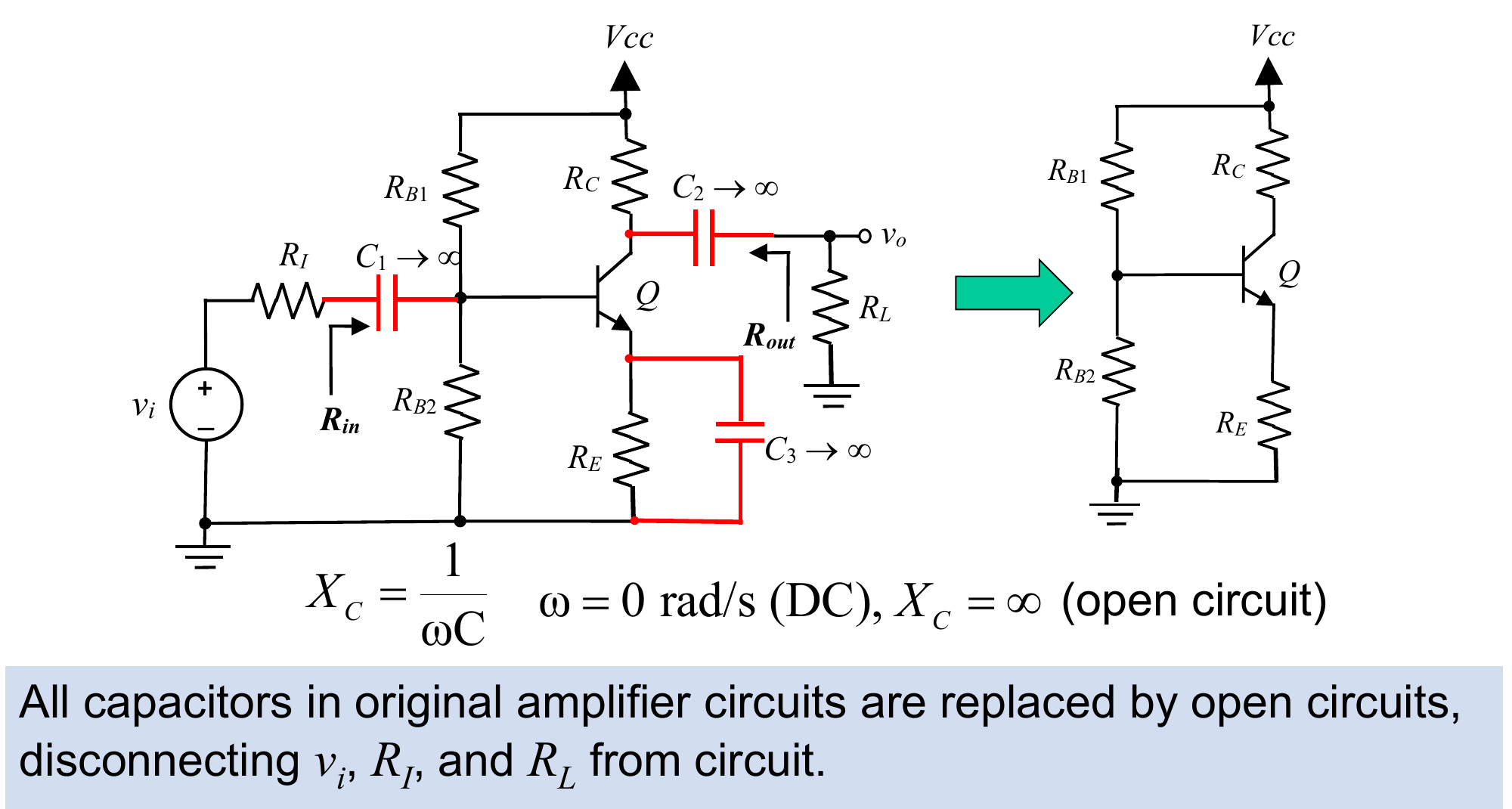
With the capacitors open, , and drop out and only the four bias resistors remain.
AC Analysis Rules
Steps:
- replace capacitors by short circuits and inductors by open circuits
- replace DC voltage sources by ground and DC current sources by opens
- replace the transistor by its small-signal model
- solve for gain, input resistance and output resistance
In the AC circuit becomes ground, so and appear in parallel () and appears in parallel with .
Combine
Total quantities are DC plus AC, for example and .
The standard bias network analysed this way is the four-resistor bias circuit.