Source
Adapted from my own handwritten and hand-typed notes from Year 1 to Year 3 of my EEE degree
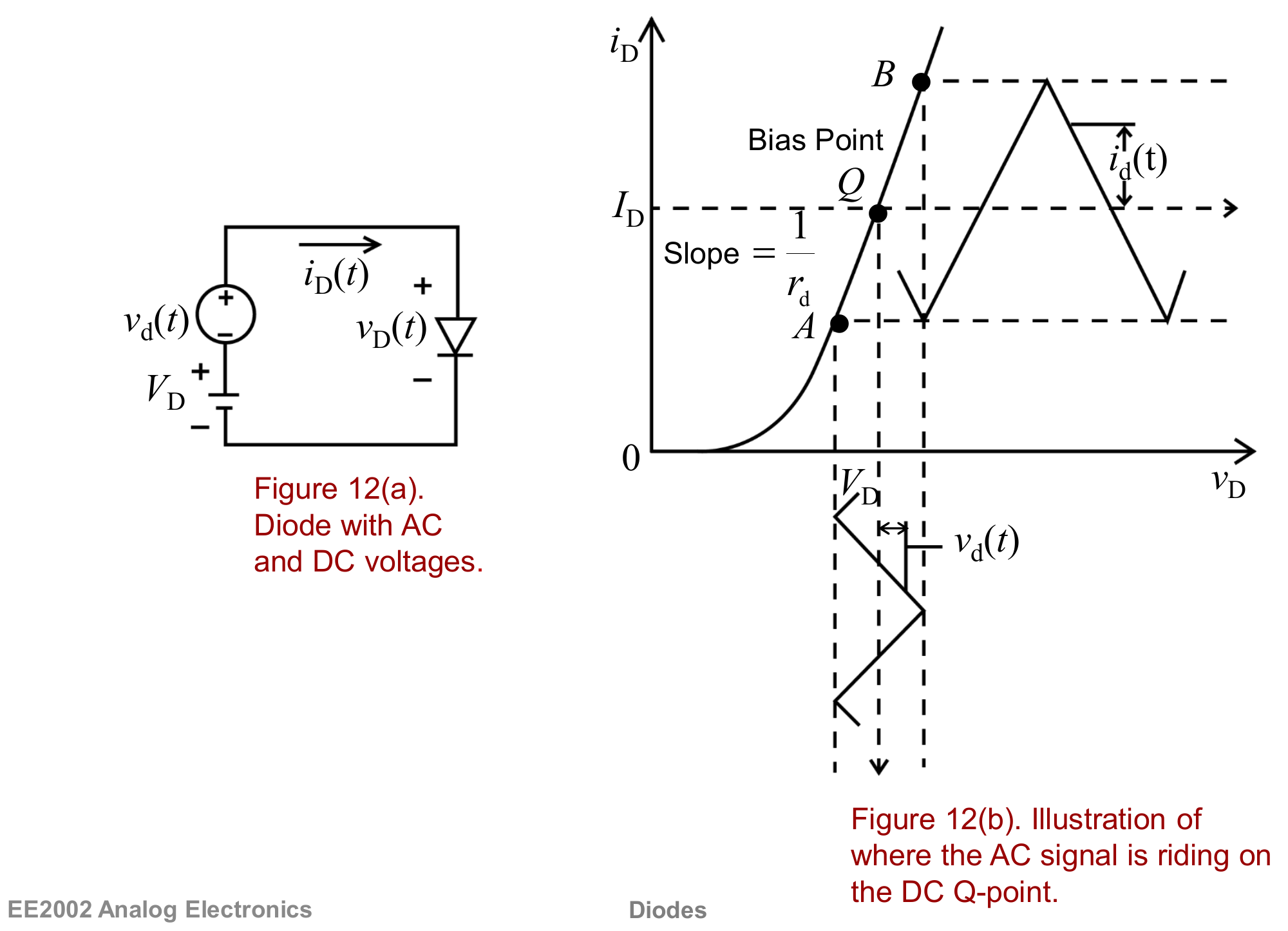
When a small AC voltage rides on the DC bias , the diode behaves like a resistor around the Q-point.
Derivation
Using and keeping only the linear term needs , so . With this means mV. Then
Small-Signal Conductance and Resistance
Meaning:
- is the slope of the - curve at the Q-point
- it is proportional to the DC current, so a higher bias gives a lower
- and
For , mV, mA: mS and Ω.
Superposition Procedure
Steps:
- DC analysis: find , from the diode equation and load line
- AC analysis: replace the diode by , kill the DC sources, solve for ,
- add the two results
Worked Example
V mV peak sine, kΩ, A, .
DC part, iterating and gives mA, V.
AC part:
Total:
The same linearisation idea gives the transconductance in the BJT Hybrid-Pi Model.