Source
Adapted from my own handwritten and hand-typed notes from Year 1 to Year 3 of my EEE degree
The output of a real op-amp cannot change instantly. The slew rate is the maximum rate of change of the output voltage:
For the µA741, V/µs. An ideal op-amp has .
What Happens Beyond the Slew Rate
When the intended output changes faster than , the output can only ramp at and falls behind. During this time:
- the output is no longer a faithful copy of the input (non-linear distortion)
- , so the op-amp is effectively open loop
- a sine wave turns into a triangle-like wave
Limit for a Sine Wave
For , the steepest slope is at the zero crossing:
So a large output amplitude lowers the usable frequency.
For a step, the minimum time for the output to change by is
Worked Example
Inverting amplifier, gain , V/µs, input 1.0 V peak so output 10 V peak.
Frequency where slew limiting starts:
If the input rises to 1.5 V at 16 kHz, the intended output is 15 V peak. Writing , its slope magnitude first reaches at
After the output ramps at 1 V/µs until it meets the intended curve again at .
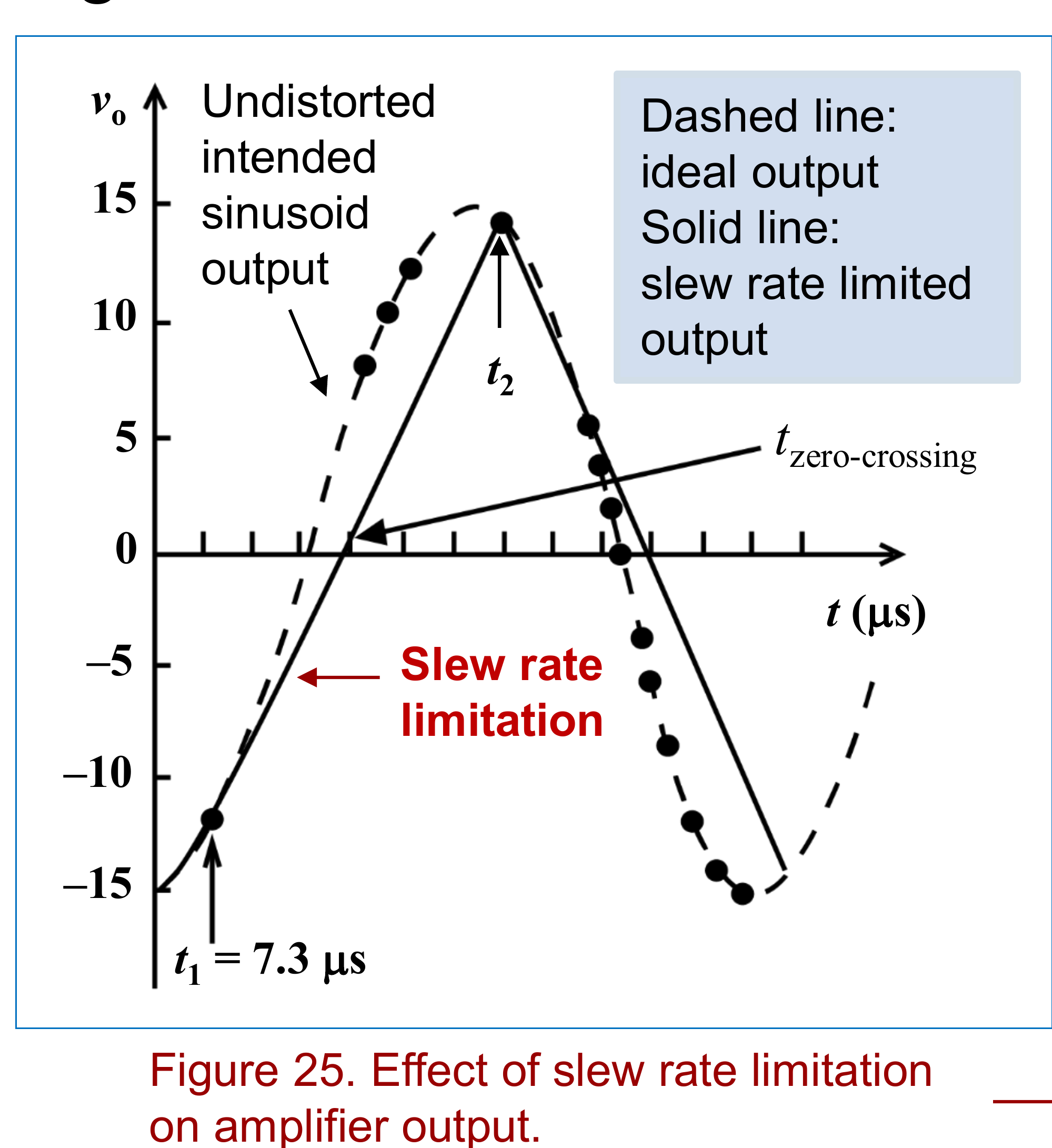
Slew rate is a large-signal limit. The small-signal speed limit is set by the gain-bandwidth product.