Source
Adapted from my own handwritten and hand-typed notes from Year 1 to Year 3 of my EEE degree
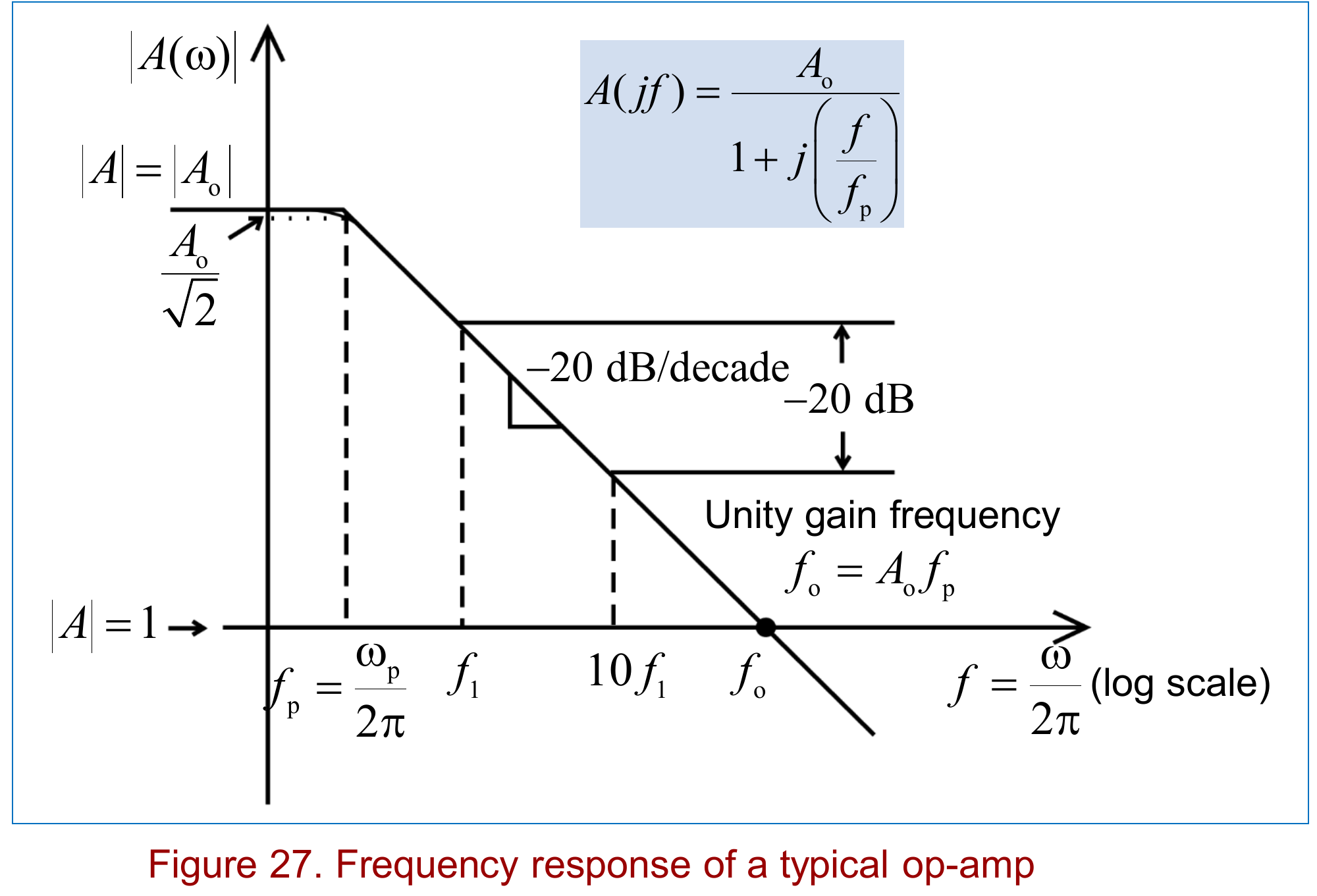
An ideal op-amp has a flat gain at all frequencies. A real op-amp has a dominant pole at a low frequency (usually below 1 kHz), so its open-loop gain is a first-order low-pass response.
Open-Loop Response
Key points:
- flat at for , down 3 dB at
- above the gain falls at dB/decade
- bandwidth in general is , measured between the points
Unity-Gain Frequency
Set :
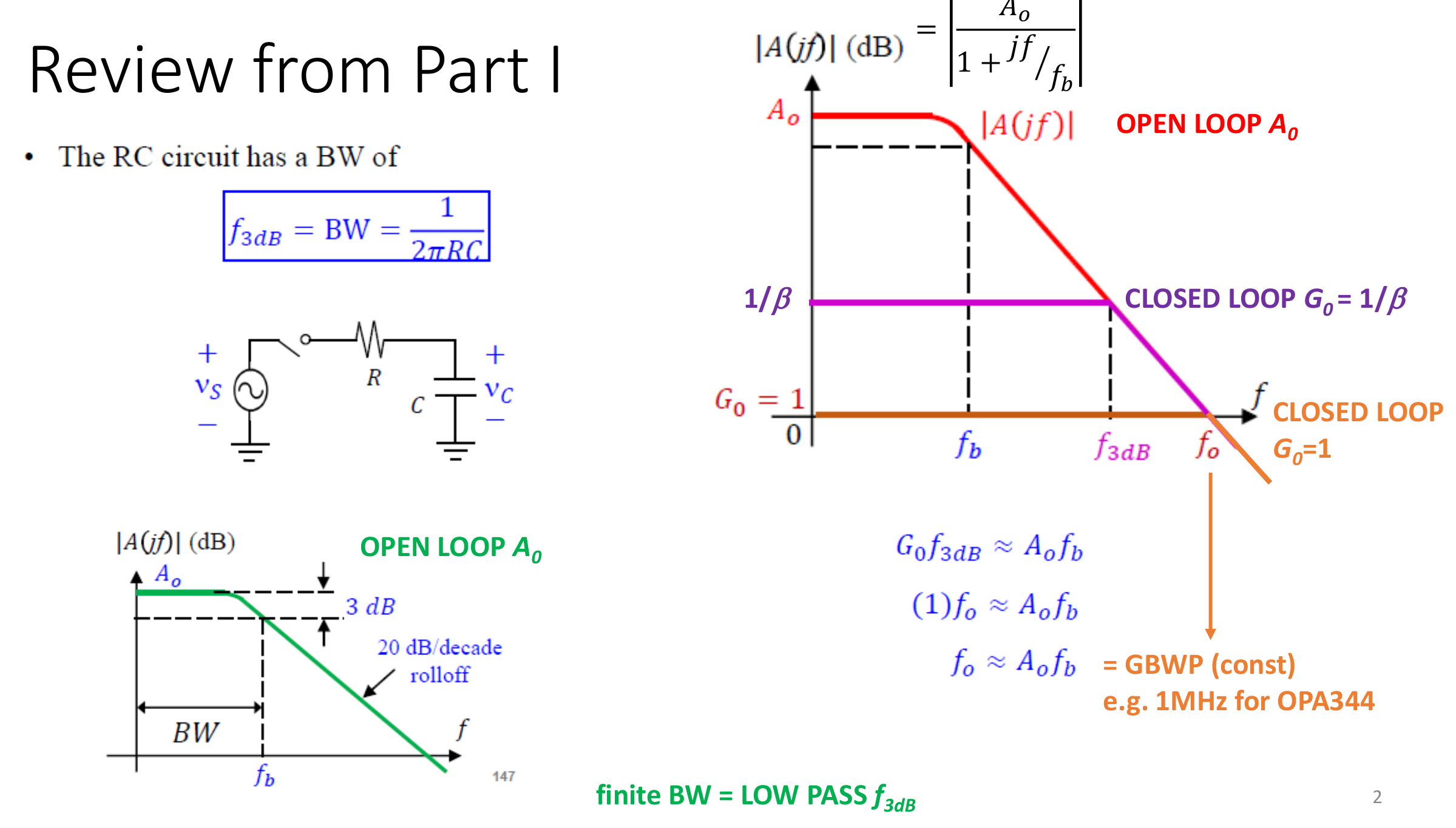
is the gain-bandwidth product (GBW). It is a constant of the op-amp, for example about 1 MHz for the OPA344.
Closed-Loop Bandwidth
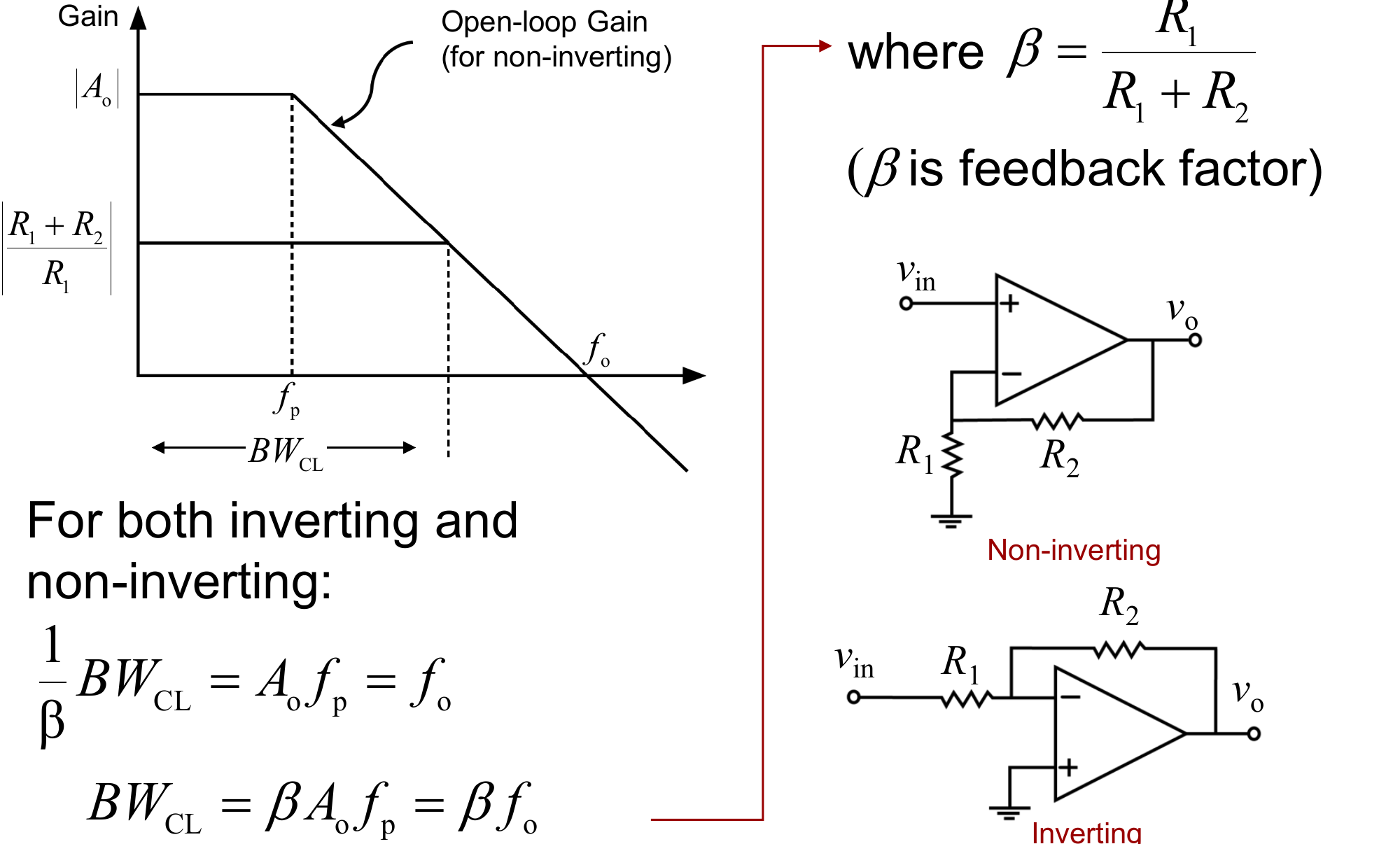
With feedback factor
the non-inverting gain is and the inverting gain is . For both configurations the closed-loop bandwidth is
So gain is traded for bandwidth: the higher the closed-loop gain, the lower the bandwidth.
Worked Example
Op-amp with MHz:
- non-inverting gain of 10 means , so kHz
- inverting gain of also has , so kHz as well
- a voltage follower () gets the full 1 MHz
Bandwidth also sets how fast the output can follow a step, see Rise Time and Bandwidth.