Source
Adapted from my own handwritten and hand-typed notes from Year 1 to Year 3 of my EEE degree
A real op-amp gives a non-zero output even when both inputs are at the same voltage, because its internal circuit is not perfectly balanced. An ideal op-amp has .
Definition
The input offset voltage is the negative of the DC voltage that must be applied between the inputs to force under open-loop conditions.
Properties:
- it can be positive or negative depending on the device
- it changes with temperature
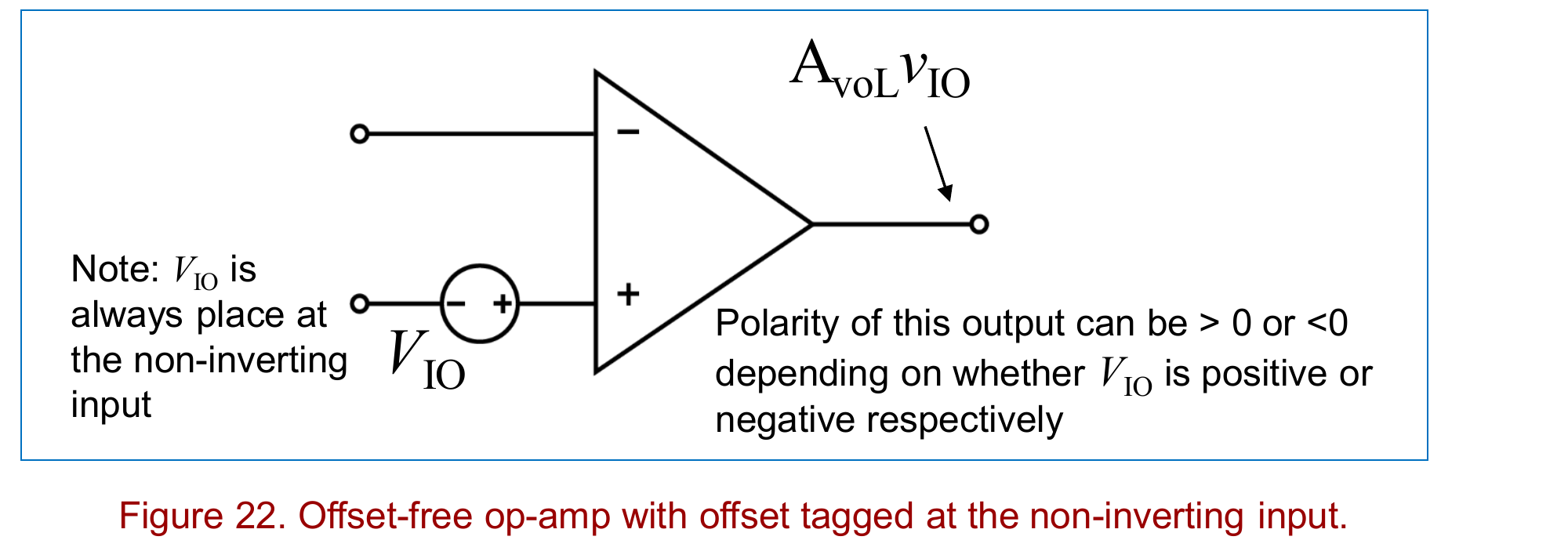
- the output offset voltage (open loop) is , and its polarity follows the sign of
Model
Treat the op-amp as offset free and add a DC source in series with the non-inverting input. Because it sits on an input pin, it is amplified by the non-inverting gain in every negative feedback circuit, even an inverting amplifier:
Worked Example 1: Inverting Amplifier
Gain (), input V DC, measured output V.
Steps:
- expected output V
- extra output V
- offset gain , so mV and mV
Worked Example 2: Non-Inverting Amplifier
Gain , input V DC, measured output V, data sheet limit mV.
Steps:
- expected output V
- difference V
- offset gain is also , so mV, which is outside the specification
The other DC error source is the input bias current.