Source
Adapted from my own handwritten and hand-typed notes from Year 1 to Year 3 of my EEE degree
Superposition, source transformation and the Thevenin and Norton theorems all work in the phasor domain, since AC circuits with fixed frequency are linear.
Superposition
At a single frequency, superposition works exactly as for DC: turn off all but one independent source, solve, and add the phasors.
When sources have different frequencies:
- solve a separate phasor circuit for each frequency, since the impedances change with
- convert each answer back to the time domain
- add the time-domain responses, never the phasors (phasors at different frequencies cannot be added)
- a DC source is the case : inductors become shorts and capacitors become opens
Example: for the mesh circuit with a 2090° V source and a 5 A source, A (voltage source alone) and A (current source alone), so A, the same as mesh analysis.
Source Transformation
A voltage source in series with becomes a current source in parallel with .
Thevenin and Norton Equivalents
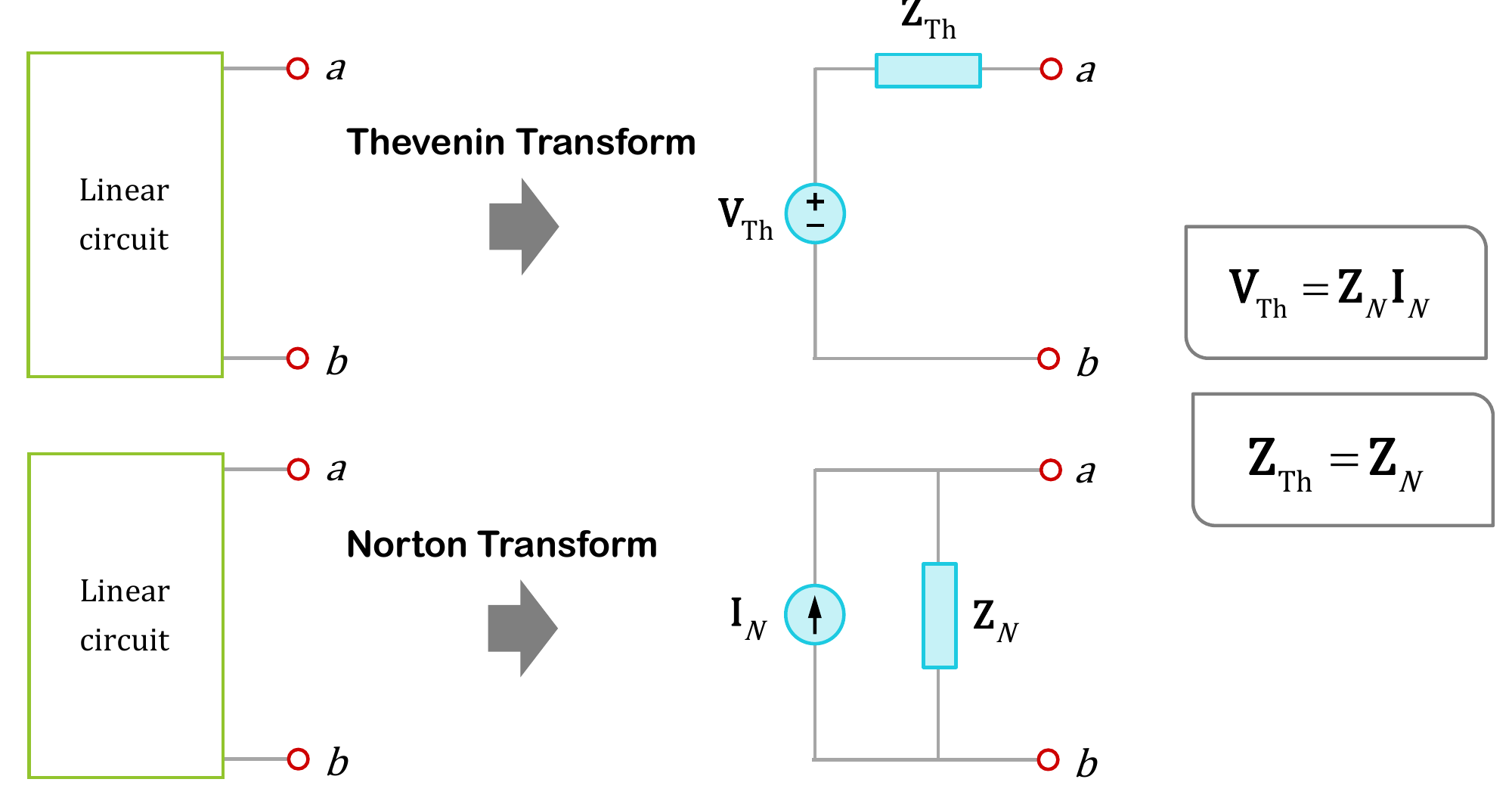
is the open-circuit voltage, the short-circuit current, and the impedance seen at the terminals with independent sources off (or found with a test source if there are dependent sources). Unlike , depends on frequency.
Worked Example
A 12075° V source feeds two branches between the same nodes: 8 in series with , and 4 in series with . Terminal a is taken between 8 and , terminal b between 4 and . Steps:
- source off:
- branch currents: and
- KVL around the loop through a and b: V
The Thevenin equivalent is also the starting point for Maximum Average Power Transfer.