Source
Adapted from my own handwritten and hand-typed notes from Year 1 to Year 3 of my EEE degree
Sinusoidal steady-state analysis uses the same methods as DC circuits, but with phasors and impedances.
Basic Approach
Steps:
- Transform the circuit to the phasor (frequency) domain: sources become phasors, becomes , becomes
- Solve using nodal analysis, mesh analysis, superposition or any other method, with complex arithmetic
- Transform the answer back to the time domain
Nodal Analysis Example
Find for a 20 cos 4t V source, 10 , 1 H, 0.1 F, 0.5 H and a dependent source , where is the capacitor current. With :
- 1 H becomes , 0.5 H becomes , 0.1 F becomes
- KCL at node 1: , giving
- KCL at node 2 with : , giving
- Cramer's rule: V and V
- A, so A
Mesh Analysis Example
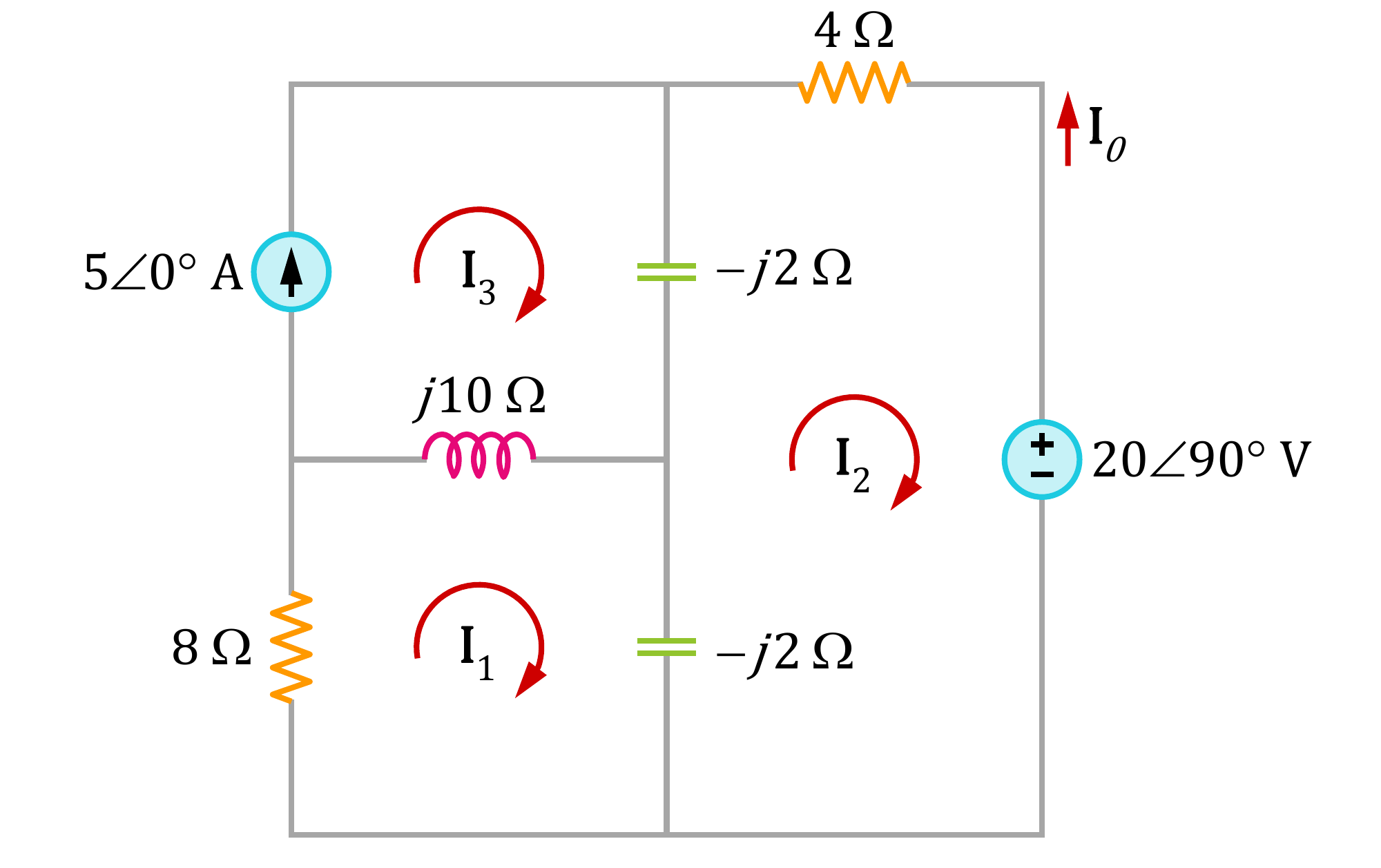
Find :
- mesh 3 contains only the current source, so A
- mesh 1: , which simplifies to
- mesh 2: , which simplifies to
- Cramer's rule: A
- A
Op-Amps in AC Circuits
The ideal op-amp rules still apply (no input current, equal input voltages), so nodal analysis at the input nodes works as usual with impedances. For example, a two-stage RC network around an op-amp driven by V gives V.
The circuit theorems also carry over, covered in AC Network Theorems.