Source
Adapted from my own handwritten and hand-typed notes from Year 1 to Year 3 of my EEE degree
A phasor is a complex number that holds the amplitude and phase of a sinusoid. With phasors, a sinusoidal circuit can be solved with algebra instead of differential equations.
Definition
Using Euler's identity :
The term (the sinor) is a vector of length rotating anticlockwise at rad/s. is its projection on the real axis. The phasor is a snapshot of it at .
Leading and Lagging Phasors
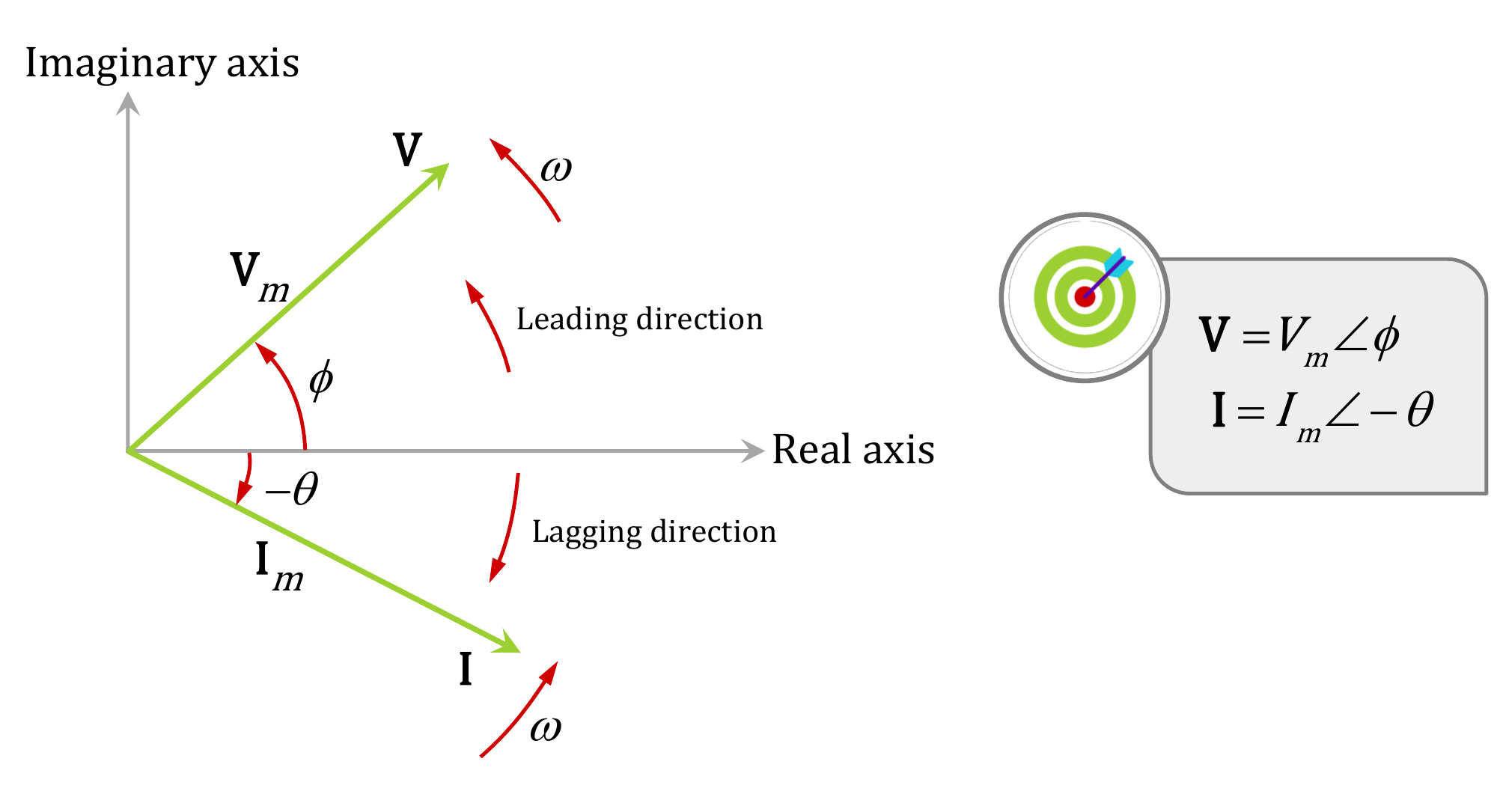
On a phasor diagram, a phasor at (anticlockwise from the real axis) is leading, and one at is lagging.
Complex Number Forms
A complex number can be written as:
- rectangular:
- polar: , with and
- exponential:
- back to rectangular: ,
Complex Number Operations
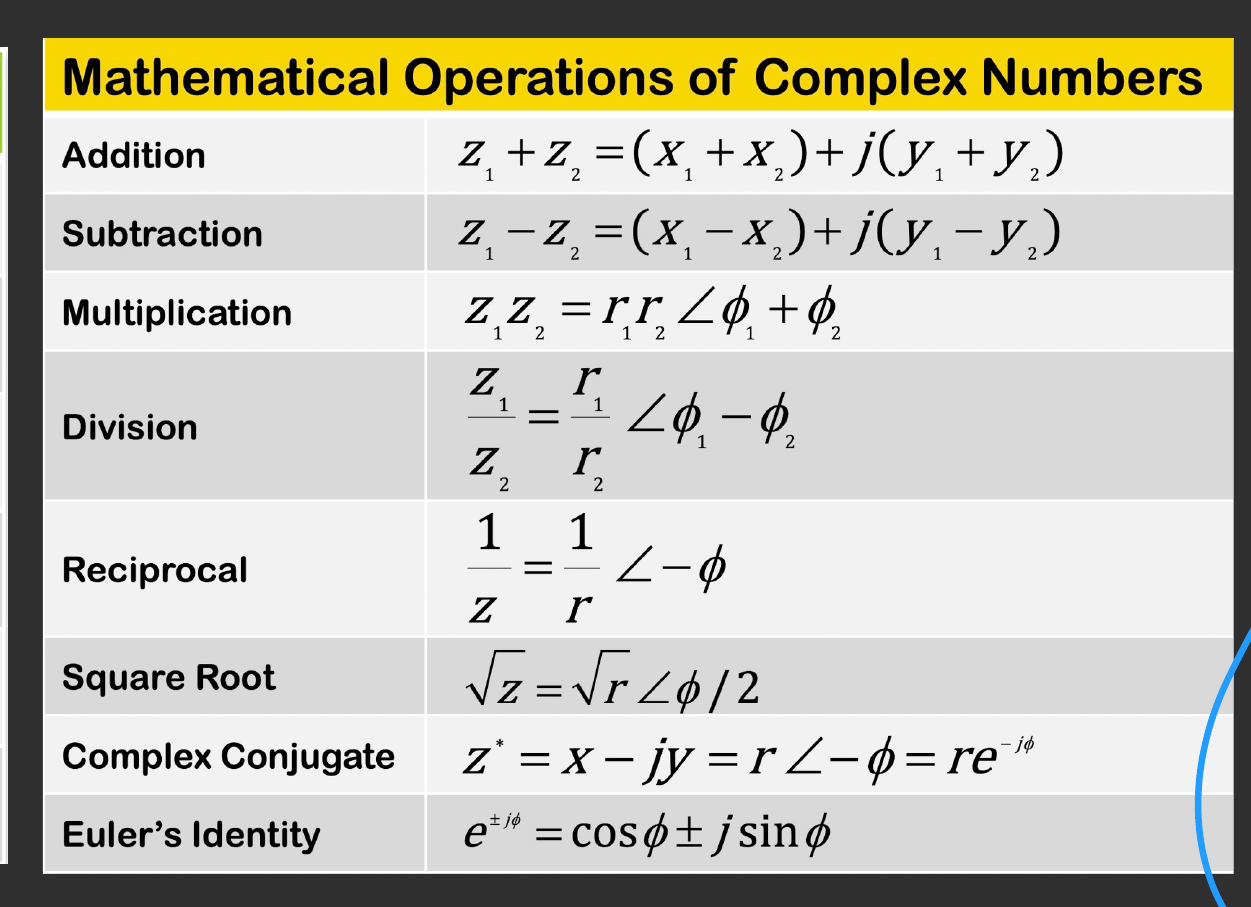
Add and subtract in rectangular form, multiply and divide in polar form.
Transforming
| Time domain | Phasor domain |
|---|---|
Always convert to cosine form first. The phasor drops the , so phasor analysis only works when every source has the same frequency. is real and time-dependent, while is complex and does not depend on time.
Derivatives and Integrals
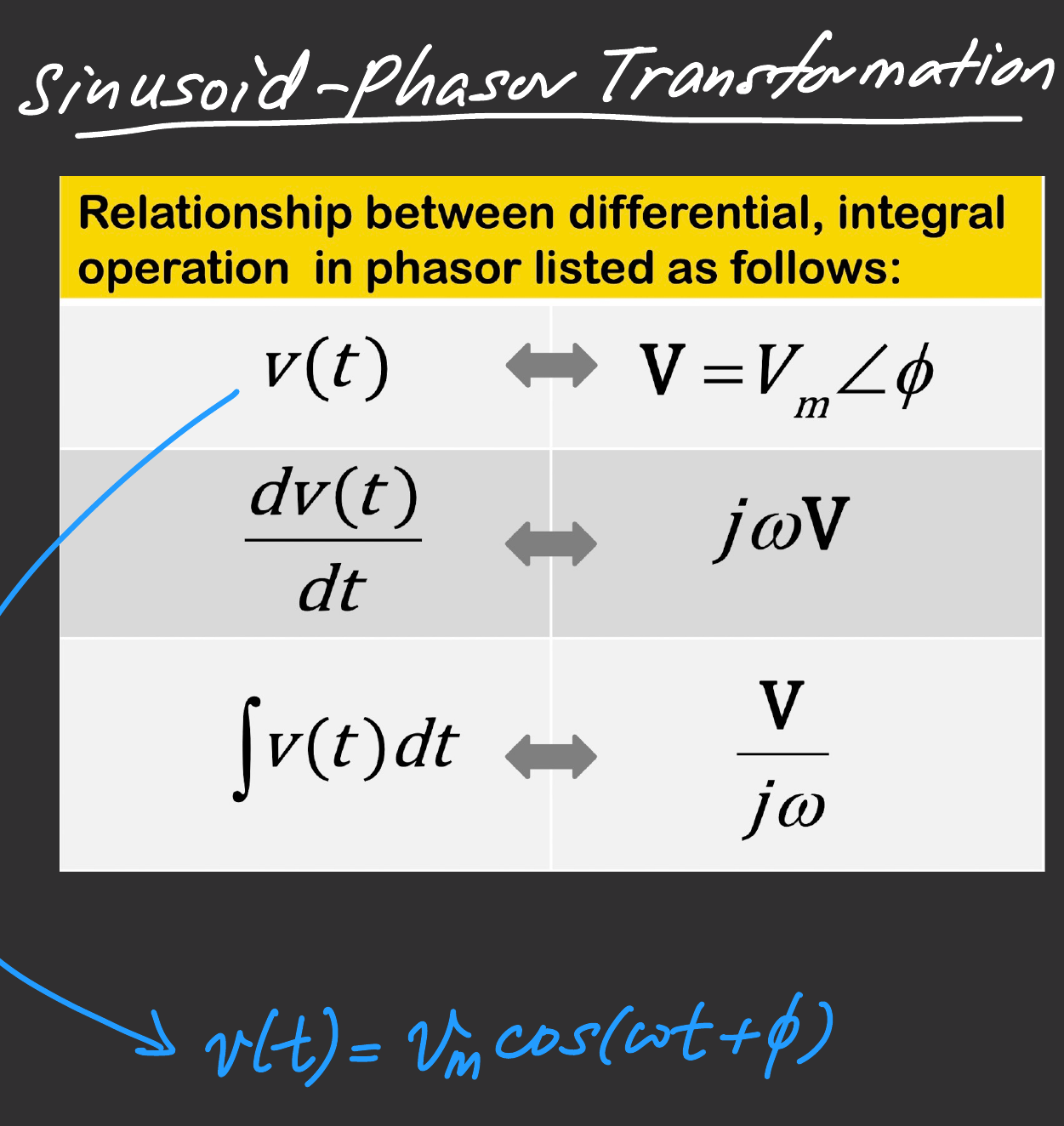
Differentiating multiplies the phasor by (a shift), and integrating divides by .
Worked Example
Convert to phasors:
- A becomes A
- V: since , , so V
Phasors applied to R, L and C give the Phasor Relationships for Circuit Elements.