Source
Adapted from my own handwritten and hand-typed notes from Year 1 to Year 3 of my EEE degree
A sinusoid is a signal in the form of a sine or cosine. Sinusoidal current is called alternating current (AC), and circuits driven by sinusoids are AC circuits. Sinusoids matter because nature is often sinusoidal, they are easy to generate and transmit, and any periodic signal can be built from them (Fourier).
General Form
Terms:
- : amplitude
- : angular frequency in rad/s
- : argument
- : phase in degrees or radians
- : period in seconds, the time for one cycle, with
- : frequency in Hz, so
Leading and Lagging
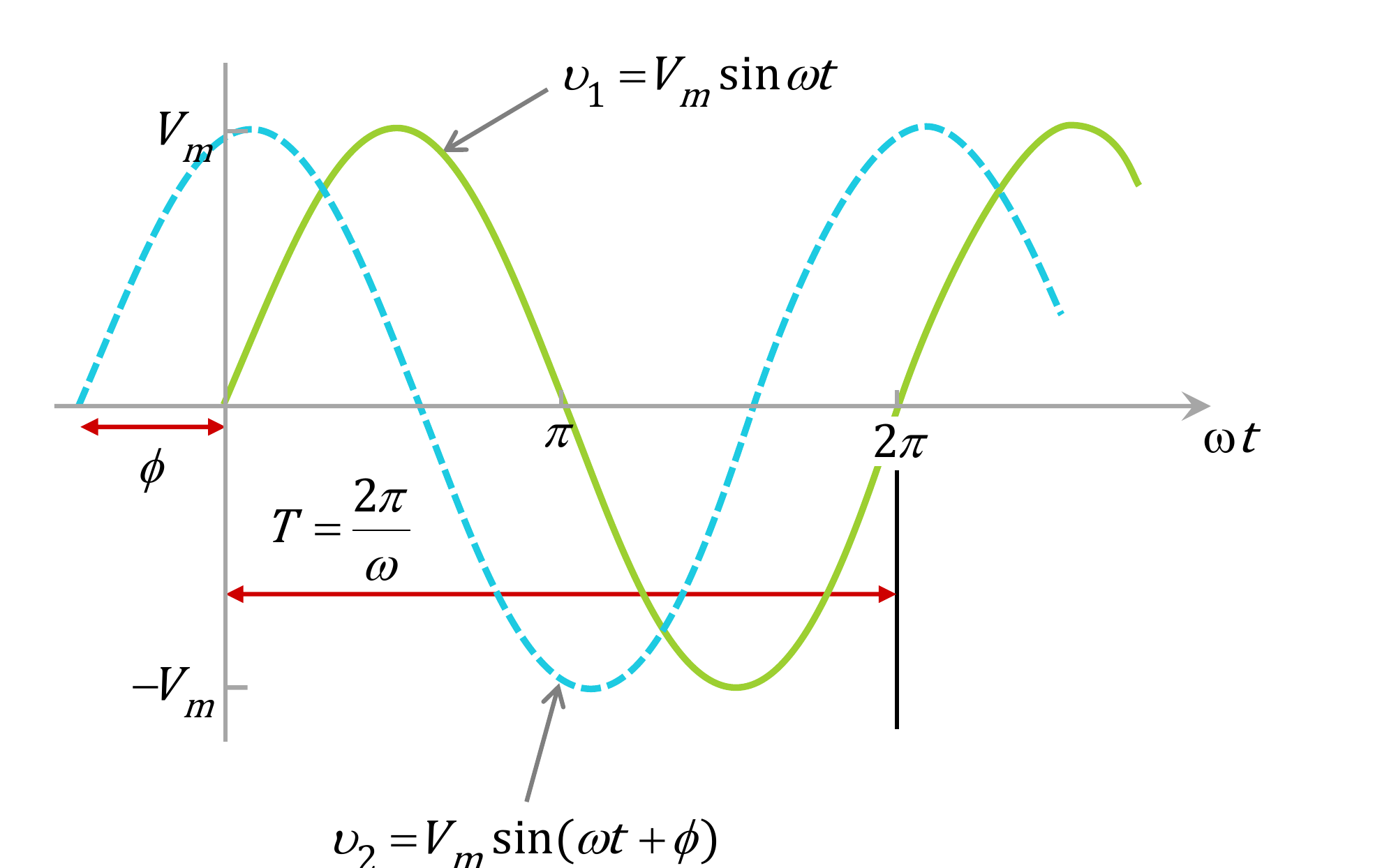
For and , reaches its peak first, so leads by (and lags by ). If they are in phase, otherwise out of phase.
Rules for comparing:
- only sinusoids of the same frequency can be compared
- write both in the same function (both cosine or both sine) with positive amplitudes
Useful identities:
- and
- and
Worked Example 1
For :
- amplitude 5, phase , rad/s
- s and Hz
Worked Example 2
Compare and :
- so leads by
Working with these directly is messy, which is why Phasors are used.