Source
Adapted from my own handwritten and hand-typed notes from Year 1 to Year 3 of my EEE degree
All four parameter sets describe the same network, so one set can be converted into another (when it exists). The notation is the determinant of , and similarly for , and .
z and y
Since and , the two matrices are inverses:
Conversion Table
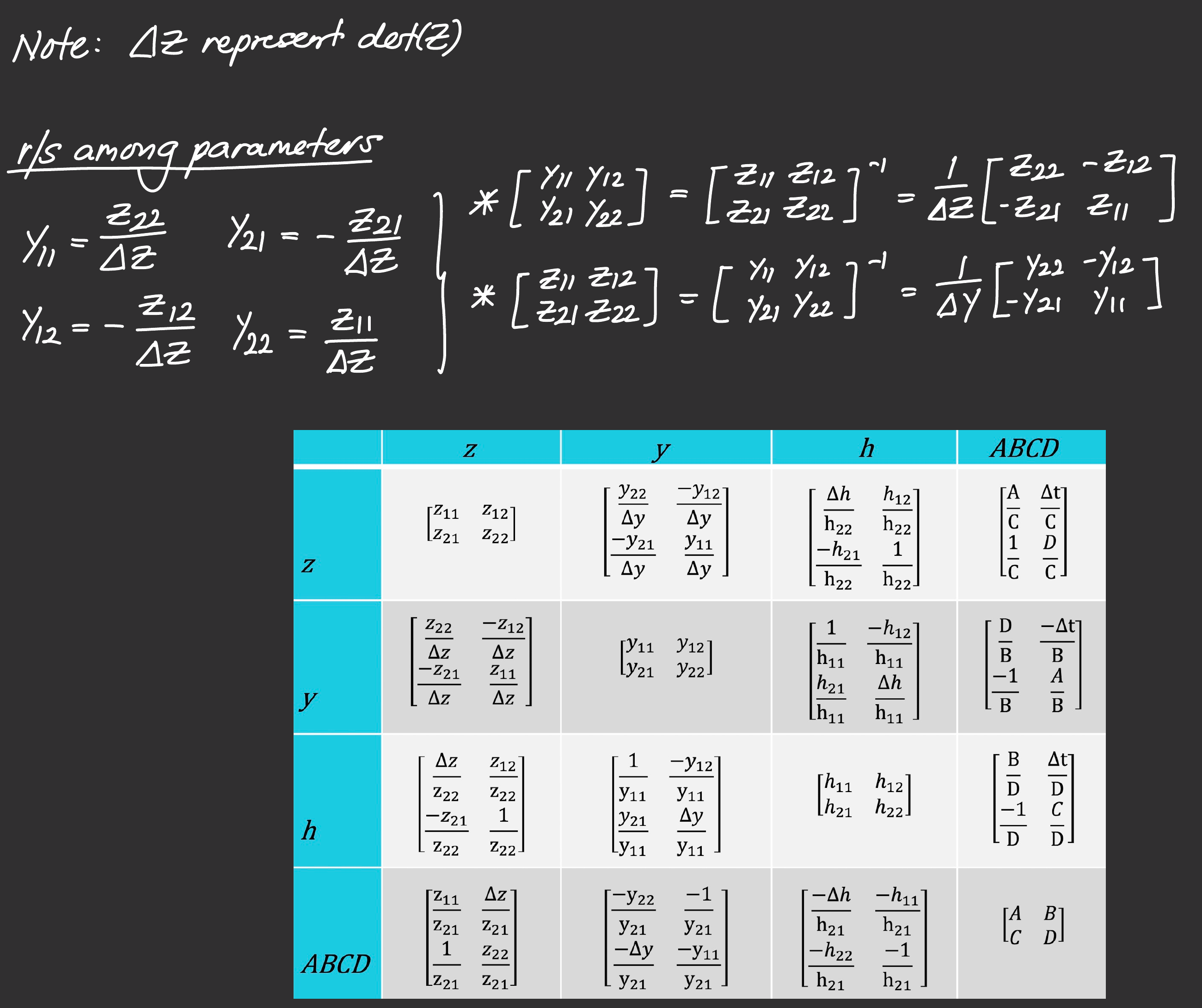
Read across a row to express that set in terms of the column set. For example, the row under gives , , , . A parameter set does not exist if its formula needs division by zero (for example no parameters if ).
Reciprocal and Symmetrical Networks
A network is reciprocal if swapping the source and the meter between the ports gives the same reading. Any network made only of R, L, C (and coupled coils) is reciprocal; dependent sources usually break this. A network is symmetrical if the ports can be swapped without changing the port voltages and currents.
Reciprocity and Symmetry Conditions
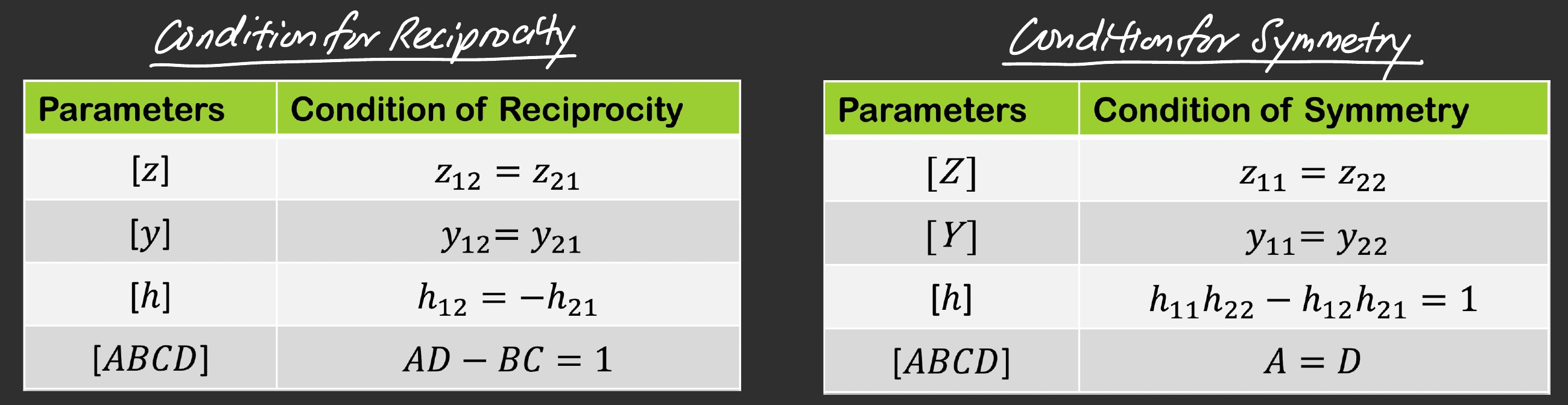
| Parameters | Reciprocal if | Symmetrical if |
|---|---|---|
A symmetrical network is always reciprocal as well, and a reciprocal network needs only three independent parameters.
Worked Example
The T network with 3 and 4 arms and a 2 leg has , so it is reciprocal. Since , it is not symmetrical. Converting, S, which matches the direct result. Back to the overview in Two-Port Networks.