Source
Adapted from my own handwritten and hand-typed notes from Year 1 to Year 3 of my EEE degree
A large network can be seen as simple two-port blocks joined together, and a design can be built by connecting simple blocks. Three connections are studied, and each has one parameter set that makes it easy.
Series, Parallel and Cascade Connections
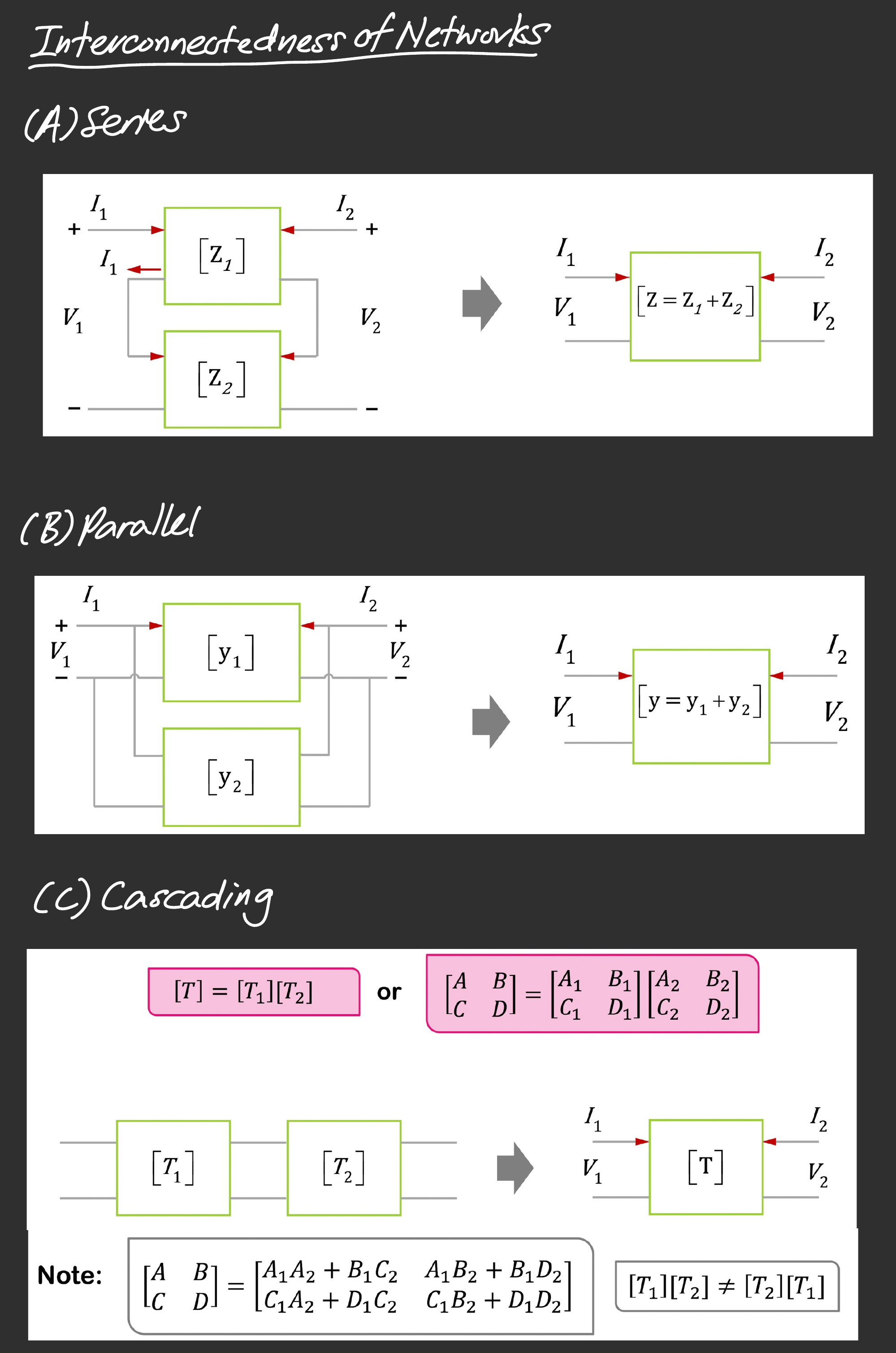
Series Connection
The input ports are in series and the output ports are in series, so both networks carry the same and the same . The voltages add, so the matrices add:
Parallel Connection
The input ports are in parallel and the output ports are in parallel, so both networks share and . The currents add, so the matrices add:
Cascade Connection
The output port of the first network feeds the input port of the second, as with two transmission lines in a row. The output of stage 1 is the input of stage 2, so the matrices multiply in order:
Matrix multiplication is not commutative, , so the order of the stages matters.
Port Condition
The simple add or multiply rules only hold if every port still satisfies the port condition (current in equals current out) after connection:
- series and parallel rules hold for common-ground two-ports connected with their ground terminals tied together
- the cascade rule always holds, whether or not the blocks share a common ground
Worked Example
Two identical series-arm blocks, each a single 2 series resistor, have , , , . Cascading:
which is a single 4 series resistor, as expected. Converting the result to other sets uses Two-Port Parameter Conversion.