Source
Adapted from my own handwritten and hand-typed notes from Year 1 to Year 3 of my EEE degree
A network function (or transfer function) relates one chosen output of a circuit to one input, without solving for every voltage and current.
Definition
where is the Laplace transform of the output and of the input, with all initial conditions zero. Its inverse is the impulse response.
Four Types of Transfer Function
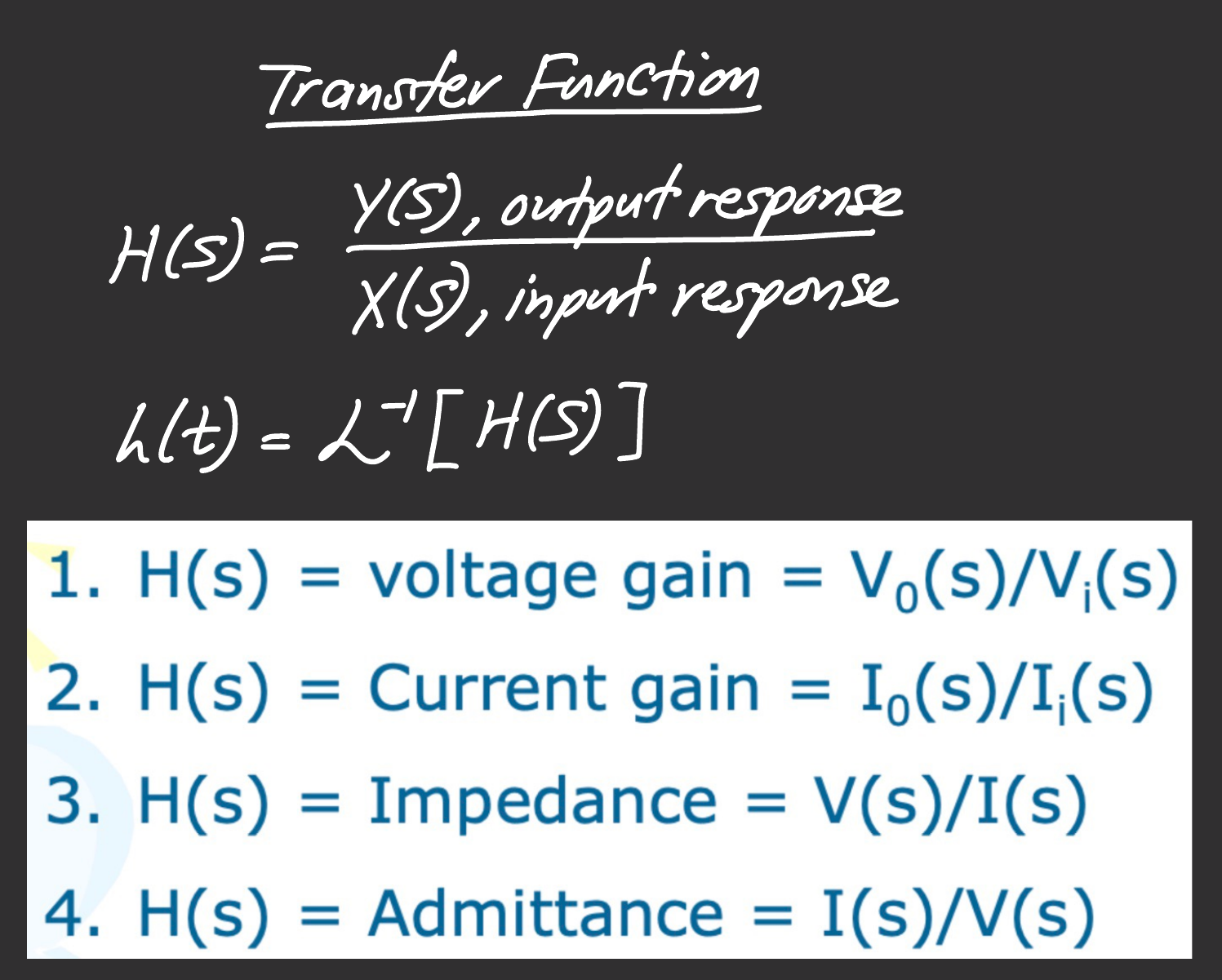
Since the input and output can each be a voltage or a current, there are four types:
- voltage gain
- current gain
- transfer impedance
- transfer admittance
The same circuit has different network functions for different choices of output.
Driving Point Functions
If the response is measured at the same port where the input is applied, the function is a driving point function.
Driving Point Impedance and Admittance
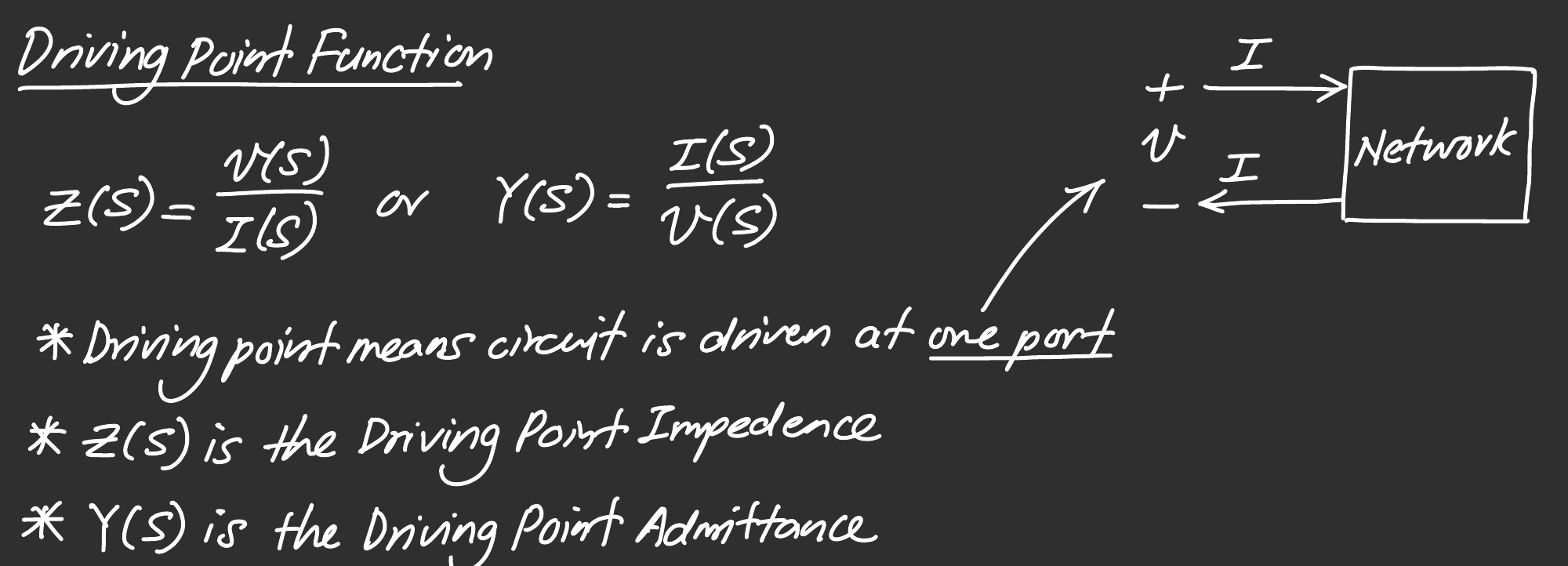
Two kinds:
- driving point impedance
- driving point admittance
For a two-port network the transfer functions link one port to the other, for example , , and .
Worked Example 1
For an RC low-pass circuit with output across :
If the output is the current instead, .
Worked Example 2
For a series RLC circuit with input and output current :
Finding H from Measured Response
If input gives output , then
so .
The behaviour of is described compactly by its Poles and Zeros of Network Functions.