Source
Adapted from my own handwritten and hand-typed notes from Year 1 to Year 3 of my EEE degree
Instead of writing a differential equation and then transforming it, the whole circuit can be transformed into the s-domain first. All the DC methods (nodal, mesh, superposition, source transformation, Thevenin, Norton) then work directly with -domain impedances.
Steps
- Find the initial capacitor voltages and inductor currents at (DC steady state before switching) if they are not given
- Transform every element and source into the s-domain, including the initial conditions
- Solve with any circuit technique
- Take the inverse Laplace transform to get the time response
Element Models
| Element | Time domain | s-domain (with initial condition) | Impedance (zero IC) |
|---|---|---|---|
| Resistor | |||
| Inductor | |||
| Capacitor |
Capacitor Model
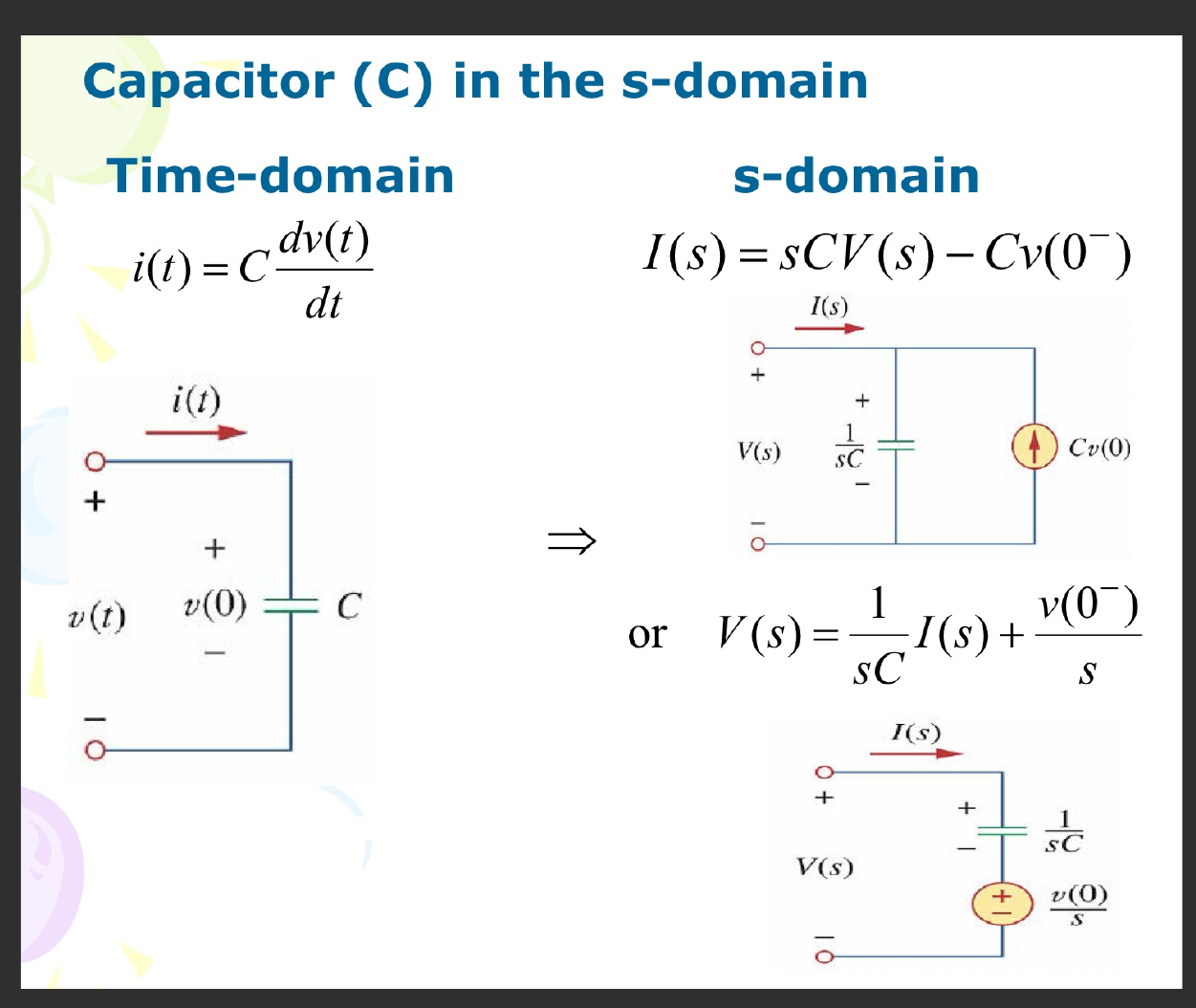
A charged capacitor becomes either:
- impedance in parallel with a current source , or
- impedance in series with a voltage source , with its terminal on the same side as the capacitor's
Inductor Model
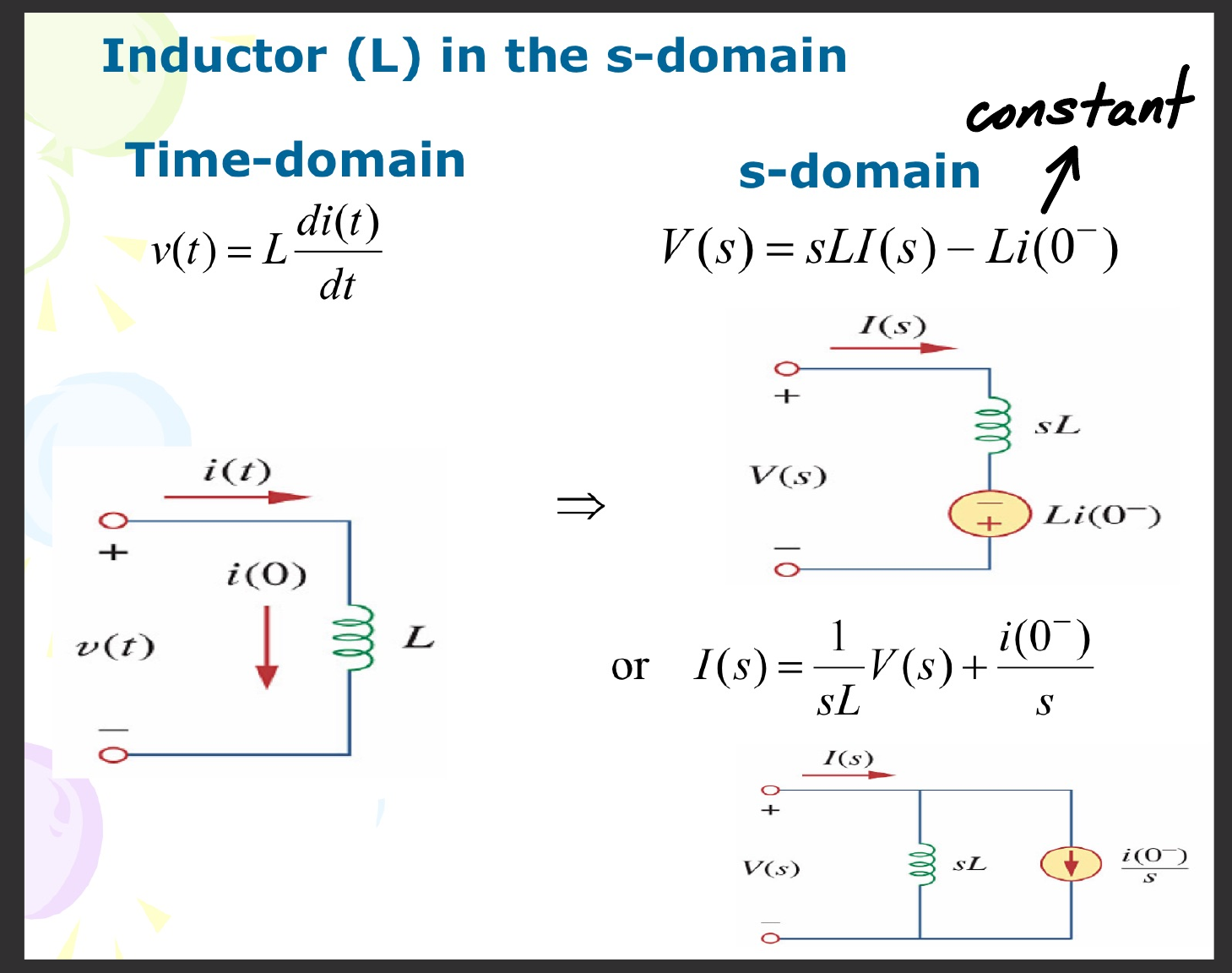
An inductor with initial current becomes either:
- impedance in series with a voltage source (a constant in ), opposing the current direction, or
- impedance in parallel with a current source pointing in the same direction as
Use the series forms for mesh analysis and the parallel forms for nodal analysis.
Worked Example
A source V drives a 1 resistor in series with a 1 F capacitor that has V. Using the series capacitor model, KVL gives
So V, which matches the first-order step formula. The initial and final value theorems give the quick check V and V.
With zero initial conditions, the ratio of output to input in the s-domain is the Transfer Function.