Source
Adapted from my own handwritten and hand-typed notes from Year 1 to Year 3 of my EEE degree
A transfer function is a ratio of two polynomials in (a rational function):
Definitions
Terms:
- zeros : roots of , where
- poles : roots of , where
- gain constant : the leading coefficient ratio
- order: the larger of (numerator degree) and (denominator degree)
Poles, zeros and fully describe .
Pole-Zero Plot
Poles and zeros are plotted on the complex s-plane, , with zeros marked "o" and poles marked "x".
Left and Right Half Planes
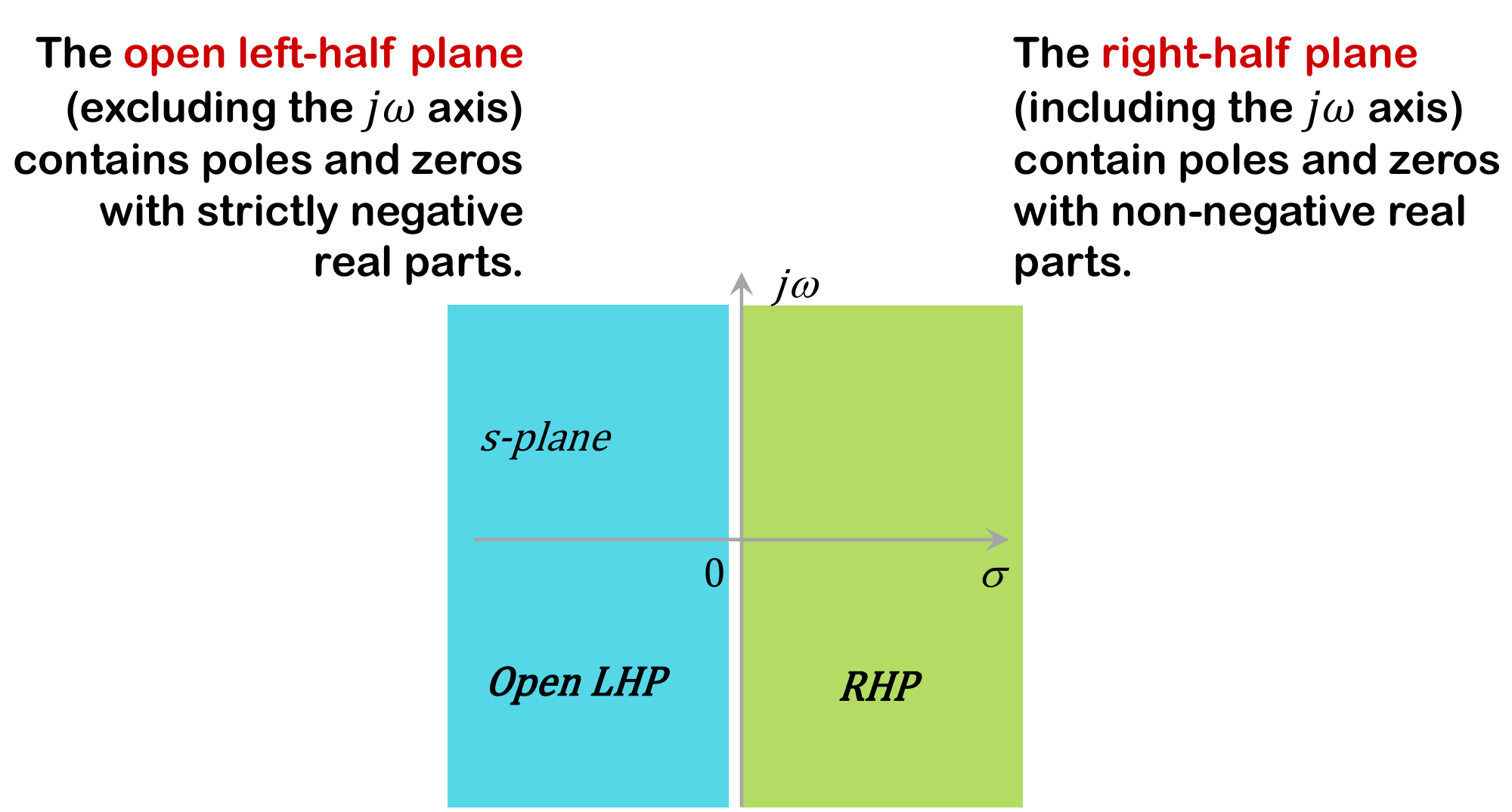
Regions:
- open left half plane (LHP): strictly negative real part, (does not include the axis)
- right half plane (RHP): non-negative real part, (includes the axis)
Complex poles and zeros of a real circuit always come in conjugate pairs, so the plot is symmetric about the real axis.
Worked Example
For
Reading it off:
- zero at
- poles at , and (from )
- order 4, gain constant
Why Poles Matter
Each pole produces one term in the partial fraction expansion of the response, so the pole positions decide the shape of the time response, which leads to the Natural and Forced Response.