Source
Adapted from my own handwritten and hand-typed notes from Year 1 to Year 3 of my EEE degree
A circuit is stable (bounded-input bounded-output, BIBO) if every bounded input gives a bounded output. A waveform is bounded if for all : for example , and are bounded, but is not.
Stability Criterion
Key idea
A circuit is stable if and only if all poles of its transfer function lie in the open left half plane (strictly negative real parts, not on the axis).
Then every natural response term decays to zero.
Other cases:
- any pole in the RHP gives a growing term, so the circuit is unstable
- simple poles on the axis give a constant oscillation and are called marginally stable, but an input at that same frequency causes resonance with a term that grows without bound, so they count as unstable
- repeated poles on the axis are unstable
Response Types
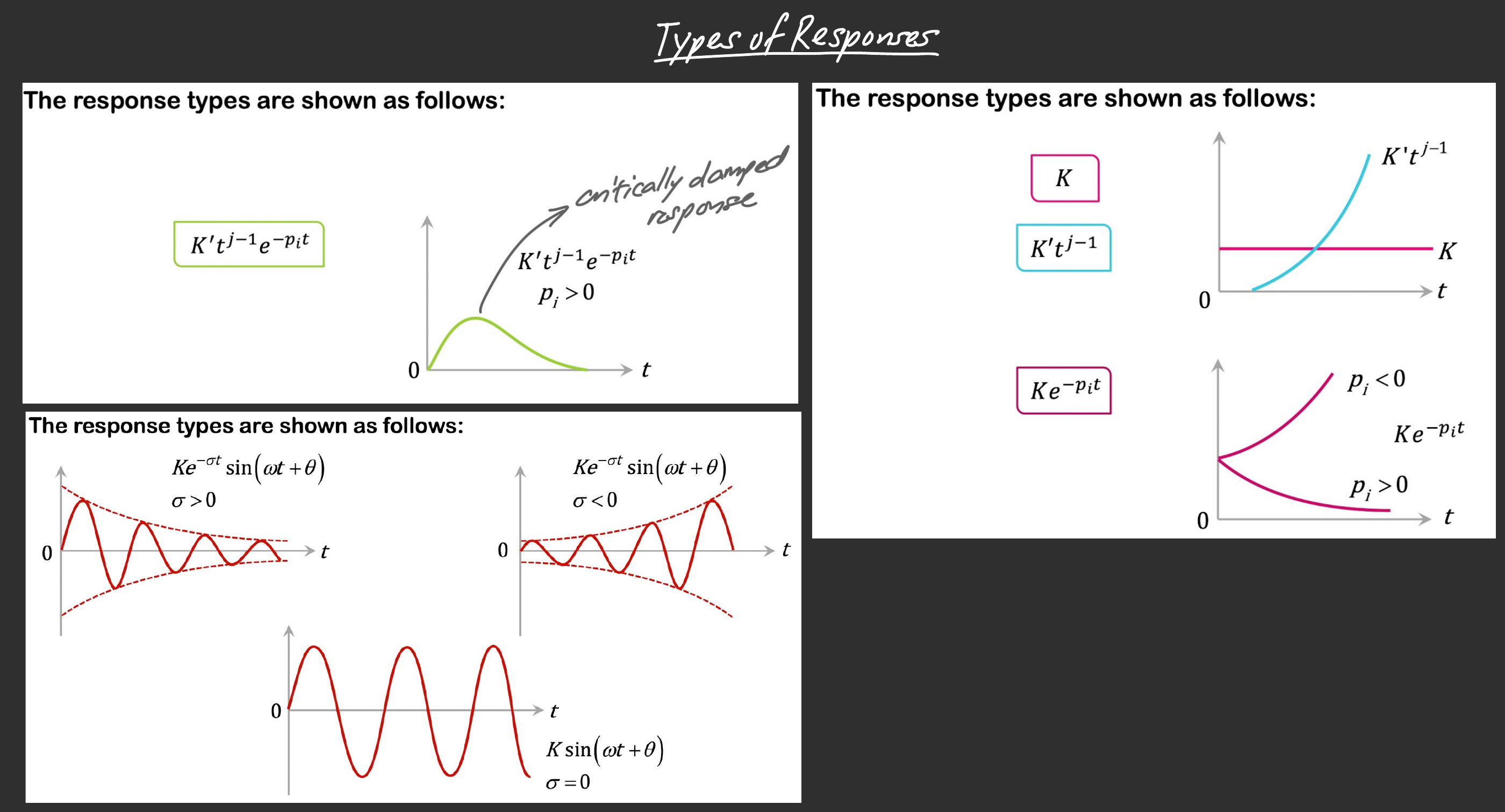
Stable responses are grouped by the poles of :
- overdamped: all poles real, negative and distinct
- critically damped: all poles real and negative, with at least two equal (gives terms)
- underdamped: all poles in the open LHP with at least one complex conjugate pair (decaying oscillation)
Passive and Active Networks
Passive networks (only R, L, C) are always stable, since they cannot create energy. Active networks with controlled sources may be unstable.
Example: an RC circuit with a VCVS of gain has
The pole is at . It is in the open LHP only if , so the circuit is stable for and unstable for .
Impulse Response Test
Since is made only of natural terms, a stable circuit has . More on this in Impulse Step and AC Steady-State Response.