Source
Adapted from my own handwritten and hand-typed notes from Year 1 to Year 3 of my EEE degree
For an input and transfer function , the output is
so the poles of come from two places: the poles of and the poles of .
Splitting the Response
If all poles are simple:
Time Response from Pole-Zero Plot
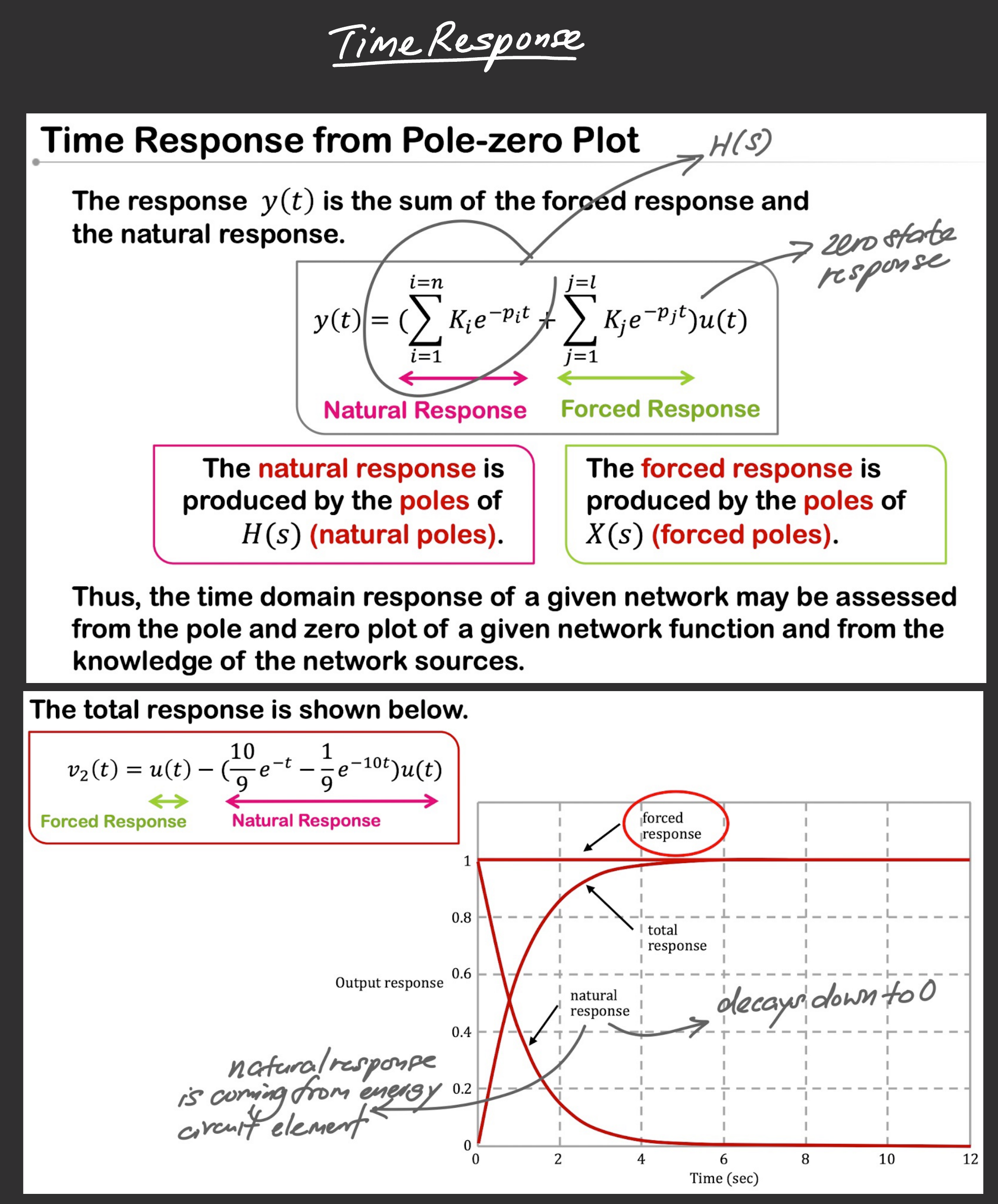
Two parts:
- natural response: produced by the poles of (natural poles), its form depends only on the circuit and comes from energy in the circuit elements
- forced response: produced by the poles of (forced poles), it looks like the input
- this total is the zero-state response, since initial conditions are zero
- resonance happens when a pole of equals a pole of , giving repeated poles and terms like that can grow
So the time response can be predicted from the pole-zero plot and the type of source.
Response Shape by Pole Location
| Pole(s) of | Time term | Behaviour |
|---|---|---|
| real, , (open LHP) | exponential decay | |
| real, (RHP) | exponential growth | |
| constant | step | |
| complex, , | decaying oscillation | |
| complex, | growing oscillation | |
| on axis, | constant oscillation | |
| repeated, | decays if , grows if |
For any pattern of poles, the total response is the sum of the terms from each pole.
Worked Example
A unit step into gives
The natural part dies away, leaving the forced part. Whether the natural part always dies away is the question of Stability of Circuits.