Source
Adapted from my own handwritten and hand-typed notes from Year 1 to Year 3 of my EEE degree
A first-order circuit has one energy storage element (or its equivalent) and is described by a first-order differential equation. The natural response is how the circuit behaves with no external source, driven only by the energy stored at .
Source-Free RC Circuit
A charged capacitor discharges through . KCL at the top node, :
RC Discharge Derivation
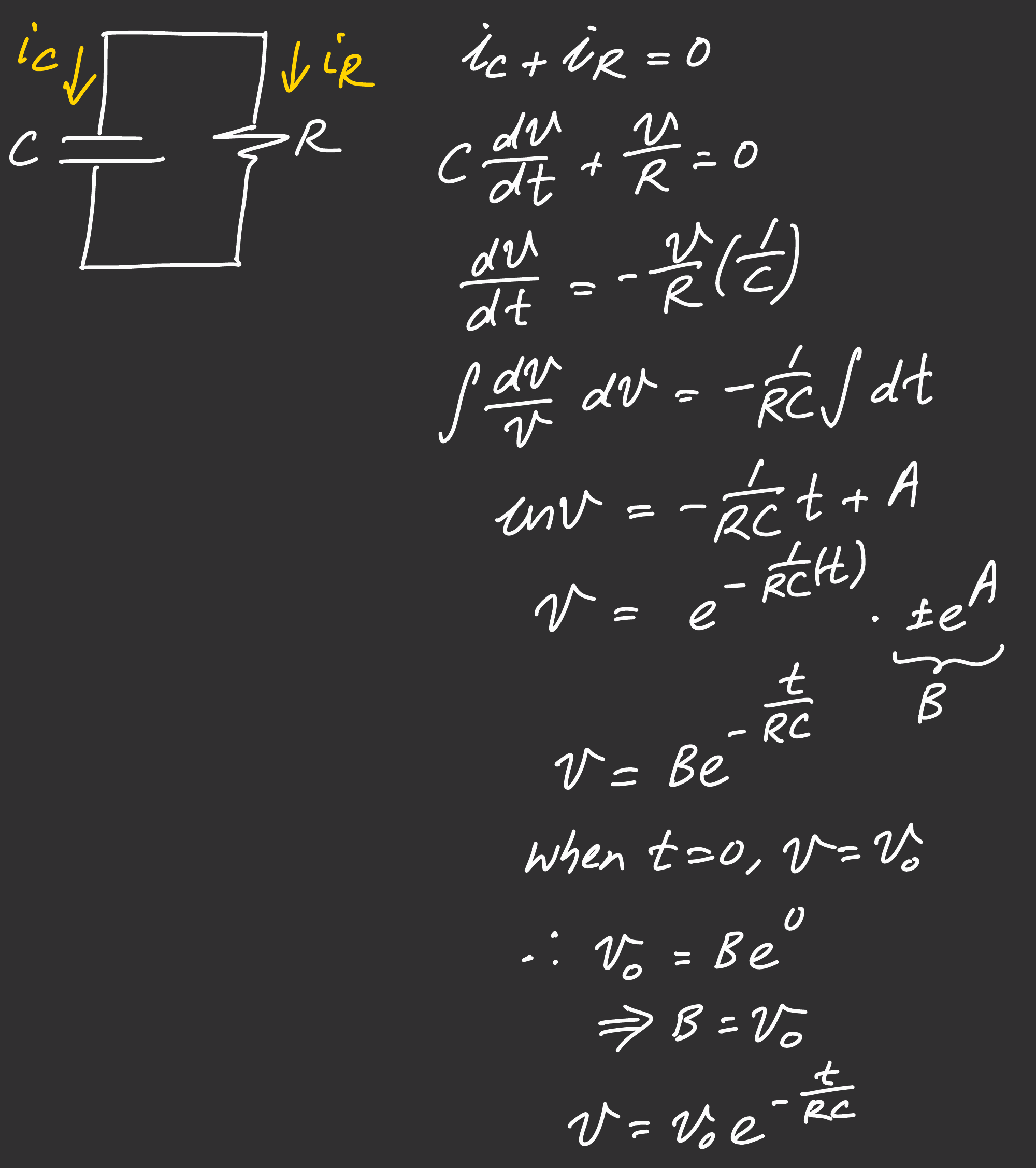
Separating variables and integrating gives , and with :
Source-Free RL Circuit
An inductor with current releases its energy into . KVL, :
Time Constant
The time constant is the time for the response to fall to (36.8%) of its initial value.
Time Constant Curves
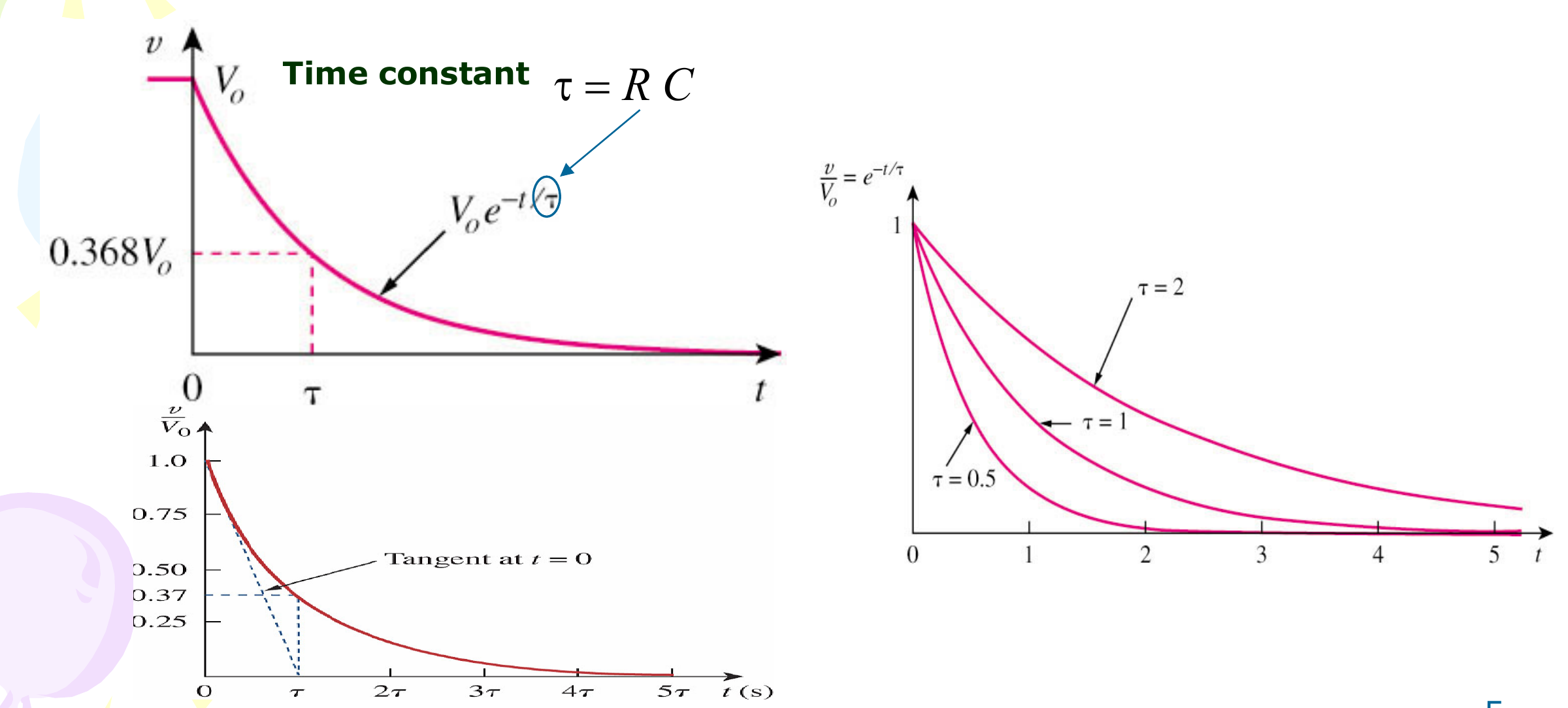
Key facts:
- small means a fast decay, large means a slow decay
- the tangent at hits zero at
- after about the response is under 1%, so the element is treated as fully discharged
- is the Thevenin resistance seen by the capacitor or inductor, not just one resistor
Method
Two things are needed:
- The initial value (capacitor) or (inductor), using DC steady state and continuity at switching
- The time constant, or
Worked Example
A capacitor of 0.1 F with V sees an equivalent resistance of 5 after the switch:
- s
- V for
- after s, V
The case with a source switched on is the Step Response of First Order Circuits.