Source
Adapted from my own handwritten and hand-typed notes from Year 1 to Year 3 of my EEE degree
Linearity
A circuit is linear if it has both properties:
- scaling (homogeneity): multiplying the input by multiplies the output by
- additivity: the response to a sum of inputs is the sum of the individual responses
A linear circuit contains linear elements (R, L, C), linear dependent sources (proportional to the first power of some or ) and independent sources. For example, if , then A gives 20 V and A gives 40 V.
Superposition Principle
The voltage across (or current through) an element in a linear circuit is the algebraic sum of the contributions from each independent source acting alone.
Steps:
- Turn off all independent sources except one and find the output due to that source
- Repeat for every other independent source
- Add all the contributions algebraically
Turning a source off means:
- voltage source becomes 0 V, which is a short circuit
- current source becomes 0 A, which is an open circuit
- dependent sources are never turned off, since they depend on circuit variables
Superposition only works for voltage and current, not power (power is not linear in or ). It usually takes more work than one nodal or mesh solution, but each sub-circuit is simpler. Another way to simplify a circuit is Source Transformation.
Worked Example
Find across the 4 resistor.
Example Circuit
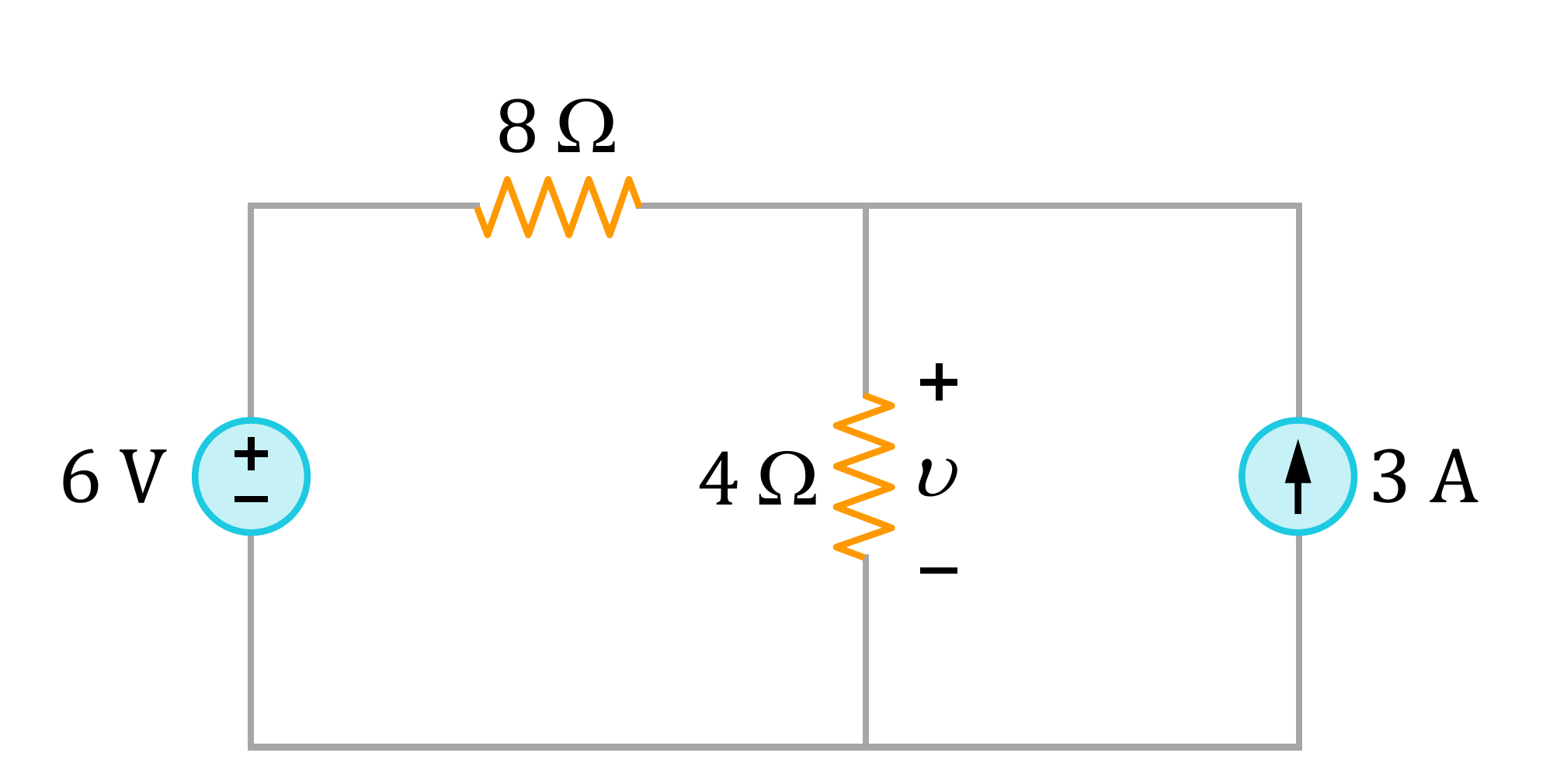
Let :
- 6 V source alone (3 A source open): voltage divider gives V
- 3 A source alone (6 V source shorted): current divider gives A through the 4 , so V
- total: V