Source
Adapted from my own handwritten and hand-typed notes from Year 1 to Year 3 of my EEE degree
A source transformation replaces a voltage source in series with a resistor by a current source in parallel with the same , or the other way round.
Source Transformation Circuits
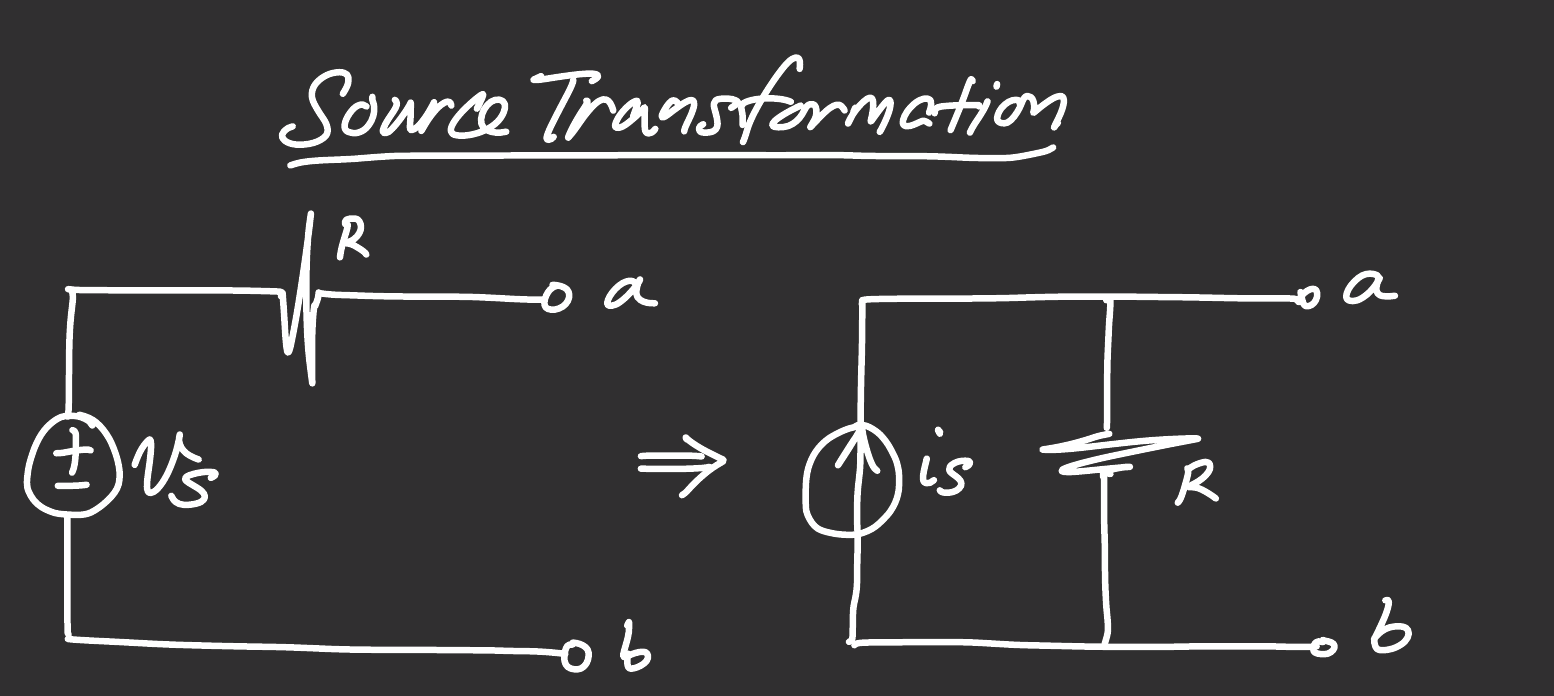
Equivalence Condition
The two circuits are equivalent at terminals a-b if they have the same - relationship. Both have resistance when the source is off, and the short-circuit current must match:
Rules:
- the current source arrow points toward the terminal of the voltage source
- it also works for dependent sources, as long as the controlling variable is kept track of
- a voltage source with no series resistor (or a current source with no parallel resistor) cannot be transformed
Repeated source transformation is also how the Thevenin and Norton forms are linked.
Worked Example
Find in a circuit with a 6 V source behind 2 , a dependent current source in parallel with 2 , a 4 resistor and an 18 V source with no series resistor.
Steps:
- transform the 6 V and 2 into a 3 A source with 2
- the two 2 resistors in parallel give 1 , then transform the 3 A source back into a 3 V source in series with 1
- the 18 V source is left alone because it has no series resistor
- KVL around the loop:
- KVL around the small loop: , so
Substituting gives A and V.