Source
Adapted from my own handwritten and hand-typed notes from Year 1 to Year 3 of my EEE degree
Mesh analysis applies KVL around each mesh and uses the mesh currents as the unknowns. It only works for planar circuits (circuits that can be drawn with no crossing branches). It suits circuits with mostly voltage sources, and it leads on to the circuit theorems such as superposition.
Steps (No Current Sources)
For a circuit with meshes:
- Assign mesh currents , normally clockwise
- Apply KVL around each mesh, writing each resistor voltage with Ohm's law
- Solve the simultaneous equations (for example by Cramer's rule)
A resistor shared by two meshes carries the difference of the two mesh currents, for example .
Matrix Form
For two meshes with in mesh 1, in mesh 2 and shared resistor :
The diagonal terms are the total resistance in each mesh, and the off-diagonal terms are minus the shared resistance.
Current Source in One Mesh
If a current source lies on the outer edge of only one mesh, that mesh current is known directly. For example, a 5 A source in mesh 2 pointing against the clockwise direction gives A, and only mesh 1 needs a KVL equation:
Supermesh
If a current source sits between two meshes, a supermesh is formed by removing the current source and any element in series with it.
Supermesh Construction
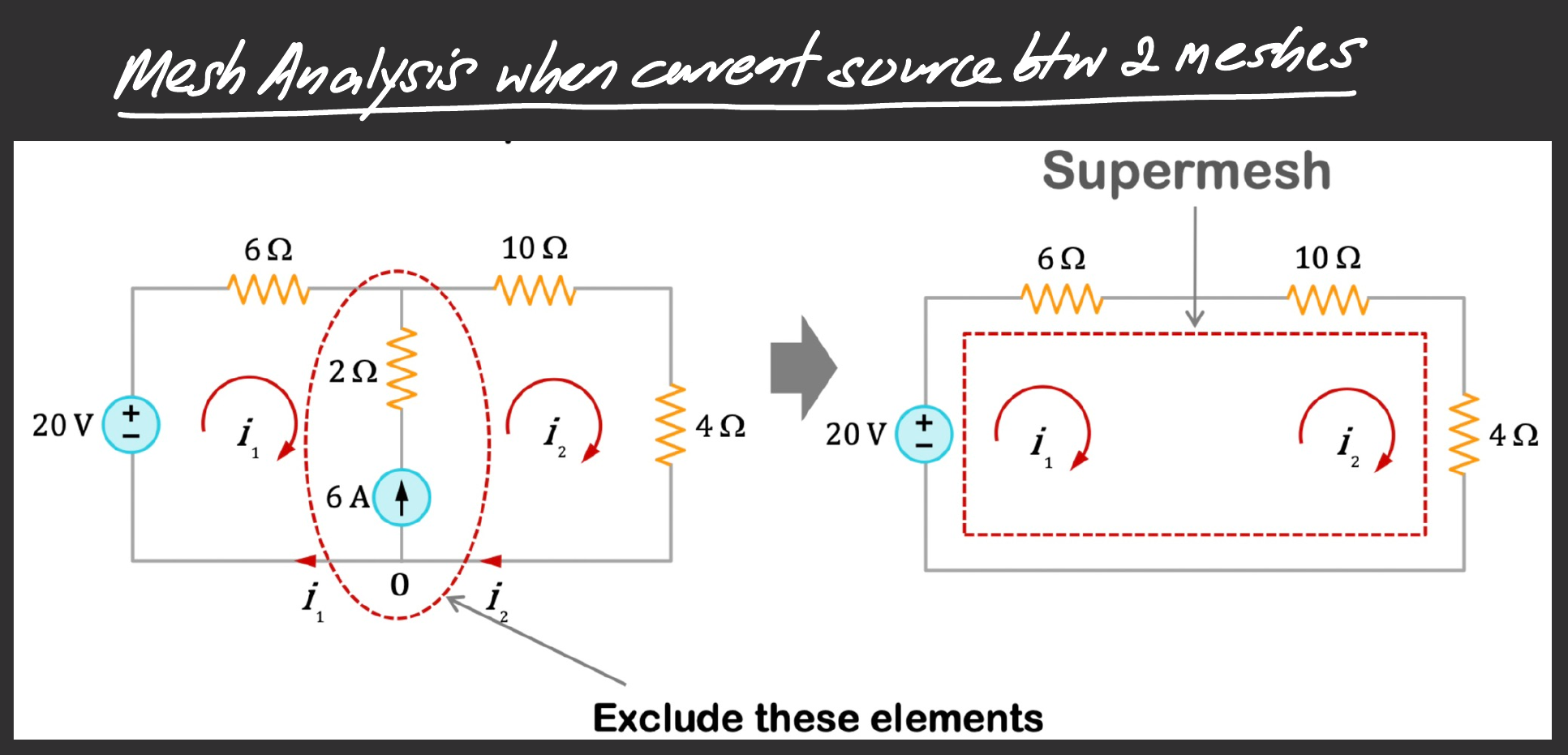
How to handle it:
- apply KVL around the supermesh path, still written using the original mesh currents
- add the constraint from the current source using KCL at a node on the shared branch
Supermesh Example
For the circuit above (20 V source, 6 , 10 , 4 , and a 6 A source shared by the meshes):
Solving gives A and A.