Source
Adapted from my own handwritten and hand-typed notes from Year 1 to Year 3 of my EEE degree
Nodal analysis applies KCL at each node and uses the node voltages as the unknowns. It is the natural choice when the circuit has mostly current sources. The dual method using KVL is Mesh Analysis.
Steps (No Voltage Sources)
For a circuit with nodes:
- Pick a reference node (ground, ), usually the bottom node or the marked ground
- Assign voltages to the other nodes
- Apply KCL at each non-reference node, writing each resistor current as
- Solve the simultaneous equations
Worked Example
A 5 A source pushes current from node 2 into node 1, and a 10 A source pushes current from ground into node 2. Node 1 has 2 to ground, node 2 has 6 to ground and 4 joins the two nodes. KCL gives:
Solving gives V and V.
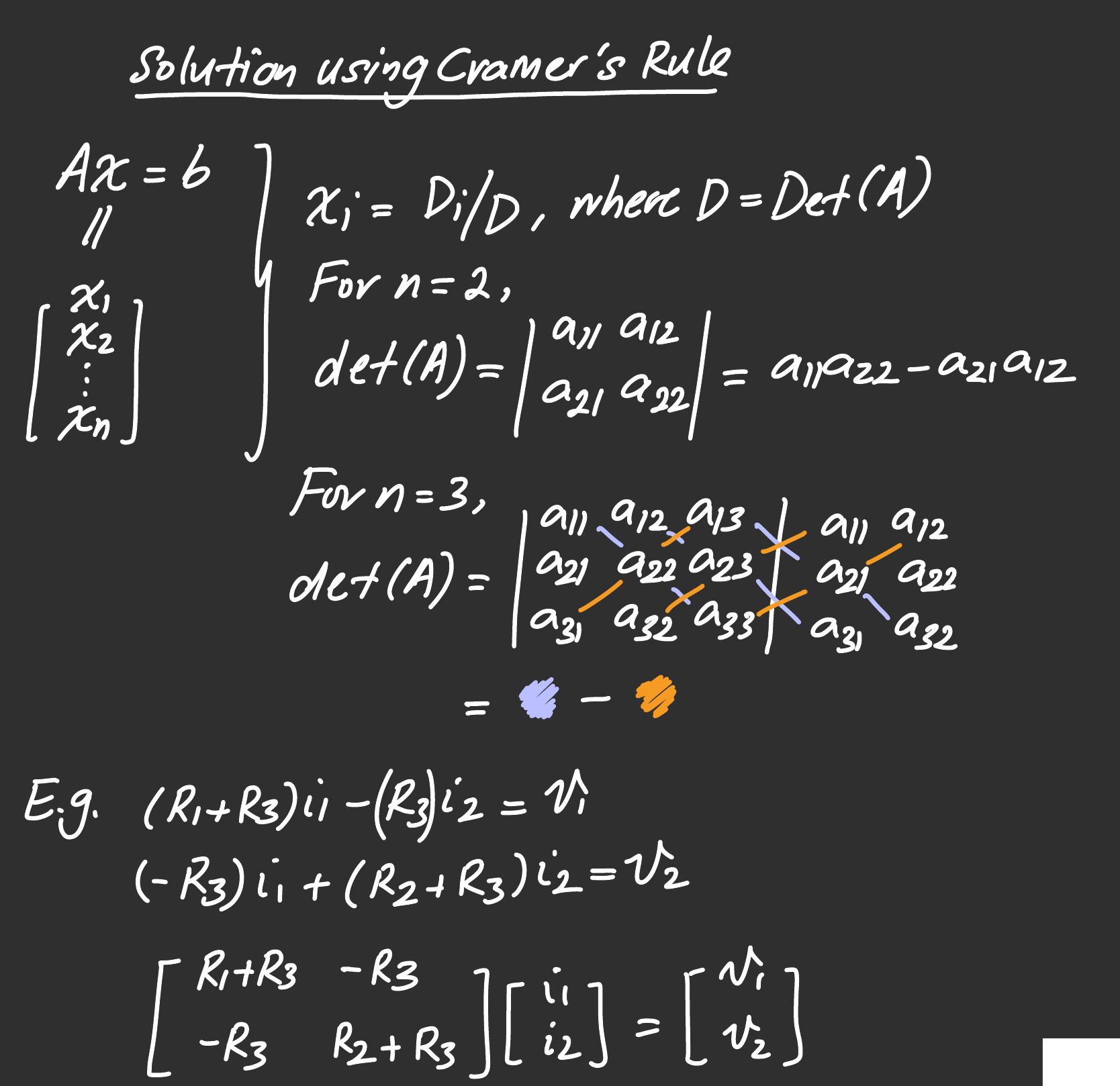
Solving with Cramer's Rule
The node equations form . If is square and non-singular, each unknown is , where and is the determinant with column replaced by .
Cramer's Rule
Supernode
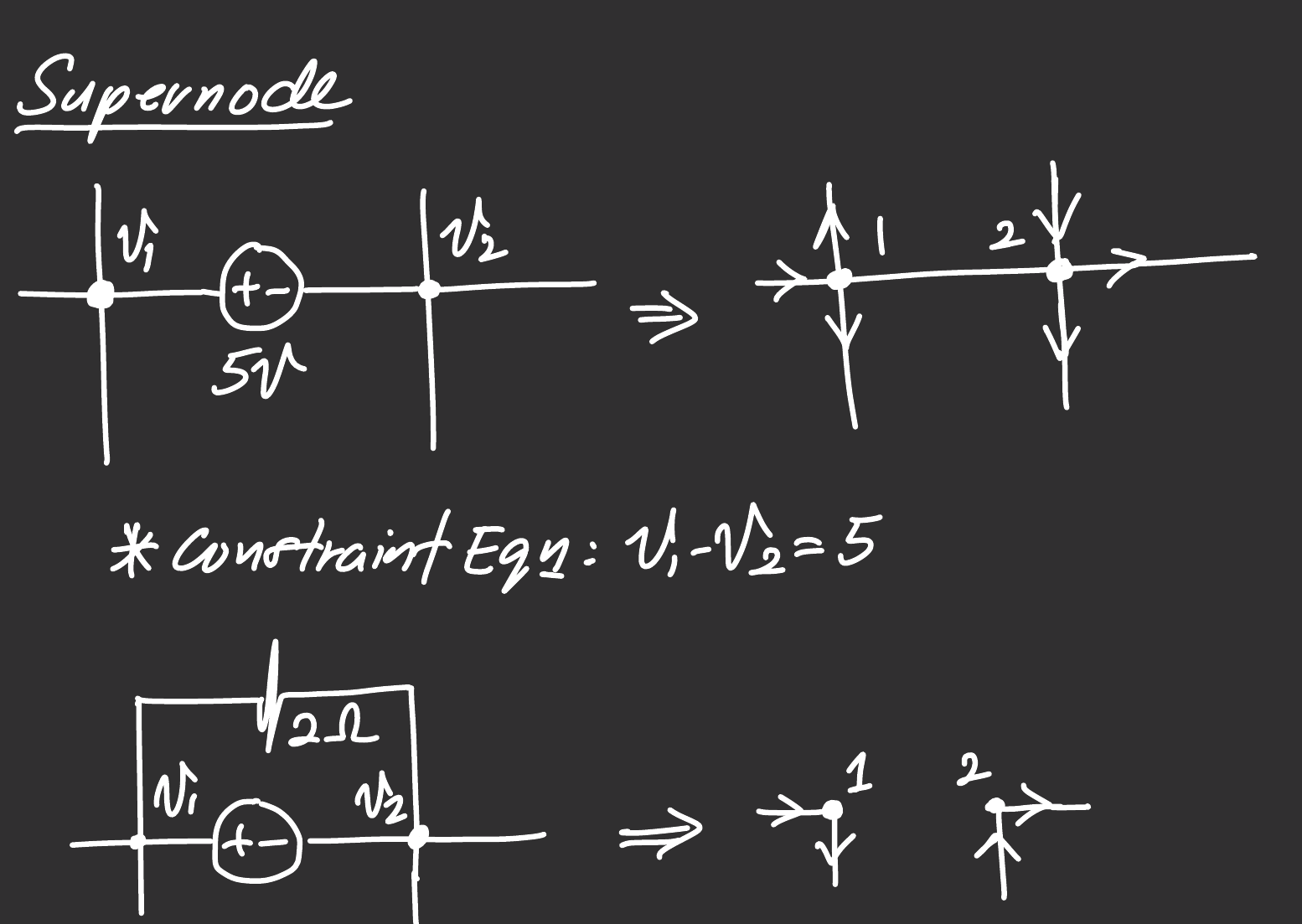
If a voltage source sits between the reference node and node , then simply equals the source voltage. If a voltage source (independent or dependent) sits between two non-reference nodes, the two nodes form a supernode.
Supernode Sketch
How to handle it:
- apply KCL to the whole supernode region: all currents leaving the region sum to zero
- add the constraint equation from the source, for example
- elements connected directly across the supernode (in parallel with the source) do not affect the node voltages
Supernode Example
A 2 A source enters node 1, a 7 A source leaves node 2, node 1 has 2 to ground, node 2 has 4 to ground and a 2 V source sets . KCL on the supernode:
With the constraint, , so V and V.