If a robotic work cell is to be used effectively, careful thought must go into the design and layout of its workspace fixtures.
Three forms of workspace fixture
- part feeders, used to present parts to the robot
- transport devices, used to move parts from one work cell to another
- part-holding devices, used in robotic assembly tasks
Part fixturing is a significant issue, since the cost of designing and developing custom part-fixturing devices can easily exceed the purchase price of the robot itself
Part feeders
A part must be presented to the robot in a way that is compatible with the tool configurations the manipulator can actually reach. When several types of part are needed for a subassembly, the feeders are often arranged concentrically around the robot base, near the outer boundary of the work envelope.
The assembly work is then done in the space closer to the robot, where precision with respect to the base axis is highest.
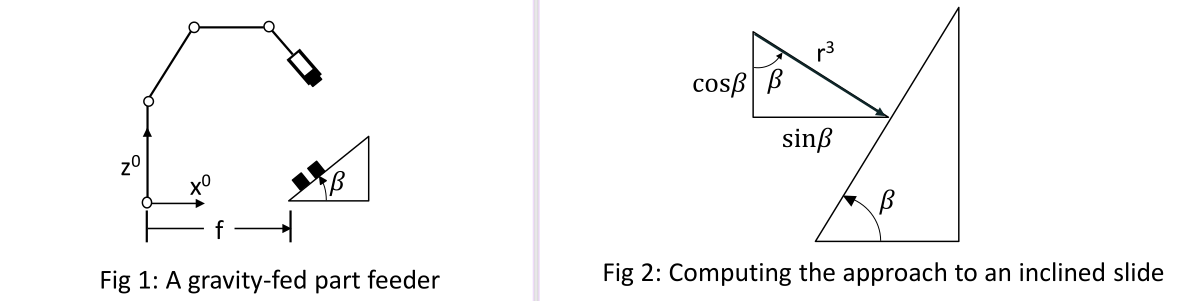
A common simple design is the gravity-fed feeder, an inclined tube or slide holding parts end to end in identical orientations. The incline angle must overcome friction with coefficient :
Conveyors and carousels
These count as part feeders too, but they do more than present parts. They also transport parts between robots and between work cells.
- a conveyor belt is a linear transport device
- a carousel is a rotary transport device
Fixed tools
Most robots are one-handed and hold only one tool at a time, so a separate work-holding fixture is needed to secure the subassembly at a workstation while the robot manipulates the new part being added. These fixtures are usually specialised jigs, built to hold one particular type of part or subassembly at the proper position and orientation.