Introduction
An optical encoder measures the angle of a joint. There are two classes: absolute and incremental.
A rotary absolute encoder gives the actual joint position as soon as power is applied. It gives a separate and unique coded word for each shaft position.
How it works
It has three major elements:
- A multiple track (multiple channel) light source
- A multiple channel light receiver
- A multiple track rotary disk
Light from a line of light sources (for example LEDs) goes through the disk at a right angle. A line of light sensors (for example phototransistors) receives the light.
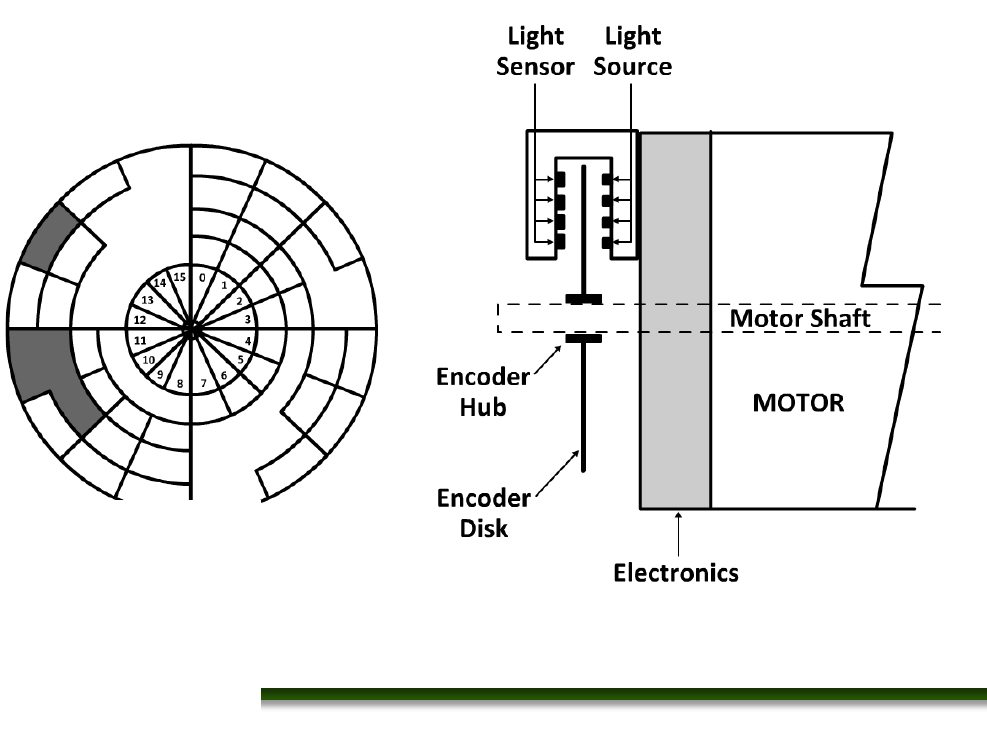
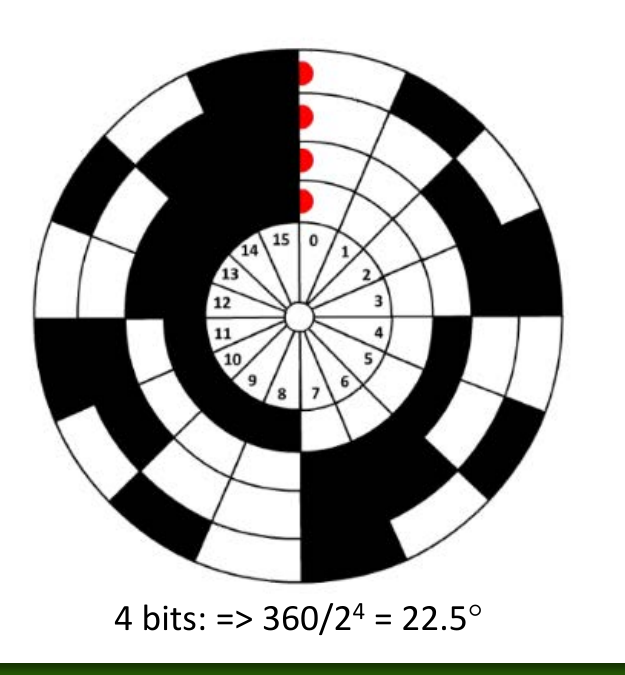
The disk is divided into circular tracks and radial sectors. Each track gives one bit. The pattern of light and dark on all the tracks gives the angle as a code, for example binary, binary coded decimal (BCD) or Gray code.
Resolution
With tracks (bits), the resolution is:
- 4 bits:
- 13 bits:
Advantage and limitation
- the major advantage is that the robot knows its joint positions at power up, so it does not need calibration
- absolute encoders are not common, because they cost too much