Clustering in an unsupurvised machine learning technique that aims to group data into clusters within the input space.
Clustering is to discover hidden structures in the data without any prior knowledge of the groupings. Clustering algorithms typically rely on a distance or similaity metric to measure how close or similar data points are in the feature space.
K-means assumes there are clusters among input samples and each data point is close to its cluster center (the mean point of the cluster).
Process
- First step is initialization where the centroids are randomly initialized within the Euclidean space
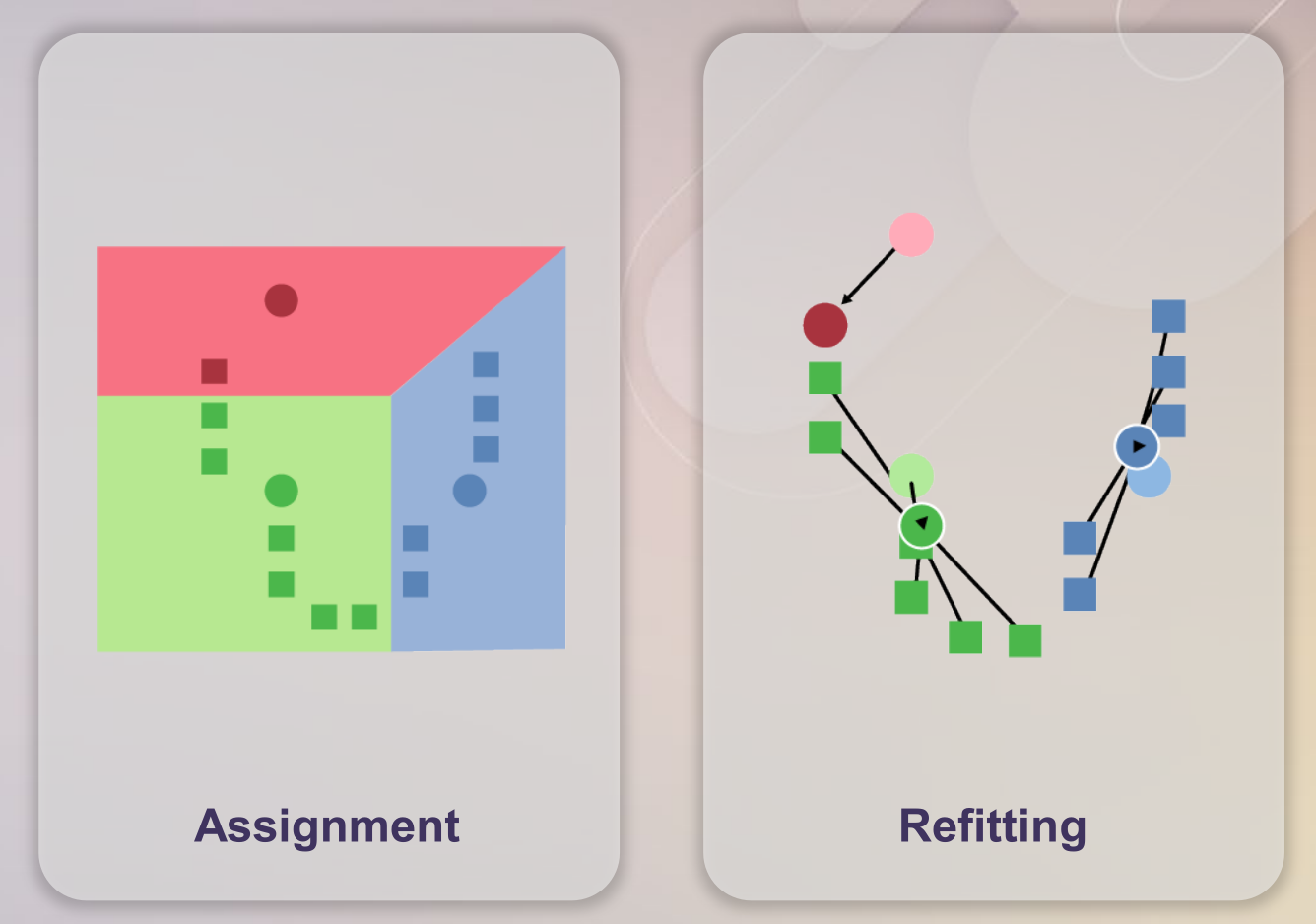
- next we iteratively alternate between assignment and refitting
assignment: assign each data point to its closest cluster
refitting: move the centroid to the center of the new cluster
Code
We can run K-Means directly on the TF-IDF matrix, with 5 different random seeds:
from sklearn.cluster import KMeans

for seed in range(5):
    kmeans = KMeans(
        n_clusters=2,
        max_iter=100,
        n_init=1,
        random_state=seed,
    ).fit(train_review_tfidf)
    cluster_ids, cluster_sizes = np.unique(kmeans.labels_, return_counts=True)
    print(f"Number of elements assigned to each cluster: {cluster_sizes}")
print()
Output:
Number of elements assigned to each cluster: [5542 1958]
Number of elements assigned to each cluster: [2079 5421]
Number of elements assigned to each cluster: [2081 5419]
Number of elements assigned to each cluster: [5433 2067]
Number of elements assigned to each cluster: [2069 5431]
| Argument | Meaning |
|---|---|
n_clusters | the value of , so the number of clusters to find |
max_iter | the cap on assignment and refitting rounds for a single run |
n_init | how many times the whole algorithm restarts from new random centroids, keeping the best result |
random_state | fixes the random initialisation so a run is reproducible |
.fit()performs the clustering, andkmeans.labels_then holds the cluster number of every documentnp.unique(..., return_counts=True)returns the distinct labels and how many documents carry each onekmeans.cluster_centers_holds the centroid coordinates
Cluster numbers carry no meaning
cluster 0 in one run is cluster 1 in the next, because the labels are assigned by whichever centroid was initialised first. Never treat cluster 0 as a fixed category.
We can also reduces the dimensions before clustering, using LSA:
from sklearn.decomposition import TruncatedSVD
from sklearn.pipeline import make_pipeline
from sklearn.preprocessing import Normalizer

lsa = make_pipeline(TruncatedSVD(n_components=100), Normalizer(copy=False))
train_review_lsa = lsa.fit_transform(train_review_tfidf)
explained_variance = lsa[0].explained_variance_ratio_.sum()
print(f"Explained variance of the SVD step: {explained_variance * 100:.1f}%")
Explained variance of the SVD step: 11.4%
TruncatedSVDis used rather thanPCA, because the TF-IDF matrix is sparse andPCAcentres the dataNormalizerrescales each row to unit length, which suits the distance measure K-Means useslsa[0]reaches the first step of the pipeline, which is theTruncatedSVDobject- 100 components keep only 11.4 percent of the variance, so most of the information is dropped and the clustering still works
We can clusters the reduced data and then reads the top words per cluster:
kmeans = KMeans(
    n_clusters=2,
    max_iter=100,
    n_init=5,
    random_state=seed,
).fit(train_review_lsa)

original_space_centroids = lsa[0].inverse_transform(kmeans.cluster_centers_)
order_centroids = original_space_centroids.argsort()[:, ::-1]
terms = tv.get_feature_names_out()

for i in range(2):
    print(f"Cluster {i}: ", end="")
    for ind in order_centroids[i, :10]:
        print(f"{terms[ind]} ", end="")
    print()
Cluster 0: movie bad good like watch make think time really film
Cluster 1: film make like good time story character movie great watch
- the model is now fitted on
train_review_lsarather than the raw TF-IDF matrix, andn_initrises to 5 inverse_transformmaps the 100 dimensional centroids back into the original word space, so each centroid can be read as word weightsargsort()sorts ascending, so[:, ::-1]reverses each row to put the strongest word firstterms[ind]converts a column index back into the word it stands for
Reading the result
Both clusters share most of their top words, so this split does not separate positive from negative reviews. Clustering finds whatever structure the distances expose, and it has no access to the sentiment labels.
K-Means forces each point into 1 cluster, and the version that lets a point belong to several is Fuzzy Clustering.