This is the special case where the degredation function is an impulse, so no blurring happens and the only corruption is the additive noise. The model collapses from:
to
In frequency domain:
- the problem changes from deblurring to noise suppression
- spatial filtering (smoothing) is sufficient
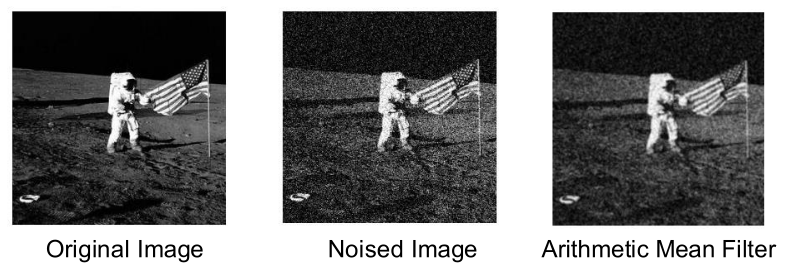
Arithmetic Mean Filter
This works by replacing the center pixel by the average of its neighbourhood:
where represents the set of coordinates in a rectangular sub-image.
Geometric Mean Filter
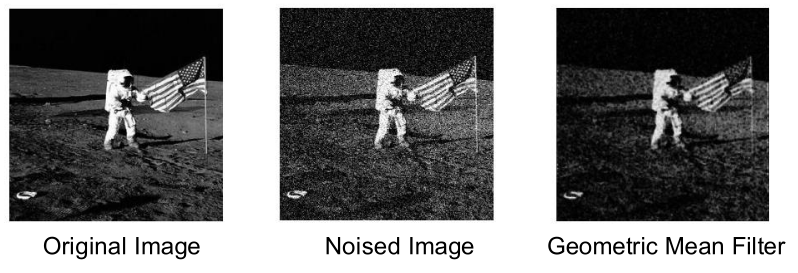
Replace the center pixel by the geometric mean of the positive samples:
- It smooths random noise while usually retaining more detail than the arithmetic mean
- The geometric mean filter does not blur the image as much as the arithmetic mean filter
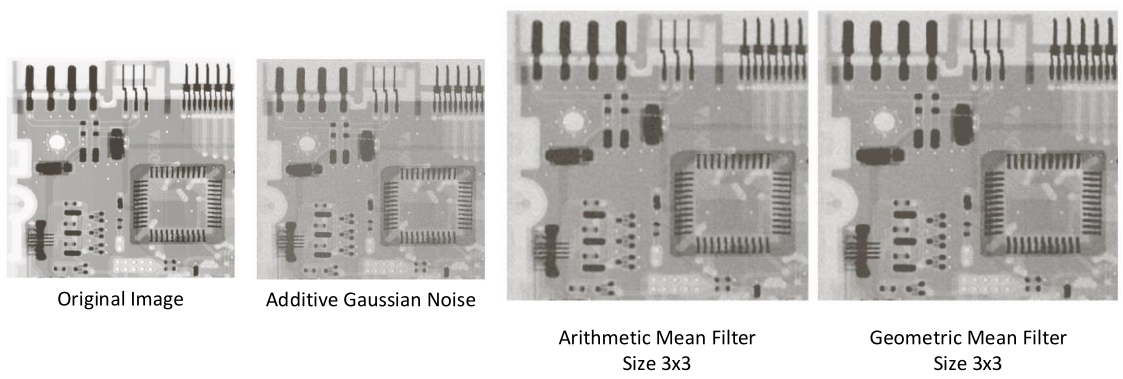
Arithmetic vs Geometric Mean Filters
This shows the difference between Arithmetic and Geometric Mean Filters. Geometric Mean Filters does not blur the image as much as Arithmetic mean filters.
Median Filter
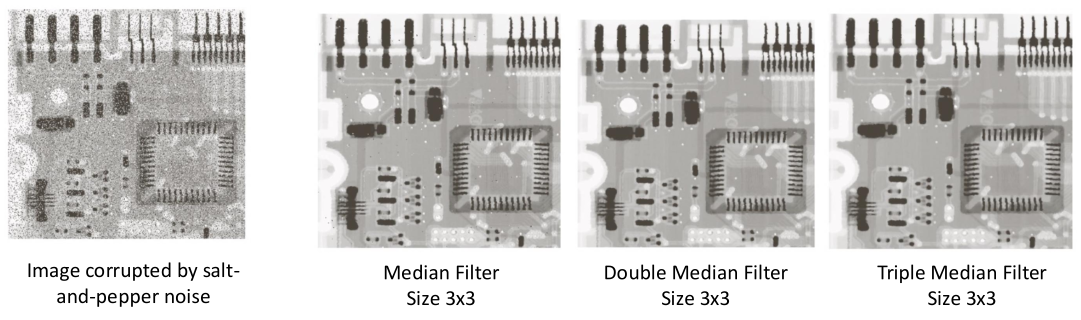
- Effective against salt-and-pepper noise
- Repeated application (double, triple median) removes more impulses at the cost of detail
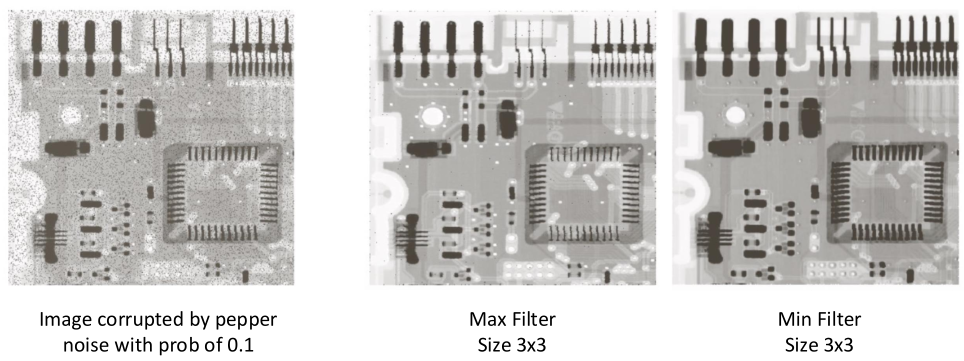
Max and Min Filters
- Max filter is used for pepper noise
- Min filter is used for salt noise
Midpoint Filter
Alpha-Trimmed Mean Filter
where denotes the remaining pixel values after removing the highest and lowest gray-level values in .