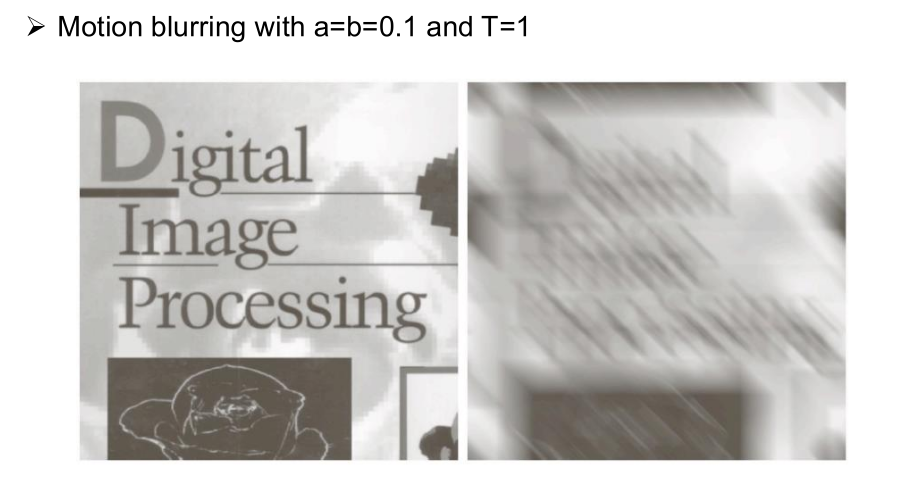
The degradation function for image restoration is usually estimated using 3 ways:
- Observation
- infer blur from a strong, interpretable image region
- Experimentation
- create an image of a known impulse under the same settings
- Modelling
- derive from optics, motion, or atmospheric physics
I. Observation
- is a sub image where the signal content is strong (we need to find this)
- is what you construct that subimage to look like when undegraded (basically our assumption of what that subsample is supposed to look like)
- The subscript s marks that both come from the subimage, not the whole image
My understanding
Ignoring noise, . Meaning that we have 2 unknowns and ... so this method is basically estimating so that we can find
II. Experimentation
- is the Fourier transform of the observed image of a small dot of light
- is a constant denoting the strength of the impulse
III. Mathematical Modelling
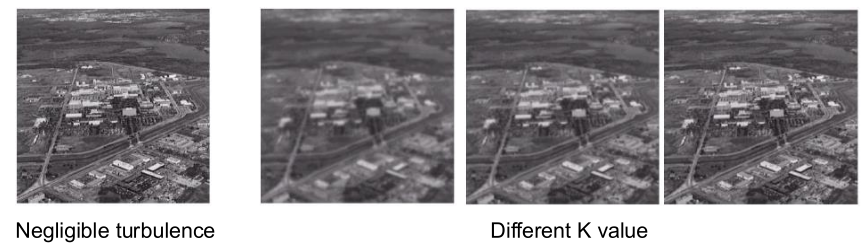
depends on the nature of the turbulence, and a larger gives more blur.
Motion Blur
Motion blur can by caused by relative motion between the scene and the sensor during image acquisition. Suppose the motion can be described by and in the and directions respectively. The blurred image can be modelled as:
where is the duration of the exposure.
Assume and . Then the degradation function is: