The quadratic classifier is the Bayes classifier for Gaussian classes in the general case, where each class has its own covariance matrix . Its Discriminant Functions are quadratic in , so its decision boundaries are curved.
Main idea
With different $\boldsymbol{\Sigma}_i$, only the $\frac{d}{2}\ln 2\pi$ term can be dropped. $g_i(\mathbf{x})$ stays quadratic and the decision surfaces are hyperquadrics.
Discriminant Function
For :
Expand the quadratic term:
where:
Slide notation
The textbook inset on slide 21 writes the bias as and uses and . These notes use the lecturer's notation , and . The in the inset is a weight, not a class.
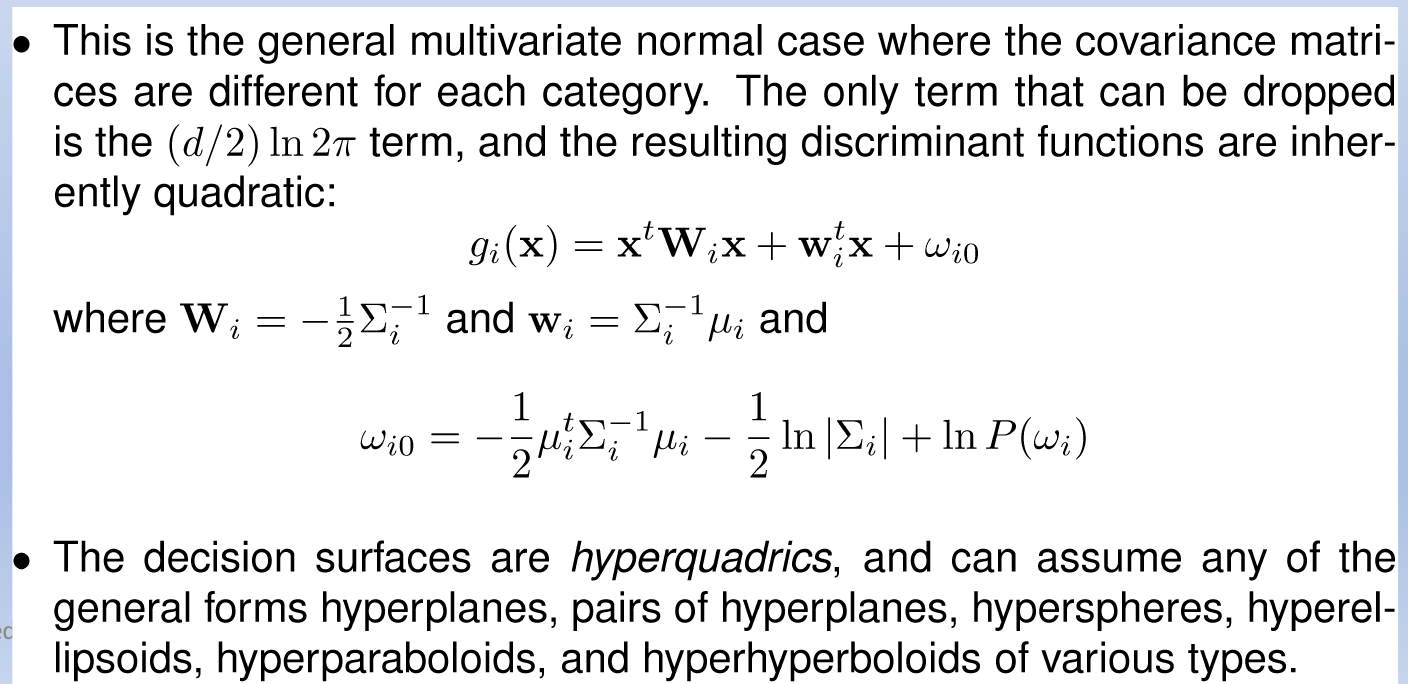
Why the quadratic term stays:
- the term depends on , so it is different for each class
- it does not cancel in
Decision Boundaries
The boundary between class and class is:
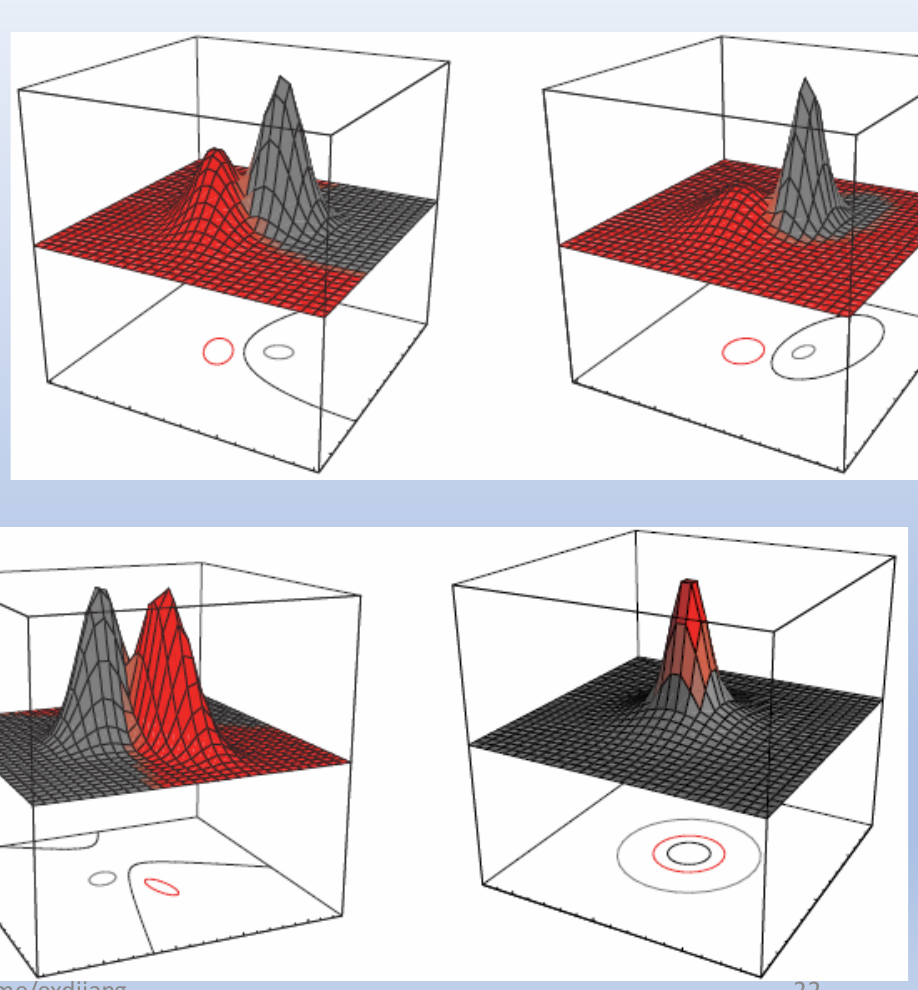
The decision surfaces are hyperquadrics. They can be:
- hyperplanes or pairs of hyperplanes
- hyperspheres or hyperellipsoids
- hyperparaboloids
- hyperhyperboloids of various types
Examples in 2 dimensions with 2 classes:
Complex boundaries for a 3-dimensional, 2-class case and a 2-dimensional, multiclass case:
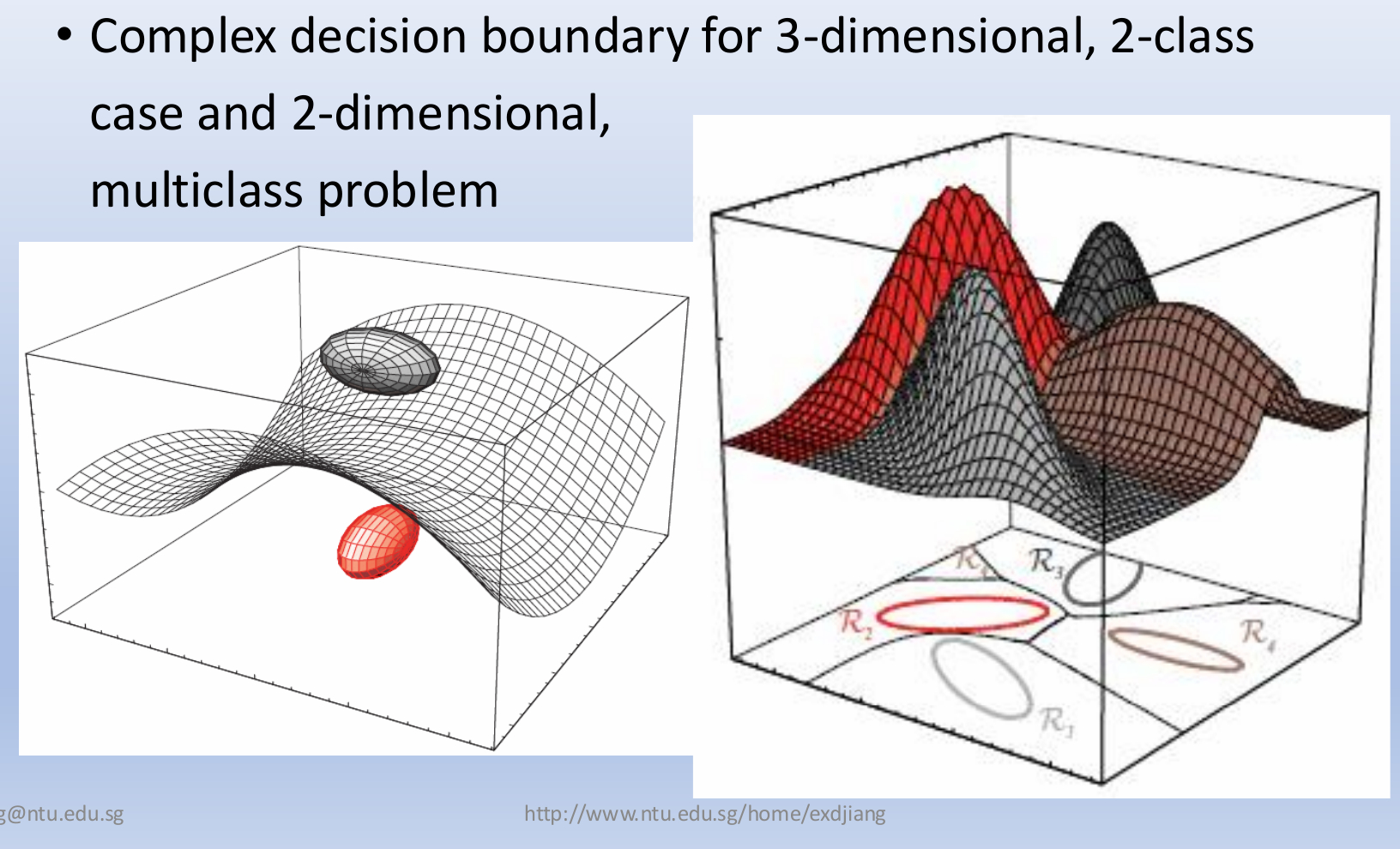
In the multiclass figure, each decision region is where is the largest. A region does not need to be connected, and one class can have a region inside the region of another class.