Source
Adapted from my own handwritten and hand-typed notes from Year 1 to Year 3 of my EEE degree
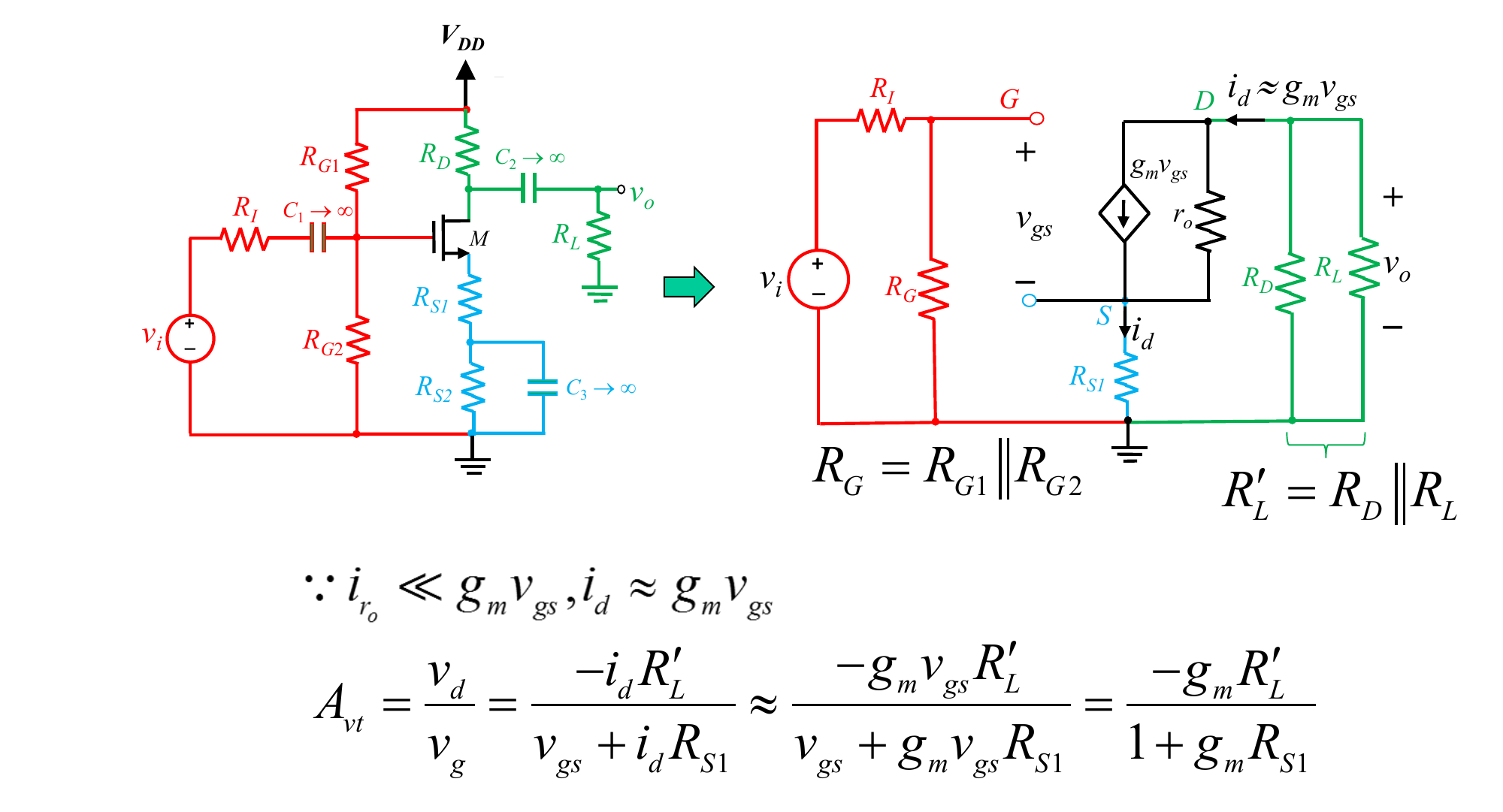
The common-source (C-S) amplifier takes the input at the gate and the output at the drain. It is the MOSFET version of the common-emitter amplifier, with an inverting gain but an input resistance set only by the bias resistors.
Fully Bypassed Source
With and :
Since no gate current flows, the MOSFET itself adds no loading at the input.
Unbypassed Source Resistor
With left in the AC path and :
Unlike the BJT case, does not change the input resistance, because the gate draws no current anyway.
Worked Example
µA/V², V, V, kΩ, kΩ, kΩ, gate biased from the drain by a chain of 1 MΩ, 2 MΩ and 2 MΩ to ground, with the gate at the lower junction and the upper junction bypassed to ground by a capacitor. The Q-point is µA, V, V.
AC:
- mS
- kΩ
- MΩ
- kΩ
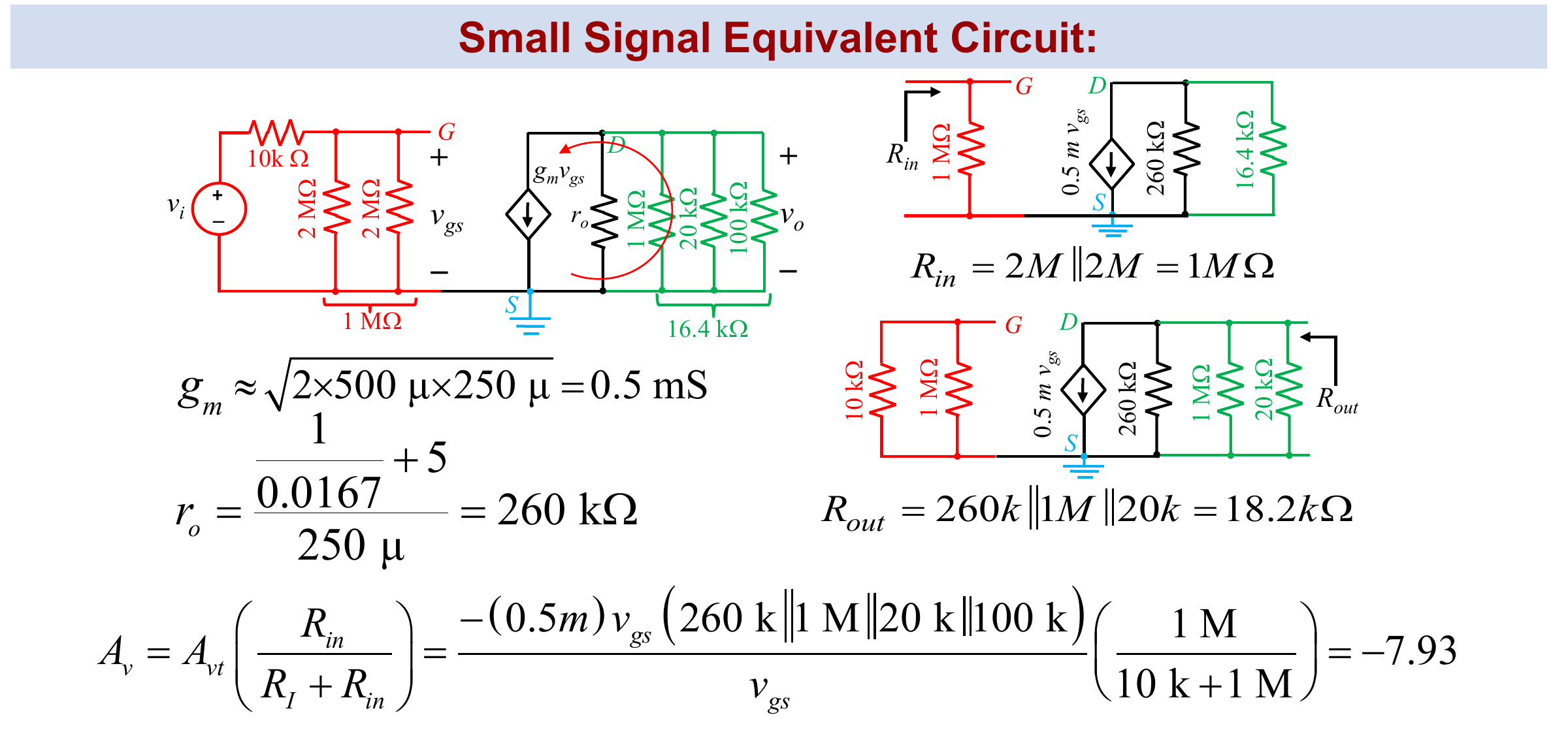
Compared with the C-E example (), the gain is much lower because is about 20 times smaller. At high frequency this stage is limited by its internal capacitances, see Common-Source Amplifier Frequency Response.