Source
Adapted from my own handwritten and hand-typed notes from Year 1 to Year 3 of my EEE degree
A bipolar junction transistor is a sandwich of three doped regions: npn or pnp. It has two junctions, base-emitter (BEJ) and base-collector (BCJ), and the bias on each junction sets the region of operation.
Bias Conditions
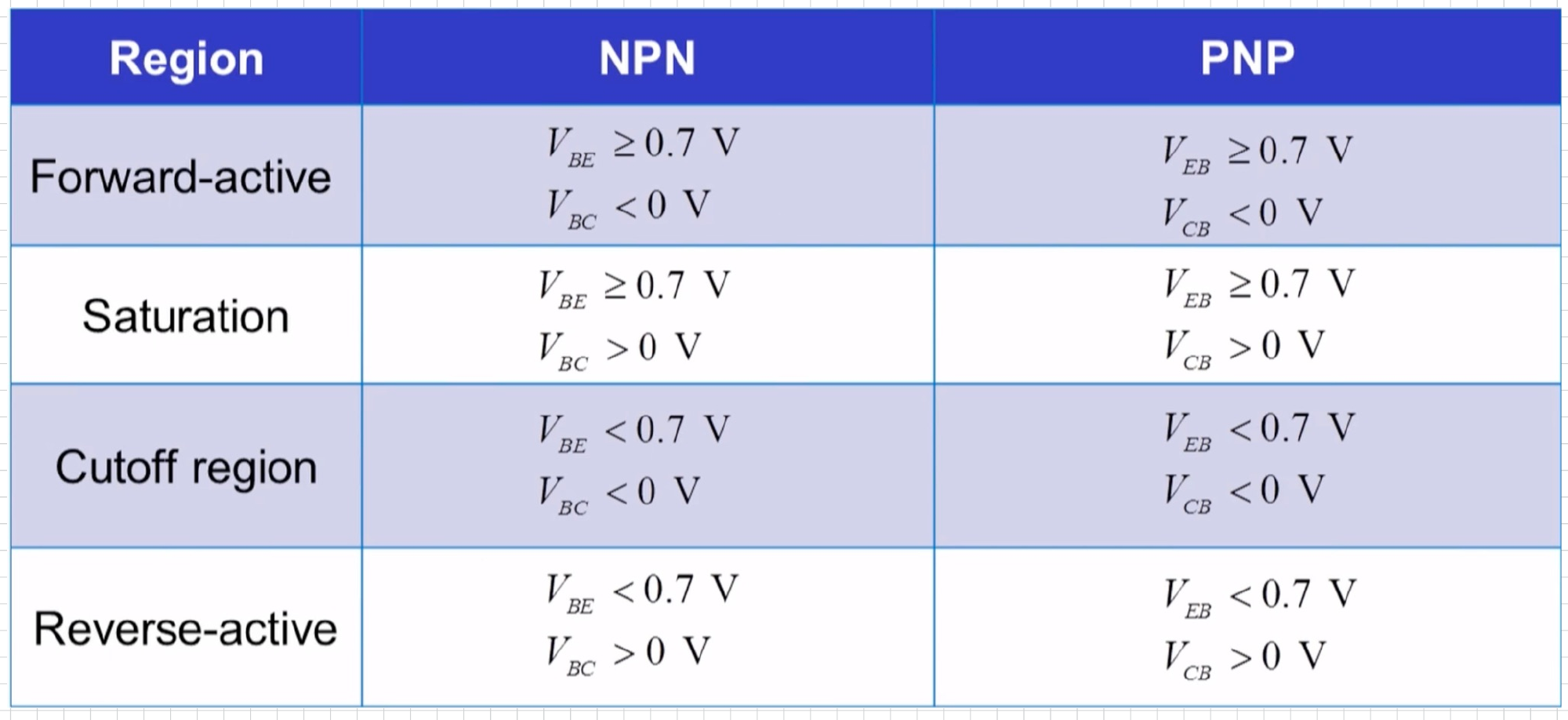
| Region | BEJ | BCJ | Use |
|---|---|---|---|
| Forward-active | forward | reverse | good amplifier, |
| Saturation | forward | forward | closed switch, to V |
| Cutoff | reverse | reverse | open switch, |
| Reverse-active | reverse | forward | weak amplifier, normally not used |
For a pnp transistor the same table holds with , in place of , .
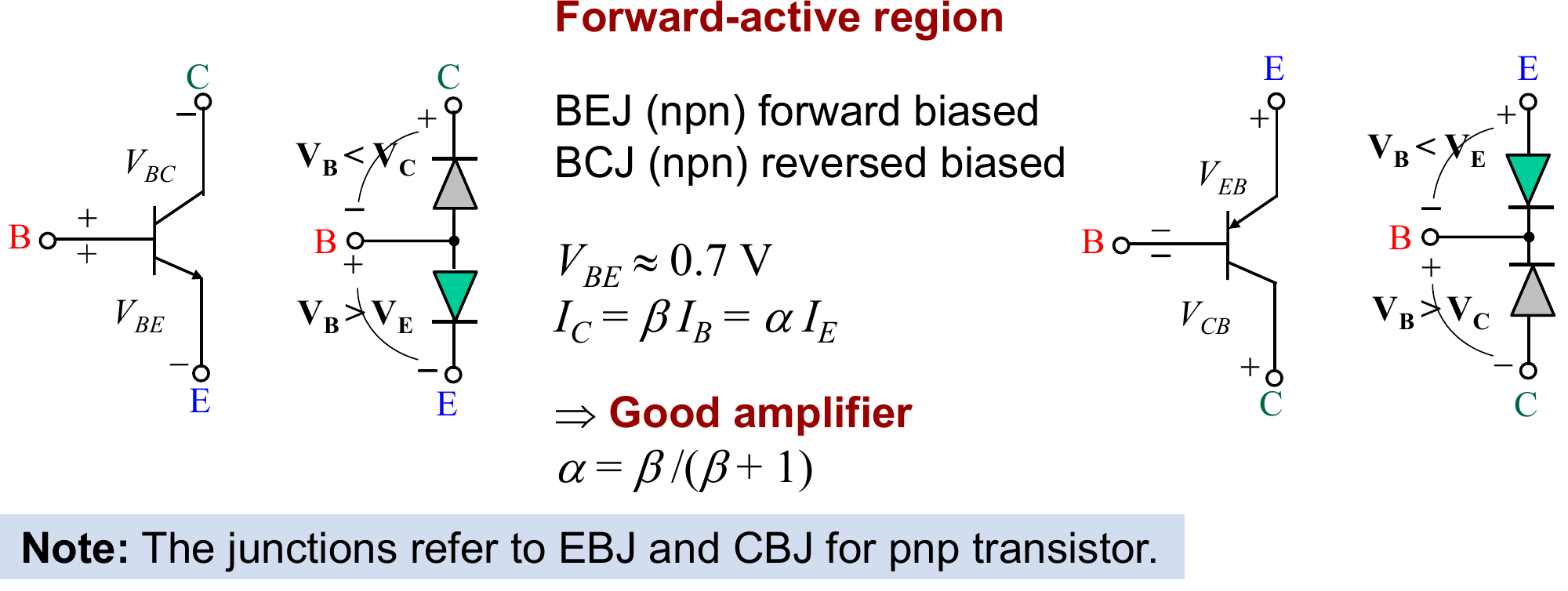
Forward-Active Region
Large-signal model with the Early effect:
Checking the Region From Node Voltages
Compute and (npn):
- , , : , , so forward-active
- , , : is too small to turn on, so cutoff
- , , : , both forward, so saturation with V
Worked Example: Wrong Assumption
V, kΩ, kΩ, V, .
Assume forward-active:
- V, mA,
- V
- V , so the BCJ is forward biased and the assumption fails
Redo in saturation with V:
- V, mA
- mA
- , far below , which is typical of saturation ()
The forward-active region is the one used in the amplifier.