Source
Adapted from my own handwritten and hand-typed notes from Year 1 to Year 3 of my EEE degree
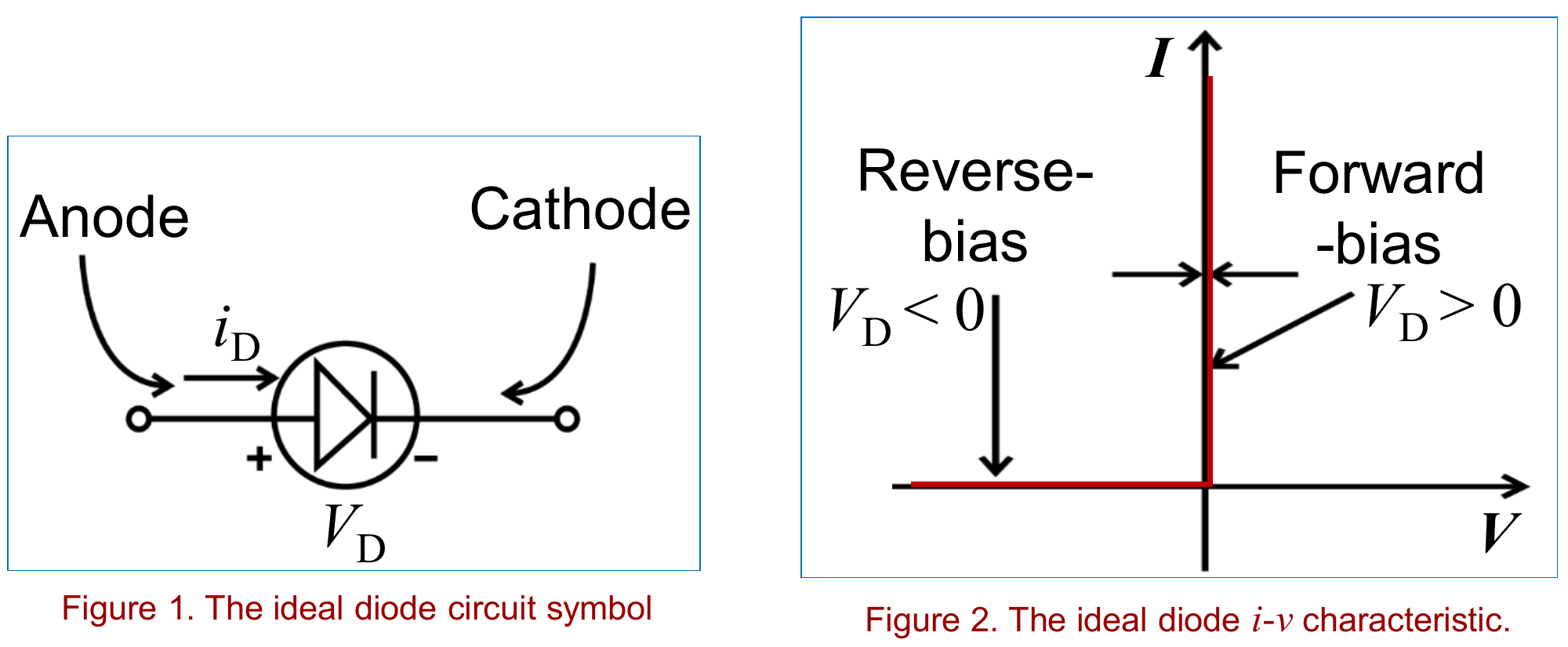
The ideal diode is a two-terminal switch that conducts in one direction only (anode to cathode).
Behaviour:
- forward bias: for any positive current, so it acts as a short circuit
- reverse bias: for any negative voltage, so it acts as an open circuit
- the external circuit must limit the forward current and the reverse voltage
Analysis Method
Steps:
- assume a state (on or off) for each diode
- replace on diodes by shorts and off diodes by opens, then solve
- check: an on diode must carry positive current, an off diode must have
- if a check fails, change the assumption and solve again
Worked Example
Find and for both circuits, with ideal diodes.
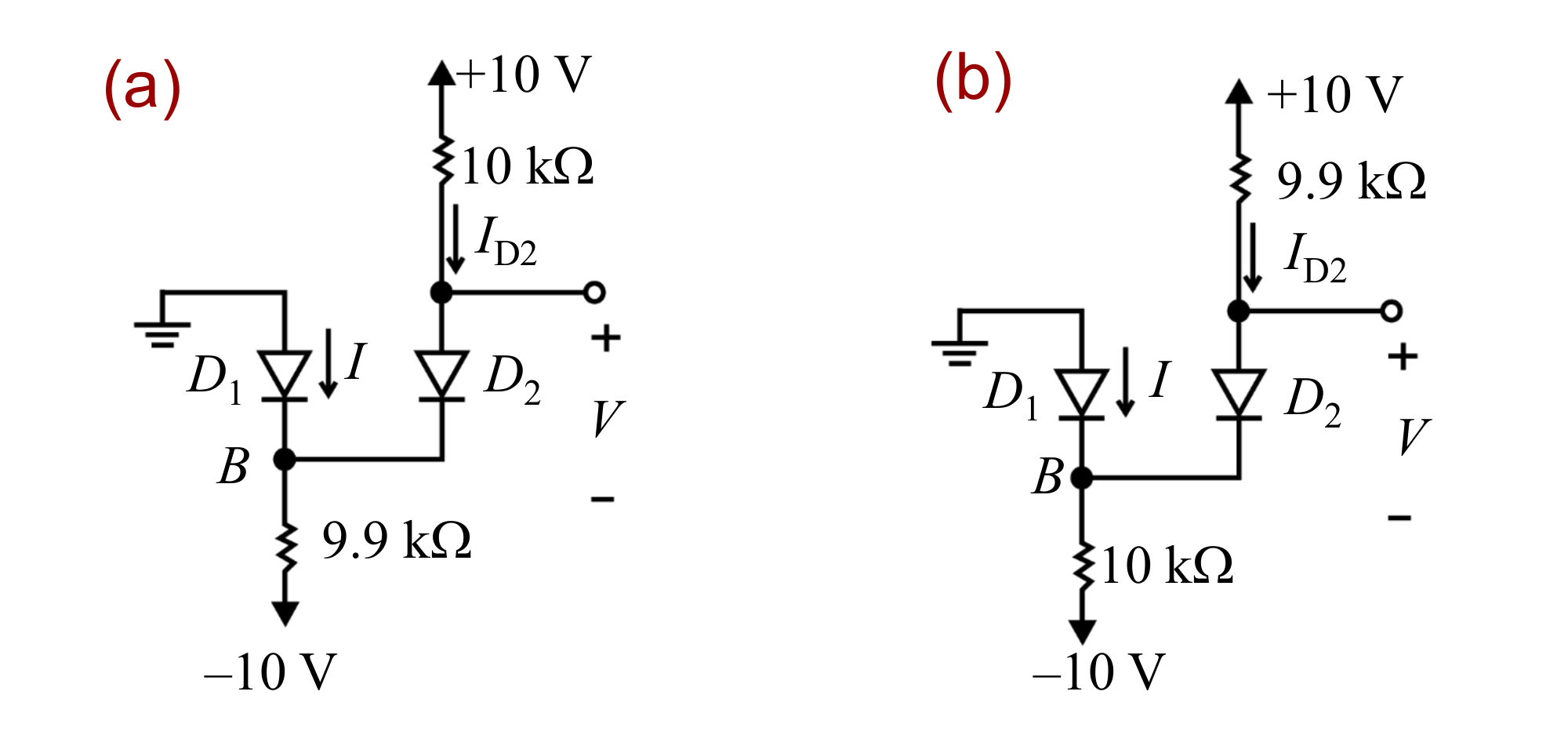
Circuit (a), assume both on. Then and .
- mA
- current down the 9.9 kΩ resistor mA
- KCL at B: mA, positive, so the assumption holds
Circuit (b), assume both on again:
- mA, bottom resistor current mA
- KCL gives mA, which is impossible for a diode
So take off and on:
- mA
- V, and V
- has its cathode at V above its grounded anode, so it is indeed reverse biased and
A real diode adds a forward drop and an exponential curve, see Diode I-V Characteristic.